
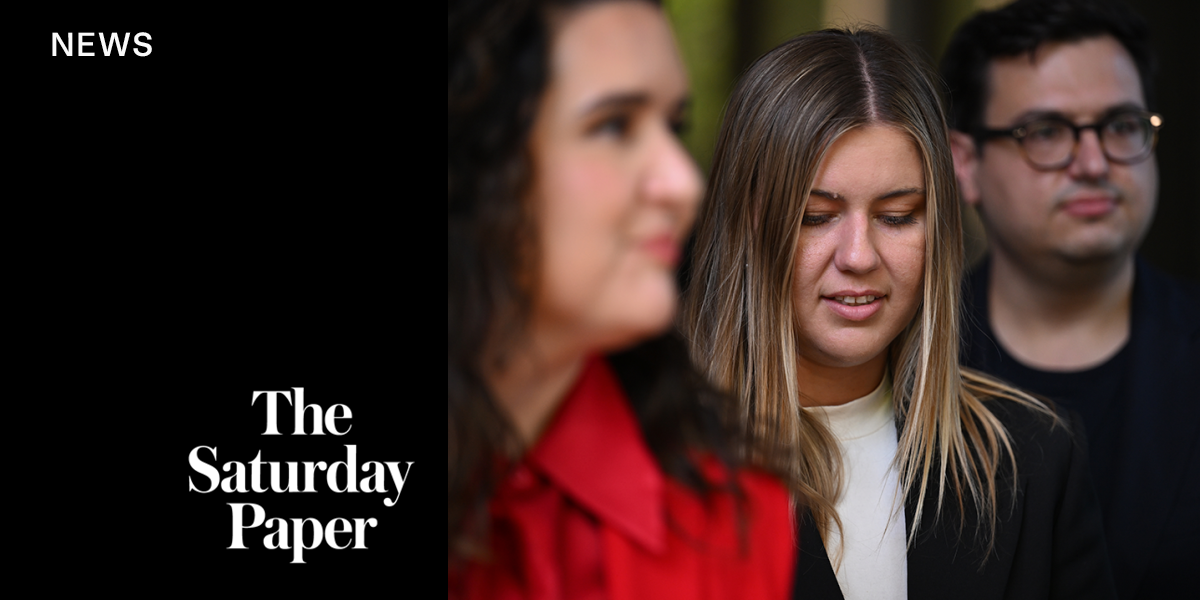
Brittany Higgins chose not to watch the full bench of the Federal Court hand down its ruling on Bruce Lehrmann’s defamation appeal on the morning of December 3.
She’d had enough of listening, yet again, to someone else recounting the grim details of her sexual assault at the hands of Lehrmann nearly seven years ago, in the office of her then boss, former defence industry minister Linda Reynolds.
So that morning, friends say, she distracted herself by playing with her nine-month-old baby, Freddie, at her home in Melbourne, while husband David Sharaz anxiously monitored the court’s YouTube channel to hear the result.
The findings, when they landed, were a resounding vindication for Higgins, and a harsh new blow for Lehrmann.
Not only had the three appeal judges unanimously agreed with the original judge, Michael Lee, that Lehrmann did indeed rape Higgins in Reynolds’ office in March 2019 but, in a twist few in the legal world saw coming, the full court judges were even more damning of Lehrmann’s conduct than the primary judge had been.
Members of Higgins’s circle point out that her powerful and emotionally raw description of what happened to her in Reynolds’ cabinet office on the night of the assault lies at the heart of this second victory.
Anyone who watched the sobbing young woman testify, live, before Lee, could not fail to have been moved by her account.
Higgins’s friends have a theory that Lehrmann gambled she would not want to give evidence in the defamation case, after the ordeal of the failed criminal trial against him, which collapsed because of juror misconduct. A retrial never went ahead out of concern for Higgins’s mental health.
This is why, they believe, Lehrmann took the substantial risk of suing for defamation over a story that, according to the court’s findings, he knew was true. Without her evidence, he might have won. With her evidence, he was thoroughly repudiated. He lost and lost again.
Many have since quoted Lee’s striking dictum that “having escaped the lion’s den, Mr Lehrmann made the mistake of going back for his hat”.
Yet as one of Higgins’s inner circle told me: “For too long we’ve been talking about Lehrmann’s ridiculous hat. The truth is, had it not been for Brittany’s bravery in testifying against her rapist, again, the world wouldn’t know what he is.”
In his original ruling, Lee appeared reluctant to find that Lehrmann actively knew Higgins was not consenting to sex despite her extreme inebriation. He did not accept, for instance, that Higgins had told Lehrmann “no on a loop”. Lee concluded Lehrmann lacked a “state of mind of actual cognitive awareness that Ms Higgins did not consent to having sex”.
However, he reasoned that the threshold for a rape had been reached on the balance of probability because of Lehrmann’s utter indifference as to whether his junior colleague was consenting or not.
By contrast, the three judges of the appeal court, led by presiding judge Michael Wigney, concluded that Lehrmann knew exactly what he was doing that Canberra night.
Brushing aside the range of implausible reasons Lehrmann offered as to why he needed to go back to Parliament House at 1.45 in the morning – to work on Question Time folders, pick up his keys, pick up documents for the minister, or drink whisky – the three justices found the “one dominant thought” in Lehrmann’s mind was to have sex with Higgins.
Nor were his faculties diminished at the time of the assault, they decided.
“On the contrary,” the three appeal judges said, “the circumstances then presented to Mr Lehrmann, as found by the primary judge, screamed loudly to anyone with normal faculties that the very drunk, passive and silent woman, prone to drowsiness and with significant impact on her cognitive abilities … had not consented to sexual intercourse.”
They concluded: “His Honour should have found actual knowledge on the part of Mr Lehrmann that Ms Higgins did not consent.”
This significantly ratcheted up the findings against Lehrmann, in line with the arguments mounted by Network Ten and their former presenter Lisa Wilkinson.
Yet the moral victory lay mostly with Higgins, who, referring to the roller-coaster of the past five years, since she first went public about her assault in an interview with Ten’s The Project, posted on Instagram: “Finally, it feels like I can breathe again.”
“I cannot begin to tell you how retraumatising it is to have your rapist weaponise the legal system against you for daring to speak out,” she wrote. “Sadly, this isn’t uncommon, it’s a legal tactic increasingly used around the world by perpetrators in a bid to sue victim-survivors into silence.”
Despite the emphatic vindication of the appeal court’s decision, there was no elation in the Higgins–Sharaz household. Another cloud was already looming on the young couple’s horizon.
… the three judges of the appeal court, led by presiding judge Michael Wigney, concluded that Lehrmann knew exactly what he was doing that Canberra night.
For several months, Linda Reynolds had been pursuing Higgins and Sharaz for damages and costs after recently winning a defamation battle against them in Western Australia.
Thus, barely a week after the appeal court ruling on Lehrmann, Reynolds succeeded in having Higgins declared bankrupt for non-payment of those damages. She pursued the same outcome against Sharaz, who was declared bankrupt this week.
Higgins told friends she was left pondering the irony that two different court rulings, on opposite sides of the country, could likely have the effect of sending both her and her rapist bankrupt, assuming Ten now resumes its pursuit of Lehrmann for a multimillion-dollar costs claim.
If so, Lehrmann would pay this price for a sexual assault. Higgins is paying it for a handful of social media posts.
There are questions now about to what degree Reynolds and her team might be able to recover monies from the trust fund that was set up for Higgins after she reached a $2.4 million settlement with the Commonwealth following Labor’s election in 2022.
Reynolds is suing the Commonwealth over the settlement, on the basis that senior Albanese ministers should not have taken as gospel Higgins’s allegations of callous treatment at the hands of Reynolds nor of a politically motivated cover-up of the rape within the Morrison government.
Reynolds maintains she was unfairly shut out of the settlement negotiations and wants the federal anti-corruption body to reopen its investigation into the matter.
It is an issue on which the Murdoch media – particularly The Australian – is campaigning relentlessly, to the concern of Higgins’s family and friends.
The Higgins camp believes the funds left in the trust account – already substantially diminished by legal fees – are most likely safe. However, the bankruptcy rulings will make it harder for Higgins and Sharaz to put their life as young parents on a firmer footing. It will stop them, for the next three years at least, obtaining a mortgage or a loan for a car.
This month, on ABC TV’s 7.30, Reynolds was unapologetic when host Sarah Ferguson pressed her on whether she had any qualms about pursuing damages against a rape victim.
“I wasn’t pursuing Brittany or David directly, but I was pursuing the truth and the judge made the award,” Reynolds said, pointing to the findings of Justice Paul Tottle in the Western Australian Supreme Court and of Lee, who dismissed the political cover-up narrative. Lee declared it to be based on “supposition without reasonable foundation in verifiable fact”.
On this aspect, too, the appeal court judges have taken a more nuanced view.
Justice Lee was scathing about what he saw as a lack of reasonableness in the way Ten and Wilkinson went about checking aspects of Higgins’s claims, particularly in relation to what she alleged was callous treatment at the hands of her political superiors after the rape.
The appeal court has been kinder to Wilkinson in this regard. It observed that Lee “appears not to have considered … Ms Wilkinson’s reliance on the supporting evidence that came from those to whom Ms Higgins had made reports of what had occurred in the days after her rape and the fact that she had made a complaint to the Australian Federal Police.”
They also noted “the significance of the comments provided in response to questions posed, before broadcast, to some of those involved at the time”.
These matters should have been “taken into account”, the three appeal judges said.
Among the primary players in this story, there was little appetite to make further public commentary this week. Partly this reflected uncertainty about Lehrmann’s next move. He has until January 2 to decide whether to try to take his case to the High Court.
Those who have been supporting Higgins throughout the past five years – through the original interview with Wilkinson on The Project, Lehrmann’s aborted criminal trial, the defamation case he then mounted, and now the appeal – are hoping there will be reforms to the justice system to better support sexual assault survivors who have to give evidence against their attackers.
One such reform, among a number of others recommended by the Australian Law Reform Commission this year, would have “justice system navigators” appointed for victims of sexual assault trying to thread their way through the maze of interactions with police, prosecutors and the courts. Because victims appear as witnesses, they are not represented by the prosecution and rarely have their own lawyers.
Fortunately, Higgins found her own such “navigator” in Leon Zwier, a leading Melbourne lawyer who has stood staunchly behind her as guide and mentor for the past five years. It’s the reason she’s bestowed the middle name Leon on her son.
In her Instagram post following Ten’s appeal court victory, Higgins pointed out that the defamation case had “in reality” put her through the ordeal of what was “once again a rape trial”.
She had no regrets, however. “Even after everything, I still believe in the importance of speaking out about gendered violence.”
This article was first published in the print edition of The Saturday Paper on
December 20, 2025 as “How Higgins’s testimony defeated Lehrmann’s appeal”.
For almost a decade, The Saturday Paper has published Australia’s leading writers and thinkers.
We have pursued stories that are ignored elsewhere, covering them with sensitivity and depth.
We have done this on refugee policy, on government integrity, on robo-debt, on aged care,
on climate change, on the pandemic.
All our journalism is fiercely independent. It relies on the support of readers.
By subscribing to The Saturday Paper, you are ensuring that we can continue to produce essential,
issue-defining coverage, to dig out stories that take time, to doggedly hold to account
politicians and the political class.
There are very few titles that have the freedom and the space to produce journalism like this.
In a country with a concentration of media ownership unlike anything else in the world,
it is vitally important. Your subscription helps make it possible.
Send this article to a friend for free.
Share this subscriber exclusive article with a friend or family member using share credits.

Used 1 of … credits
use share credits to share this article with friend or family.
You’ve shared all of your credits for this month. They will refresh on January 1. If you would like to share more, you can buy a gift subscription for a friend.
SHARE WITH A FRIEND
? CREDITS REMAIN
SHARE WITH A SUBSCRIBER
UNLIMITED
Loading…