

PARIS, France — Father and son Sajid and Naveed Akram, who opened fire on a Hanukkah gathering at Australia’s Bondi Beach Sunday, killing 15, are far from being the only ones to carry out deadly terror while operating as a family.
Recent examples include brothers Dzhokhar and Tamerlan Tsarnaev, who bombed the 2013 Boston Marathon, and siblings Cherif and Said Kouachi, who were behind the January 2015 terror attack on the French satirical magazine Charlie Hebdo.
Another set of brothers, Salah and Brahim Abdeslam, were among the 10 jihadists who rampaged across the French capital in November that year, killing 130.
“It’s a longstanding and well-known phenomenon because terrorist indoctrination remains a social phenomenon, and the closest social environment is often the family,” Alexandre Rodde, a terrorism and mass casualty attack analyst, told AFP.
“Among the 19 terrorists who hijacked the planes on September 11, 2001, there were three sibling groups,” said Rodde, from the French National Gendarmerie and Coventry University in the UK.
Get The Times of Israel’s Daily Edition
by email and never miss our top stories
By signing up, you agree to the terms
Laurence Bindner, a specialist in online extremism, said on the whole there were more “horizontal radicalizations” between siblings than “vertical” ones of parents or children.

Brothers Dzhokhar (left) and Tamerlan Tsarnaev in an image taken approximately 10-20 minutes before the blast near the finish line of the Boston Marathon, April 13, 2013. (AP/Bob Leonard)
But she highlighted the example of Christine Riviere, a Muslim convert nicknamed “Granny Jihad,” who traveled to Syria three times in support of her jihadist son, Tyler Vilus.
Vilus fought alongside the Islamist State group in the early 2010s.
“This was an upward radicalization where the son progressively ‘contaminated’ the mother,” said Bindner, who co-founded the JOS Project, which analyzes the digital and media strategy of extremist groups.
“In the Bondi Beach case, we don’t yet know how it worked. It seems as if the son was involved in a network linked to IS,” she added.
‘Less readable’
Rodde said jihadist structures were now tending to reduce the size of cells to “very restricted groups of two or three individuals, even lone actors.”
One Western intelligence source said that made the threat “atomized” and “less organized,” allowing rapid radicalization.
“It’s harder to work on because the structures are less readable,” they added.
Western intelligence agencies have long kept a close eye on potential recruiting grounds for Islamist extremists, such as mosques, bookstores, and certain neighborhoods — or online.
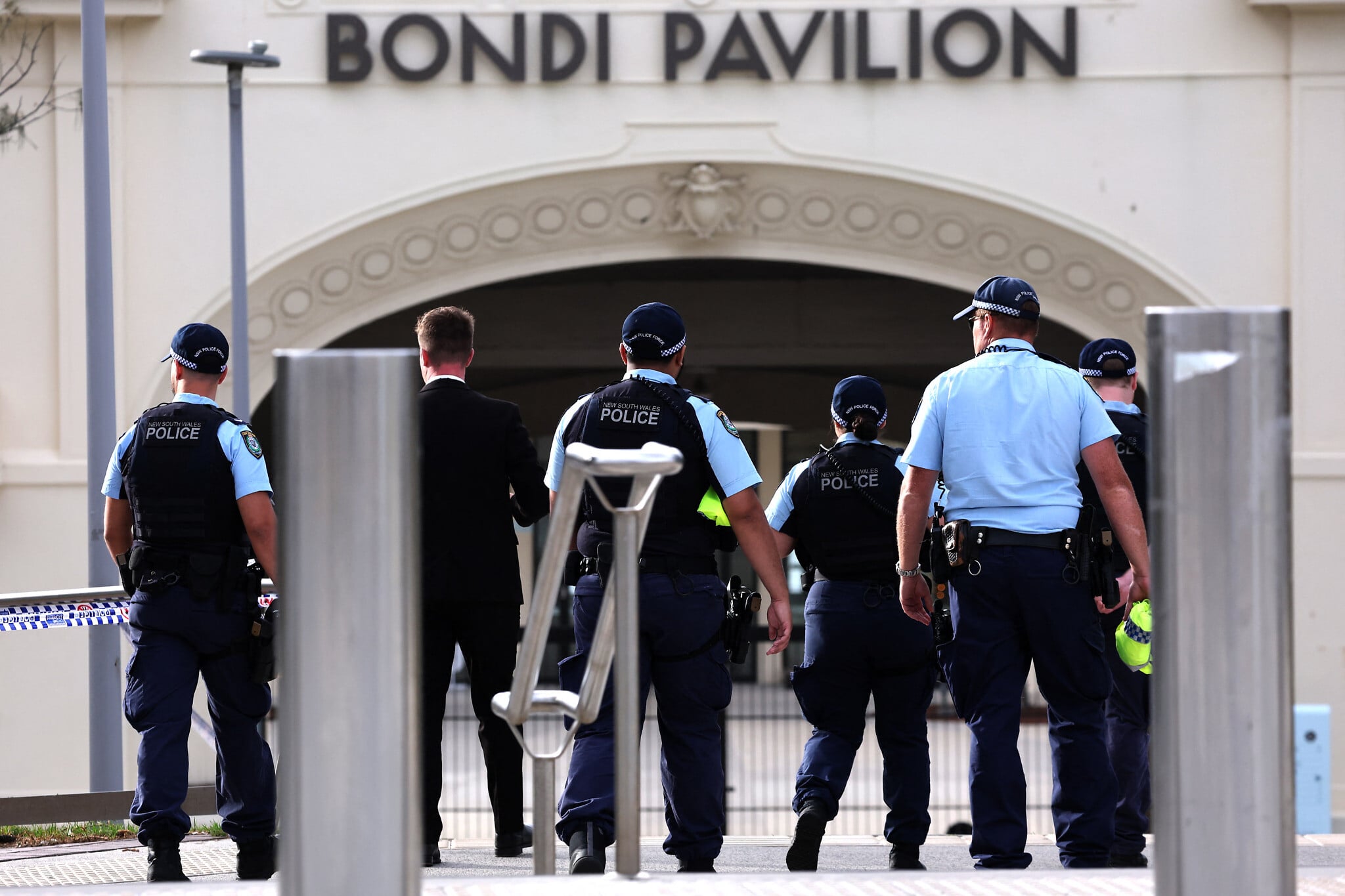
Police inspect at the scene of a shooting at Bondi Beach in Sydney on December 15, 2025. (DAVID GRAY / AFP)
But radicalization within a family makes the authorities’ job more difficult, said Mohammed Hafez, a specialist in Islamist movements, political militancy, and violent radicalization at the Naval Postgraduate University in Monterey, California.
“The conversations are private. They don’t need to get on Telegram, on WhatsApp, or other platforms that can be observed,” said Hafez, who wrote a 2016 paper, “The Ties That Bind: How Terrorists Exploit Family Bonds.”
Families, friends, or work could help stop an individual from being radicalized over a platform such as Telegram, but if it happens in the home, “you are trapped,” he added.
“You are with that loving brother, or you’re with that father, or with that husband or wife. There is no walking away from that. There are no countervailing voices because you’re trapped in that relationship,” Hafez said. “I suspect a lot of people will go along with a brother or a father or a husband or a wife, not because they buy the ideology or they believe in the cause but because they value the relationship.”
Times of Israel staff contributed to this report.
You appreciate our journalism

You clearly find our careful reporting valuable, in a time when facts are often distorted and news coverage often lacks context.
Your support is essential to continue our work. We want to continue delivering the professional journalism you value, even as the demands on our newsroom have grown dramatically since October 7.
So today, please consider joining our reader support group, The Times of Israel Community. For as little as $6 a month you’ll become our partners while enjoying The Times of Israel AD-FREE, as well as accessing exclusive content available only to Times of Israel Community members.
Thank you,
David Horovitz, Founding Editor of The Times of Israel