
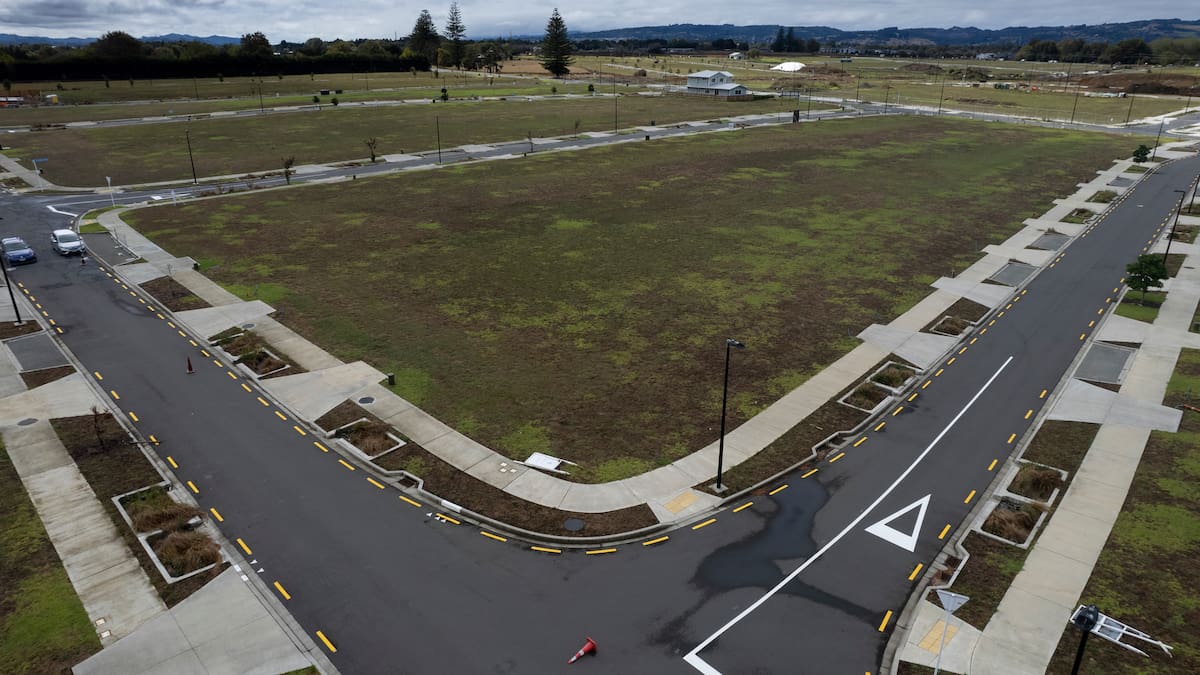
Fu admitted he was a selfish saviour because he did it to save his 250-home subdivision with its $80m in presales on nearby Derbyshire Lane.
He had no other choice after neighbouring developers figured they could “sit there waiting for me to invest … so they can connect for free”.
“It helps the community … but to be honest, it’s mainly for myself,” Fu said.
The Karaka area’s troubles highlight the risks associated with relying on developers and private groups to build public infrastructure.
Located 35km south of Auckland’s city centre, the area had been part of the Hayfield Park development designated as a Special Housing Area for future urban development under a previous National scheme.
An empty Hayfield Way subdivision in Karaka with home buyer Jing Zhang’s house in the background. Photo / Brett Phibbs
A consortium of developers building in the area agreed to fund and build the water infrastructure.
But when it hit hurdles and cost blowouts, the consortium couldn’t agree a way forward and the company set up to collect payments from each of them for the infrastructure went into liquidation in 2019.
It left a ghost town around Hayfield Way with streets and footpaths laid, lamp posts erected but no houses.
Brendon Verhoeff, director of engineering consultants Maven Associates, said the original developers had laid the first main water pipe.
But when they were “forced to go under”, the second back-up line remained unbuilt.
It was needed as a backup supply, especially for emergencies such as a fire.
Without it, water supply authority Veolia refused to give final consent to the subdivision.
The Karaka development on Hayfield Way was among a series of developments that stalled in 2019.
Many home buyers, who had signed to purchase homes off the plans, were left in limbo, with construction of promised houses put off indefinitely.
Eventually, Fu stepped up.
Maven engineers had to design a new route for the backup supply, bringing it 3km from the existing connections in an undertaking that took more than a year.
Verhoeff estimated the fix solved the water issue for “pretty much the entire peninsula” and all surrounding housing developments, unlocking the potential for another 5000 homes.
But it was unlikely to leave Fu with much profit.
“Developers work on a 10% or 15% margin and having to pay for [the public pipes] was a fair bit of their profits,” Verhoeff said.
Millan Arora had expected to be living in his Karaka home in 2022 but instead the land sat bare and empty. Photo / Brett Phibbs
Fu said the situation put him under pressure.
His project faced impending sunset clauses that would have allowed those who pre-bought land to pull out of purchases.
Facing the loss of millions in sales, Fu couldn’t wait for his neighbours to pay their share, he said.
However, his intervention came too late for home buyers in other nearby developments.
Milan Arora told the Herald in 2022 he had signed on to buy in one of the original projects that collapsed along Hayfield Way.
Delays in land division consents linked to the water issue meant he was unable to start building on his site.
Building costs were estimated to have jumped by $300,000 because of the delays, he said at the time.
Jing Zhang’s home had already been built as a showroom but she couldn’t take ownership because the final water consents hadn’t been issued. Photo / Supplied
Jing Zhang was another affected buyer.
After posing for photos outside her finished, waterless home in 2021, she eventually “backed out” of the deal three years ago.
“We just can’t drag on forever,” she said this week.
Zhang said she reached a “mutual agreement” with her home builder in which she was repaid her deposit.
The delays forced her family to buy a new property at a significantly higher price.
“Unfortunately, we had to take the hit.”