
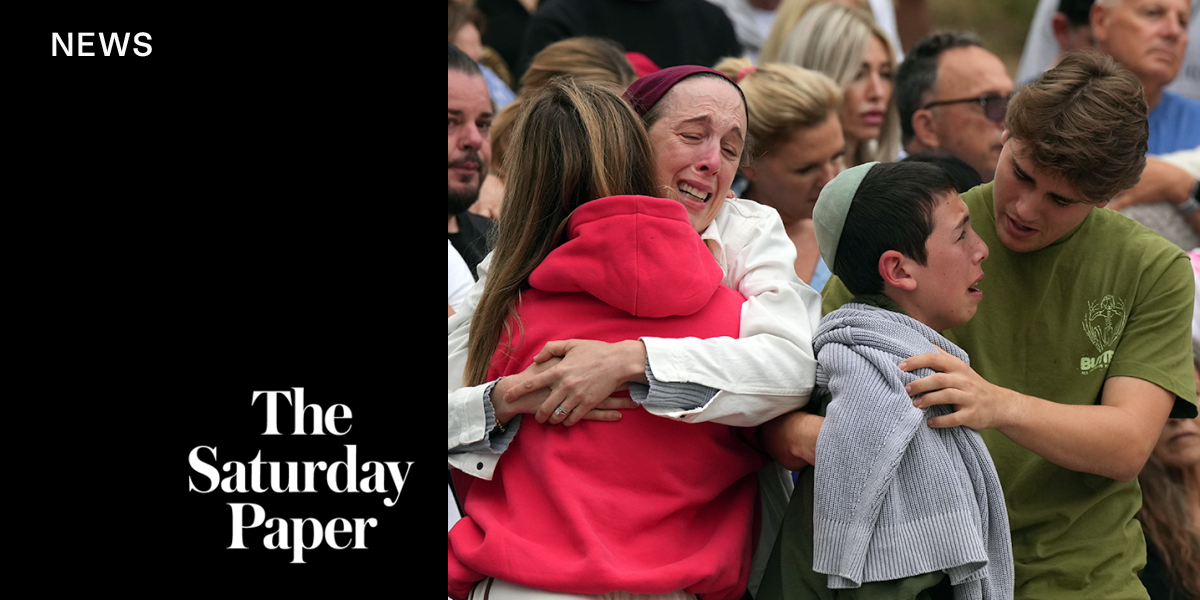
Every day since Sunday’s massacre at Bondi Beach, in which he lost a friend, Rabbi Gabi Kaltmann has woken at 5.30am and from not long afterwards his phone has rung more or less constantly. Kaltmann is the rabbi of the Ark Centre, a Jewish community centre in Hawthorn East, Melbourne, and in the past week his pastoral support has been demanded ceaselessly.
“From the moment I get up in the morning, my phone starts ringing with elders of the community telling me that they’re on the verge of a breakdown,” he says. “It’s unimaginable what we as a community have just experienced. These are the daughters and sons of Holocaust survivors, and they are frankly struggling to comprehend, to come to terms with, what has just happened.”
As has been obvious in my calls with Jewish leaders and friends this week, as it has been in public events attended by political leaders, there is profound anger among Jewish Australians, as there is fear and great sorrow. Kaltmann testifies to this anger also. “It’s one call after another, and with just the most unrelenting attack on [political] leadership, to which I just listen and acknowledge. They generally last for an average of six, seven minutes, emotion-filled monologues about what the Jewish community and Jews are going through.”
Kaltmann tells The Saturday Paper he has counselled many parents, unsure about how to discuss the massacre with their children and, in some way, wanting to quarantine them from the obscenity. “What I’ve heard from parents is that they are trying to paint Sydney as a distant and foreign land, and not something as close in reality as it actually is,” he says. “But the ones I think that are doing it toughest, the ones on the verge of nervous breakdowns or psychological episodes, are the over 60s. It’s just one phone call after another, and when I meet people on the street they just want to hug you and weep on your shoulder.”
Kaltmann listens patiently to each of them. He is sympathetic to their anger, although he is diplomatic about his own. “I don’t want to go to war with political leaders here,” he says. “But for the past two years, the Jewish community has been telling anyone that would listen that they don’t feel safe. There’s a sense of insecurity. It’s been one thing after another, from schools being defaced, synagogues being torched, to people being attacked and vilified in the streets, to a riot in Caulfield. And the feeling, the consensus, is that we were not taken seriously.”
Kaltmann says it pains him to consider the federal government’s inaction on Jillian Segal’s report. Segal was appointed by the Albanese government in 2024 as its anti-Semitism envoy, and tasked with a plan for combating it. She delivered her report in July, but it had not been formally responded to before Sunday’s massacre. “Why go to the effort of empowering somebody and then letting their work sit gathering dust on a bookshelf?” Kaltmann asks.
On Thursday this week, Prime Minister Anthony Albanese formally responded – something Segal described as being a “long time coming”. Albanese said his government’s proposed reforms comprised five points: the creation of new hate speech offences committed by community or religious leaders; legislatively determining hate as an aggravating feature of online harassment; increasing the penalties for hate speech that incites violence; creating a federal offence for the promotion of racial supremacy; and the creation of a public list of organisations that promote hate speech or violence.
“I think, unequivocally, the greatest defence this country has had against a mass casualty terrorism attack has been our firearms laws.”
Between funerals on Wednesday, former treasurer Josh Frydenberg, a Jewish man, stood before the Bondi Pavilion’s memorial and spoke with both obvious heartache and righteous anger. “This massacre at Bondi is the greatest stain on this nation, has brought the greatest shame to our nation,” he said. “I’m here to mourn, but I am also here to warn. Unless our governments, federal and state, take urgent, unprecedented and strong action, as night follows day, we will be back grieving the loss of innocent life in another terrorist attack in our country.”
Frydenberg listed the slaughter’s grim distinctions: Sunday was the worst terrorist attack on Australian soil; the severest loss of Jewish life anywhere in the world outside the state of Israel since October 7, 2023. It was an act that despoiled our soul, desecrated an idyll, and will perpetually haunt Jewish Australians; an obscenity that has cratered families and whose traumatic reverberations will ripple indefinitely.
As well as the profound grief and fear, Sunday confirmed for Frydenberg – and Australian Jews generally, he said – the accuracy of their warnings and the inadequacy of their reception. Alongside the grief and fear was a sense of betrayal and awesome fury. “This was all too predictable,” Frydenberg said. “Ever since those hours after Hamas’s horrific attack on October 7, we saw the heinous scenes on the steps of another national icon, the Sydney Opera House, with people celebrating that death and destruction … And since that day, we have seen the doxxing of Jewish creatives, the cancelling of Jewish artists, the boycotting of Jewish businesses, the graffitiing of our schools, the harassment, the intimidation of Jewish students and staff on our university campuses, and of course the firebombing of our synagogues and day care centres and daily, daily protests of hate in this, the lucky country, which is lucky no more.
“And for two-and-a-half years, as the Australian Jewish community and others have raised the alarm bells, they were told by people who should know better that this was not as significant as they had said. We were told they didn’t say ‘Gas the Jews’ on the steps of the Opera House, they simply said ‘Where are the Jews?’ ”
One remarkable feature of Frydenberg’s speech was his blunt attribution of the mass killing to the ineffectiveness of the prime minister – a man who he said had not proved his worthiness for the office. “Our prime minister, our government, has allowed Australia to be radicalised on his watch,” he said. “It is time for him to accept personal responsibility for the death of 15 innocent people, including a 10-year-old child. It is time our prime minister accepted accountability for what has happened here.”
The ex-treasurer then proposed eight actions for the prime minister, including the outlawing of radical preachers and, as has been done in the United Kingdom and Germany, the designation of Hizb ut-Tahrir as a terrorist organisation. Hizb ut-Tahrir seeks the re-establishment of a global Islamic caliphate and have enthusiastically sought the recruitment of young Muslims here. Only last month, ASIO chief Mike Burgess likened the group to the neo-Nazi National Socialist Network and expressed his preference for outlawing them.
Perhaps most controversially, however, Frydenberg proposed that pro-Palestine protests be “stopped”, saying they were “incubators of hate”.
His final suggestion was the immediate establishment of a royal commission into the massacre and the “rise of anti-Semitism”.
Albanese and Home Affairs Minister Tony Burke were quick to reject the usefulness of a royal commission. “The last thing that I want,” Burke said on Wednesday, “is the delays that happen on a royal commission.”
Only an hour before Frydenberg’s speech, the father-in-law of one of the victims – Rabbi Eli Schlanger, an organiser of the Hanukkah event – spoke at his son-in-law’s funeral. “When these animals who look like humans attack us, they hope we will become dormant,” Chief Rabbi Yehoram Ulman said. “That we will remove our yarmulkes and never go to Bondi Beach again. But we won’t let them succeed.”
Frydenberg evidently agreed. On the ABC’s 7.30 program that evening, he said: “If I’m not going to speak out, who is? If not now, when? If not me, who?”
Carrick Ryan can certainly understand the Jewish community’s anger, although he gently counsels against it. Ryan was an officer with the Australian Federal Police for 10 years, principally working within its counterterrorism command, before he left five years ago to work on fraud investigations in the corporate sector.
“Whether we’re looking at right-wing violence, whether we’re looking at this new breed of left-wing conspiracy theories, or we’re talking about Islamic extremism, they have a common target of their hostility, which unfortunately always seems to be the Jewish people,” Ryan says. “And I think what people don’t seem to understand is what it must feel like for the Jewish people to be in that constant situation where they are really, at any one point, prone to being targeted by acts of violence from so many different areas within our society.
“I think that anger is palpable, and I think Australia’s Jewish community would feel vulnerable. There’s a large number of people that have failed to really listen to that and appreciate that. So, I can understand why that would cross over [into anger] and the natural thing would be to look at who has failed to protect them.”
If there has been political recrimination, there have also been angry and baffled questions asked of police and intelligence agencies. Was the risk assessment of the Hanukkah event adequate? How was it that one of the shooters, Sajid Akram, could legally acquire six guns – not least after his son had drawn the attention of ASIO for his links to Islamic State? Were intelligence services aware of their trip to the Philippines – a place notorious for its guerilla camps and arms training – and, if so, did they appreciate its significance?
Ryan’s counterterrorism work was largely preventive – as such, success can be invisible or only modestly publicised. It is the failures – or perceived failures – that find infamy and invite anger. “I always used to get a huge sense of pride that by foiling these attacks – and, yes, you might get this small headline – but people would get on with their day. That was the point. We managed to ensure that the terror that these guys had so much wished to impose upon the community, that we prevented that terror, and that people could go on with their lives and focus on their family and their day-to-day life. That was a beautiful thing. That’s how we knew we were doing our job. We got to kind of confront the evil that most of the rest of Australia didn’t know existed.
“Some of the attacks that I can think of that have been foiled by the JCTT [Joint Counter Terrorism Team] when I was there… there was one instance of people attempting to get guns to light up Parramatta court. There were two 16-year-old boys that wanted to go and start cutting heads off in Bankstown. There was the attempt to blow up an A380 in the sky. You had numerous terror cells that were going to try and take down the AFP building. So, it always felt like a real point of pride that we’ve managed to keep the country safe and keep people beautifully naive to it to a degree.”
Ryan will not be drawn on any perceived failures to prevent Sunday’s massacre – it’s too early. There is, however, always the fear that “someone will slip under the radar”, most often when they’re isolated. It’s easier to target, surveil and prevent larger conspiracies to commit acts of terror – the chance of indiscretion is greater. “Sometimes this evil manages to simmer to the top,” Ryan says. “And without knowing whether it’s fair or not, I’m sure there’ll be people within the organisation right now that would be absolutely distraught thinking about whether or not there’s something they could have done differently. I suspect there’ll be plenty of people within the AFP and ASIO and New South Wales Police right now that will have that sick feeling in their stomach.”
Both the prime minister and NSW Premier Chris Minns have pledged gun reform. Earlier this week, national cabinet met to thrash out the details, which included limiting gun licences to citizens and reducing the maximum number of weapons allowed to an individual. John Howard, long commended for his own gun reforms after the Port Arthur massacre almost 30 years ago, said he would likely support additional reform but said it must not serve as a distraction from the federal government’s failings on anti-Semitism. He called it an “attempted diversion”.
For Carrick Ryan, tightening gun controls seems both obvious and necessary. “I think, unequivocally, the greatest defence this country has had against a mass casualty terrorism attack has been our firearms laws,” he says. “Even when you look at the actions of these men on Sunday … if they had automatic weapons – if they had something like an AR-15 – we would be talking about hundreds dead.
“I don’t see any public utility in anyone having hunting rifles if they live in inner suburbia. The public good here just does not exceed the danger that it poses to us. So if we’re looking for ways to find a solution to this, the most obvious case is tightening gun laws. There’s public utility in that. It also seems like the most mature response.
“A society that comes out of a painful event like this, our instincts might be to cry for blood, and you want people to pay and we want to be angry, when the reality is, you know, the most utility, the most useful response we can make, would be just to look at these gun laws. It might seem like low-hanging fruit, but the reality is we’re never going to totally stop madmen. We’re never going to be able to destroy this ideology, nor any other violent ideology. And so the reality is that as long as madmen live amongst us, and they always will, we’re just going to have to take away the weapons that can allow them to cause so much damage.”
This article was first published in the print edition of The Saturday Paper on
December 20, 2025 as “‘It’s unimaginable what we as a community have just experienced’”.
For almost a decade, The Saturday Paper has published Australia’s leading writers and thinkers.
We have pursued stories that are ignored elsewhere, covering them with sensitivity and depth.
We have done this on refugee policy, on government integrity, on robo-debt, on aged care,
on climate change, on the pandemic.
All our journalism is fiercely independent. It relies on the support of readers.
By subscribing to The Saturday Paper, you are ensuring that we can continue to produce essential,
issue-defining coverage, to dig out stories that take time, to doggedly hold to account
politicians and the political class.
There are very few titles that have the freedom and the space to produce journalism like this.
In a country with a concentration of media ownership unlike anything else in the world,
it is vitally important. Your subscription helps make it possible.
Send this article to a friend for free.
Share this subscriber exclusive article with a friend or family member using share credits.

Used 1 of … credits
use share credits to share this article with friend or family.
You’ve shared all of your credits for this month. They will refresh on January 1. If you would like to share more, you can buy a gift subscription for a friend.
SHARE WITH A FRIEND
? CREDITS REMAIN
SHARE WITH A SUBSCRIBER
UNLIMITED
Loading…