
Every December, I go to local schools and give presentations about Hanukkah to the children.
Some of these are public schools, while others are explicitly Christian; and some are private schools with middle-class or wealthy students, while others serve poor students who are food and housing insecure. I serve as a rabbi in Central Pennsylvania, so when I speak to the children I often start by asking them if they have met a Jewish person before. Almost always, less than half of the group raises their hands, but by the end of the presentation they are all joyfully singing “I Have a Little Dreidel” and wishing me a Happy Hanukkah.
Lightfield Studios/Adobe Stock
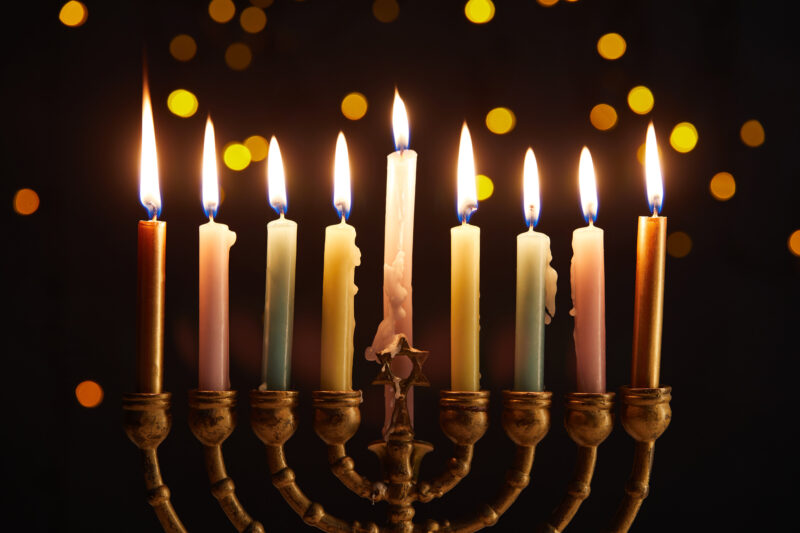
Illustrative. Chanukah candles burning brightly.
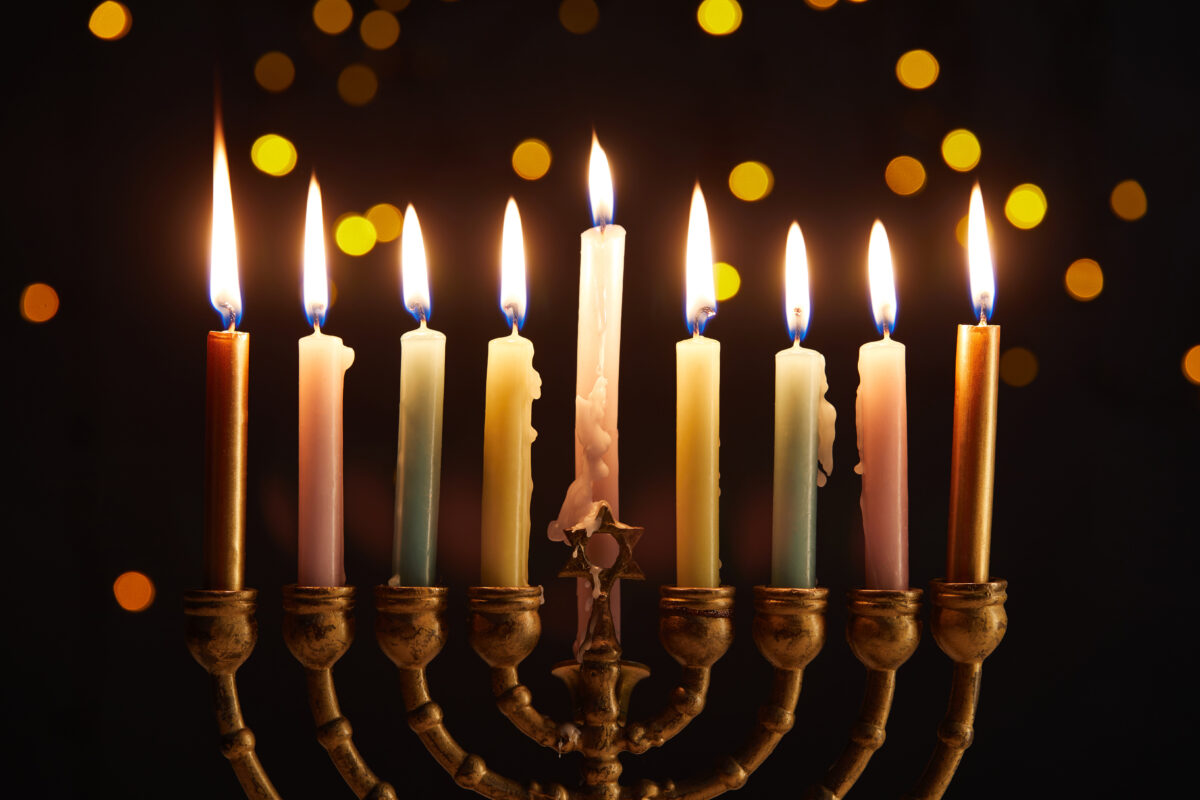
On Hanukkah, we place the menorah in our window to spread the good news about the miracle of light. Our calling in this season is “l’farsem et ha’nes,” to publicize the miracle. In this dark period for the Jewish people, from the unprecedented attack on Oct. 7, 2023 to the horrifying shooting in Sydney just a few days ago, it’s important to take a moment on Hanukkah to talk about what is good and the beautiful and light in Judaism.
So often we are forced to come to the world stage with warnings and pleas, talking about the hatred of Jews and the need for protection. Instead of centering fear, we can choose to amplify resilience and joy. This holiday explicitly calls upon us to speak publicly about the miracles we have experienced, our gratitude to God and our commitment to spreading light to others.
This framing goes back to early definitions of the holiday. In their discussion of Hanukkah in the Talmud, our sages maintain the focus on the miracle of light, rather than the war and oppression that led up to it. They ask, “Mai Chanukah?” “What is Hanukkah?” and respond by discussing a miracle of oil lasting for eight days, a story with no apparent antecedents. They continue to detail the laws of lighting the menorah, the obligation of every Jew to participate in commemorating the miracle. They exhort us to place the menorah in a public facing place, and even discuss liability if one’s menorah starts a fire. But they do not discuss the war of the Maccabees and the oppressive laws that led up to it.
Like film directors, the rabbis of the Talmud are very intentional about how they tell the story of this holiday. They have placed God and the miracle of light in the center of the frame, and the historical conflict in the margin.
At this time of year in particular, we should take their cue. We should spend our outward-facing moments focusing on the light and joy that Judaism brings to the world, and take a break from recounting the awful wars and oppression we have had to endure.
I used to think differently. My own grandmother and great grandmother were Holocaust survivors whose entire extended family perished in Poland. When I transferred to a public high school, I was shocked to find that there was no Holocaust Memorial Day program, so I made flyers and booked a classroom and shlepped my grandmother to my school to tell her story. Several students thanked me afterward, saying they had never heard a survivor’s story first hand.
Twenty years later I am a rabbi, still teaching about Judaism to Jews and non-Jews alike. And yet, my philosophy about what to teach has changed. Today, there are all too many stories in the news proving that this Jewish experience of persecution is ongoing. It’s clear what Jews are battling against these days. What is not as apparent, however, is what Jews are fighting for. What is it that has kept us alive over thousands of years, even as we are marginalized and hated by one society after another?
We are called to be a light unto the nations, and what better opportunity than Hanukkah to shine? More than other Jewish holidays, Hanukkah has become integrated into the Western psyche through its proximity to Christmas. In a dutiful (if sometimes thin) nod to diversity, Americans call this period “the holidays” and place a menorah next to a Christmas tree in shop displays.
Furthermore, Hanukkah has become recognizable to the Western mainstream. Just as the Passover Seder format is based on an ancient Greek-style meal, and Purim happens when many cultures have a carnival holiday, American Jews in a Christmas-saturated world emphasize gift-giving and song-singing on Hanukkah.
This makes it easy to introduce the holiday of Hanukkah to people unfamiliar with Judaism. “Tell me about some of the things you do to celebrate Christmas, or Kwanza?” I ask the kids at school presentations. Immediately they tell me about the gifts exchanged, the special foods eaten, the songs sung. I can then tell them about latkes and jelly doughnuts and the reason that we fry foods in oil. I do tell the story of the Maccabees fighting the oppressive Assyrian Greeks; but like our sages, I emphasize the miracle of the light. In doing so, I reinforce the message that Jewish holidays are just like yours, only a bit more… oily?
I continue to shlep my grandmother around to share her story with new audiences. It is certainly important to talk about antisemitism and to advocate for Jewish safety in these frightening times. But by focusing exclusively on this subject in the public sphere, like coming to schools to talk exclusively about the Holocaust, we risk people knowing us only by our worst experiences. There are so many wonderful things about Judaism. Let them know about our culture, our wisdom, our joy and our love, too.
On this Hanukkah, let us place our menorahs in our window and remind ourselves that the message we want to be sending to the public is not just one about darkness, but one about light. In doing so, may we be blessed to have that light reflected back on us.
Rabbi Ariana Capptauber is the rabbi of Beth El Temple in Harrisburg, Pa.