
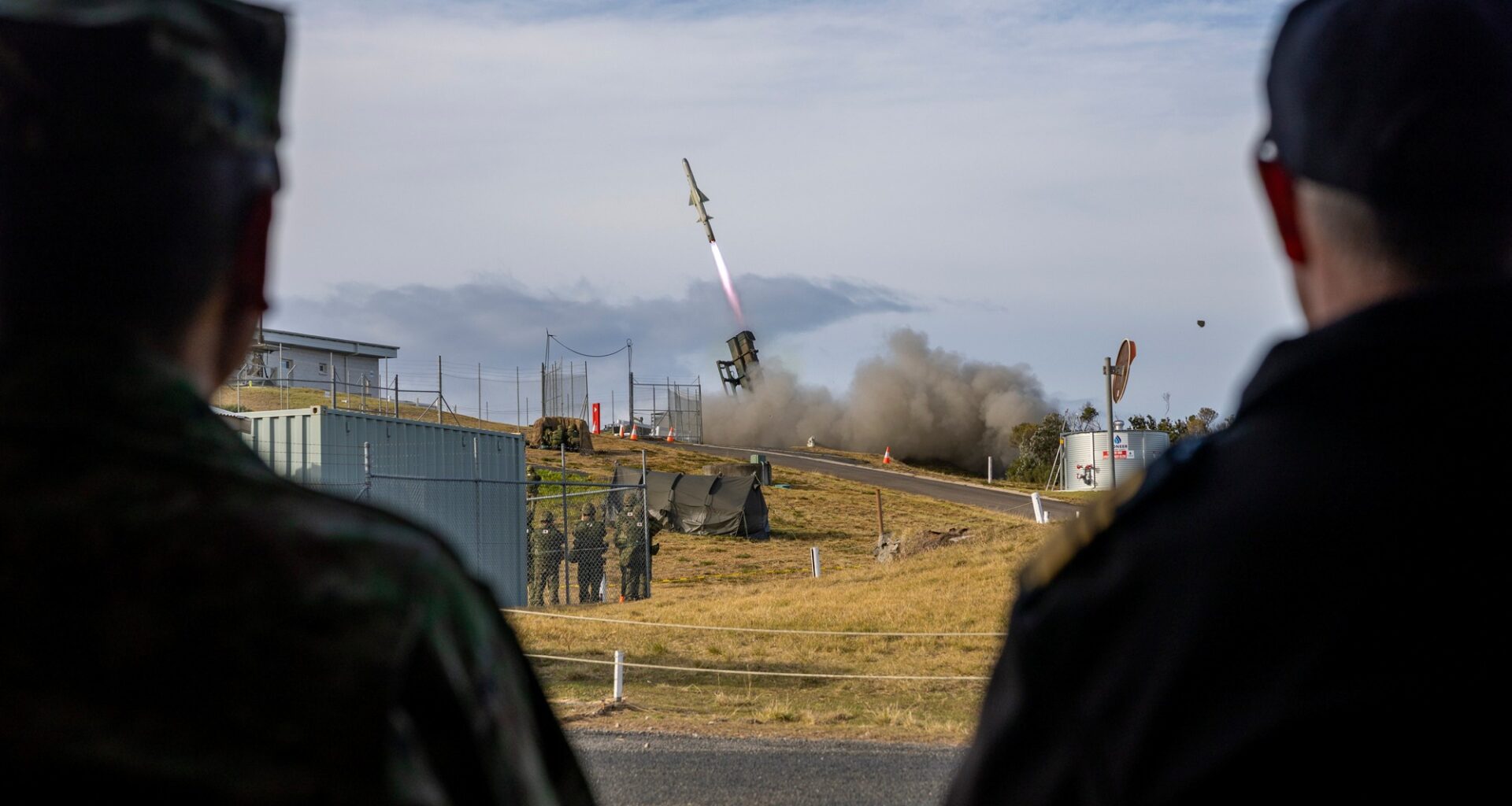
Ground-launched missiles for warding off enemy warships could be the next item on the table for Australia–Japan defence equipment cooperation.
The candidate weapon is the Upgraded Type-12 SSM, unofficially called the Type-12 SSM-ER, which Japan plans to introduce before April of 2026. From what little of its specification that has been disclosed, we know that this is an advanced weapon of great range, and it should be an alternative to a US missile that Australia is presumably considering.
If Canberra judges that the ground-launched Type 12 SSM-ER is cost-effective, it may also see buying it as a way to further strengthen what the two countries call their special strategic partnership.
The problem is in that term ‘cost-effective’. Japan isn’t saying how much the weapon costs, in part to hide the size of its missile stock. And Japan’s domestic regulations prohibiting the export of lethal weaponry have ensured there’s been none of the price transparency that often goes with international sales.
Yet a rough price figure for the Type-12 SSM-ER can be estimated: about US$3 million per round, which looks competitive.
The figure is about US$1 million more expensive than other ground-launched anti-ship missiles that Australia plans to introduce, the US Lockheed Martin PrSM Increment 1, at roughly US$2.1 million per round, and the ground-launched version of Norway’s Kongsberg NSM, at about US$2.2 million. But the Type-12 SSM-ER can fly much farther than they can.
The three ground-launch systems can all hit ships, but their strengths differ. PrSM Increment 1 is ballistic, meaning it flies high and comes down very fast on its target, so it should be hard to intercept. The NSM and the Type-12 SSM-ER, by contrast, are cruise missiles, a category in which the latest types use new technologies to confound defences. Both have a stealthy design. Kongsberg employs a sophisticated guidance system for better accuracy on the NSM, while the Japanese weapon has a real-time data-command system to pursue moving targets at long distances.
Japan’s missile can fly more than 1,000 km, roughly twice as far as PrSM Increment 1 and maybe three times as far as NSM.
This means that the Type-12 SSM-ER may in fact be an alternative to an upcoming US weapon–PrSM Increment 4, which will also fly around 1,000 km and, being more capable and complex, cost probably much more than the PrSM Increment 1. The PrSM Increment 4 is known to be a prospect for Australia, because the country’s 2023 Defence Strategic Review called for acquisition of every kind of PrSM missile.
In the past, the lack of clear pricing for Japanese weapon systems may not have been a major concern, but today it risks slowing the growing momentum behind Japan–Australia defence-industrial cooperation—especially as Japan begins to ease its weapon export restrictions. For Australia, cost-effectiveness will be central to any decision to partner with Japan on defence equipment, and that requires at least a rough sense of pricing—not only shared behind closed doors, but available to the public as well.
Very few attempts have been made to estimate the unit costs of Japan’s current or future missiles of any category. In this article, I make an initial attempt to do so with publicly available procurement data for the existing Type-12 SSM and its upgraded derivative, the Type-12 SSM-ER.
Cost per round
Missiles with similar capability, size, and development timelines generally have comparable costs. The Boeing AGM-84 Harpoon Block II is the closest analogue to the original Type-12 SSM: they are roughly similar in dimensions, weight, range, and guidance system and both entered service in the early 2010s. Public data places the Harpoon Block II’s unit price at about US$1.2 million (¥140 million at an exchange rate of ¥120 per US$1 in 2015). Given Japan’s smaller production scale and the Type-12 SSM’s slightly larger airframe, a reasonable estimate for its unit price is around ¥150 million (US$1.25 million) per missile.
Estimating the cost of the Type-12 SSM-ER is more difficult because it features major performance upgrades and has a redesigned airframe, and little is known of its specifications. But in missiles (and aircraft) unit cost often scales approximately with development cost, and the Type-12 SSM-ER cost about 2.9 times as much to develop as the original Type-12 SSM. Applying this ratio suggests a unit price of roughly ¥450 million (US$3 million at ¥150 per US$1 in 2025), which aligns broadly with other long-range anti-ship missiles, such as the Lockheed Martin AGM-153C LRASM at about US$3.2 million.
Cost per battery
A ground-launched anti-ship missile is deployed in a battery of equipment, including launchers, reload vehicles, command-and-control systems and surface radars. Assessing the real cost of acquiring such weapons therefore means estimating the price of the entire battery, not just the missiles. For the original Type-12 SSM, this is possible because, despite year-to-year cost fluctuations, Japan consistently bought a battery a year from FY2016 to FY2021. The average cost, including 48 missiles in launchers and reload vehicles, was ¥10 billion (US$83 million).
For the Type-12 SSM-ER, however, Japan has bought missiles in bulk while acquiring ground equipment separately, making the battery-level cost much harder to determine.
Even so, we can discern an approximate price per battery by combining the cost of the missiles and the ground systems. According to Japanese procurement data, three ground-equipment sets bought in FY2024 and FY2025 averaged roughly ¥10 billion (US$67 million) each. A battery holds 32 missiles (in four launchers and four reload vehicles), which would cost about ¥14.4 billion. The total, then, would be around ¥25 billion (US$180 million) per battery.
The calculation, though derived approximately from publicly available information, should provide a valuable indicator for discussion of a possible Type 12 SSM-ER purchase. Its implication is that Japan’s ground-launched anti-ship missile procurement costs may not differ substantially from those of comparable and competing systems.
Battery
Ground equipment
Missile
Type-12SSM (in 2015 exchange rate)
¥10 billion (US$83 million)
¥2.8 billion (US$23 million)
¥150 million (US$1.25 million)
Type-12SSM-ER (in 2025 exchange rate)
¥25 billion (US$180 million)
¥10 billion (US$67 million)
¥450 million (US$3 million)
Comparison of the estimated prices of the Type-12 SSM and Type-12 SSM-ER, adjusted to 2015 and 2025 exchange rates, respectively.