
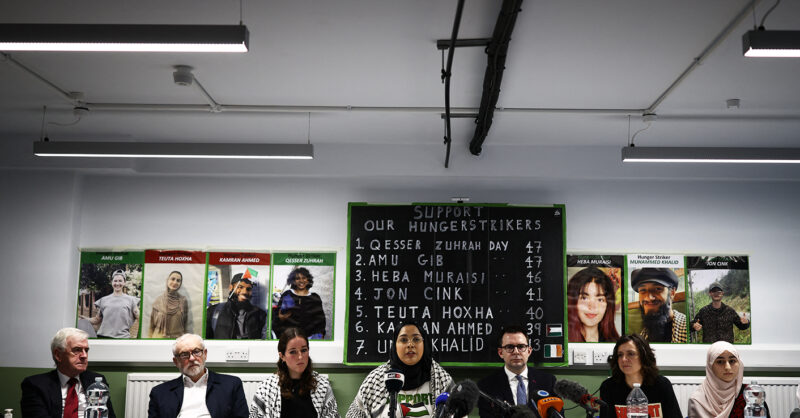
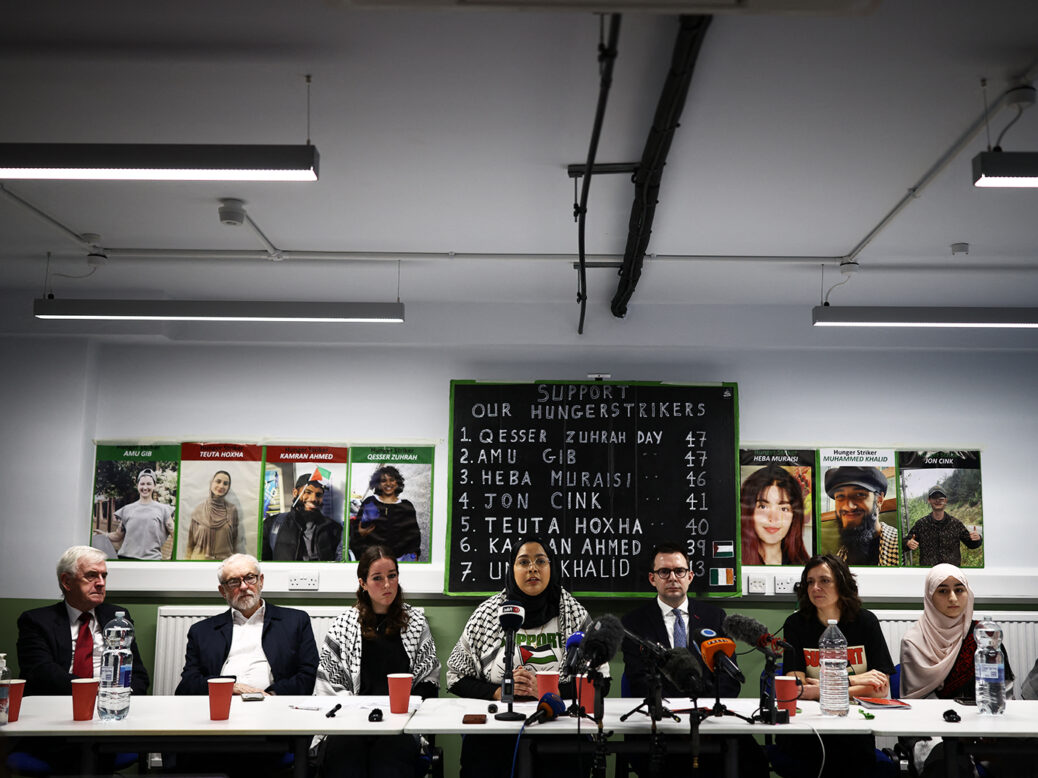
Photo by Henry Nicholls/ AFP via Getty Images
HMP Bronzefield, in Ashford, Surrey, is built in the shape of three white crosses. The largest female jail in Europe, it holds more than 500 prisoners, including Lucy Letby. Inside it, the pro-Palestine activist Amu Gib is starving to death.
“I’ve asked for more info about saints,” Gib wrote to a friend a few weeks into their hunger strike. “Part of me is needing more prayers to call on.” Gib, who has a shaved head and uses they/them pronouns, wrote that they were thinking a lot of Lama Rod Owens, the Buddhist teacher who’d guided them on a meditation retreat a few years ago. “I guess lots of sitting down and hot water bottles, too.”
Amu Gib and Qesser Zuhrah began their strike on the morning of 2 November, the 108th anniversary of the Balfour agreement, which expressed British support for a “national home for the Jewish people” in Palestine. They have now gone 48 days without food. Since they began, six other prisoners, from HMP Pentonville, Wormwood Scrubs, Peterborough and New Hall, joined them – although two of the later joiners this week paused their strike for hospitalisation. On Wednesday, Zuhrah collapsed in Bronzefield; MP Zarah Sultana and other protesters gathered outside the prison until she was taken to hospital.
The remaining six strikers have five demands: immediate bail, the right to a fair trial (which they say would include the release of documents related to “the ongoing witch-hunt of actionists and campaigners”), ending censorship of their communications, “de-proscribing” Palestine Action, which is classed as a terrorist group, and the shutting down of Elbit Systems, the Israel-based defence manufacturer with several UK factories.

Treat yourself or a friend this Christmas to a New Statesman subscription for just £2
The six hunger strikers are facing charges related to break-ins at a factory run by Elbit, Israel’s largest weapons manufacturer, last August, and at RAF Brize Norton, where two military planes were sprayed with red paint in June this year. Some of the accused, including Gib, are scheduled to go on trial in mid-January 2027. If the strike continues, they will not live to that date. After a certain point without food, the stomach bloats, hair falls out and skin flakes, and the extremities swell. Death often comes from infection, which the body can no longer produce enough energy to fight.
Ray, a friend of Gib who would not give me their surname, said some strikers refuse to be fed even in hospital. Their supporters protest outside prisons and the Ministry of Justice. Anger is growing; if any striker dies in the coming days, they could riot.
These are the largest collective hunger strikes in Britain since the Irish republican strikes of the 1980s. Then, Martin Hurson died after 46 days on strike. Bobby Sands was elected an MP from prison; he died after 66 days. “This is the sound of the bone/Breaking through the skin/Of a slowly dying man,” the poet John Montague wrote when Sands died. “This is the song of his death./This is the sound of his living on.”
Some of the former Irish republican hunger strikers are offering support to the prisoners. Tommy McKearney, who participated in the 1980 strike for 53 days, attended a London assembly in early December for the prisoners, as did Bernadette Devlin McAliskey, a former Northern Irish MP and prominent campaigner for the strikers. They shared their experiences of the 1980s strikes and the harm their bodies endured. “They were very realistic about how much damage it did to the community that they were part of,” Ray said. “They said they are still reckoning with some of that trauma.”
McKearney was close to death when the 1980 hunger strike was called off. “He was in and out of consciousness,” Ray said. “It took him, he says, several months to recover enough to move around and function, and about four years to regain some sense of normality. So these hunger strikers are now entering a very long process of recovery, if they don’t die.”
Gib has lost more than 10kg so far, and is experiencing a constant headache and difficulty with vision. Ray has visited them on three occasions and saw an obvious decline. “They look a lot thinner and slower,” they said. “Their skin and eyes show signs of strain, and they are obviously finding it difficult to stand and sit… They’ve told me they try to limit activities like going upstairs, because if they go upstairs, that will take up too much energy.” They compared it to a person “disabling themselves”.
Most of the public may not understand the strikers; David Lammy has refused to meet them, and politicians and TalkTV pundits joke that they should “just eat an effing sandwich”. But the prisoners, all aged between 20 and 30, are part of a generation who feel deeply affected by the war in Gaza. For them, the more than 60,000 Palestinian deaths that have been registered since Israel invaded Gaza following the atrocity of 7 October, 2023, are a moral stain on the West that no amount of liberal handwringing can wipe away. In a voice recording from prison, Gib lamented “a society that imprisons its conscience.”
If the strikers are released, with some or all of their goals achieved, they will be able to claim a victory in their battle against the government. But if they die, they will reach a kind of martyrdom, like the saints Gib wants to learn more about. What is more, whatever the cynicism of the public at large, their deaths will only further radicalise a significant cohort in the country who are already disillusioned with their government and political class more generally. Gib speaks about their strike with the conviction of a soldier. “My body has been put in the custody of the state but I still have the duty to fight for freedom from oppression,” they said in another voice recording. “We as a movement have a strong history of demonstrating a commitment to justice and liberation so complete that we can survive without eating.”
Before their arrest, Gib lived with Ray in a “flotilla” of houseboats. They met while living on the pro-Palestine encampment in Oxford in 2024. Gib, an ambulance driver at the time, “was really quite central” to the encampment, said Ray. After the tents were moved, they built a community garden on the lawn of the Pitt Rivers museum, using the soil from where the tents had stood. They planted poppies and other white and dark-petaled flowers in the shape of the Palestine flag. The day after they had finished creating the garden, the university sent in bulldozers to destroy it. Perhaps they thought the struggle was over. It was only the beginning.
[Further reading: Recovering the lost history of Gaza]
Content from our partners