
Mr. President,
I would first like to thank the Under Secretary-General for Political Affairs, Ms. DiCarlo, and the Assistant Secretary-General for Humanitarian Affairs, Ms. Msuya, for their briefings, and I would like to thank Ms. Jalabi for her poignant testimony and proposals.
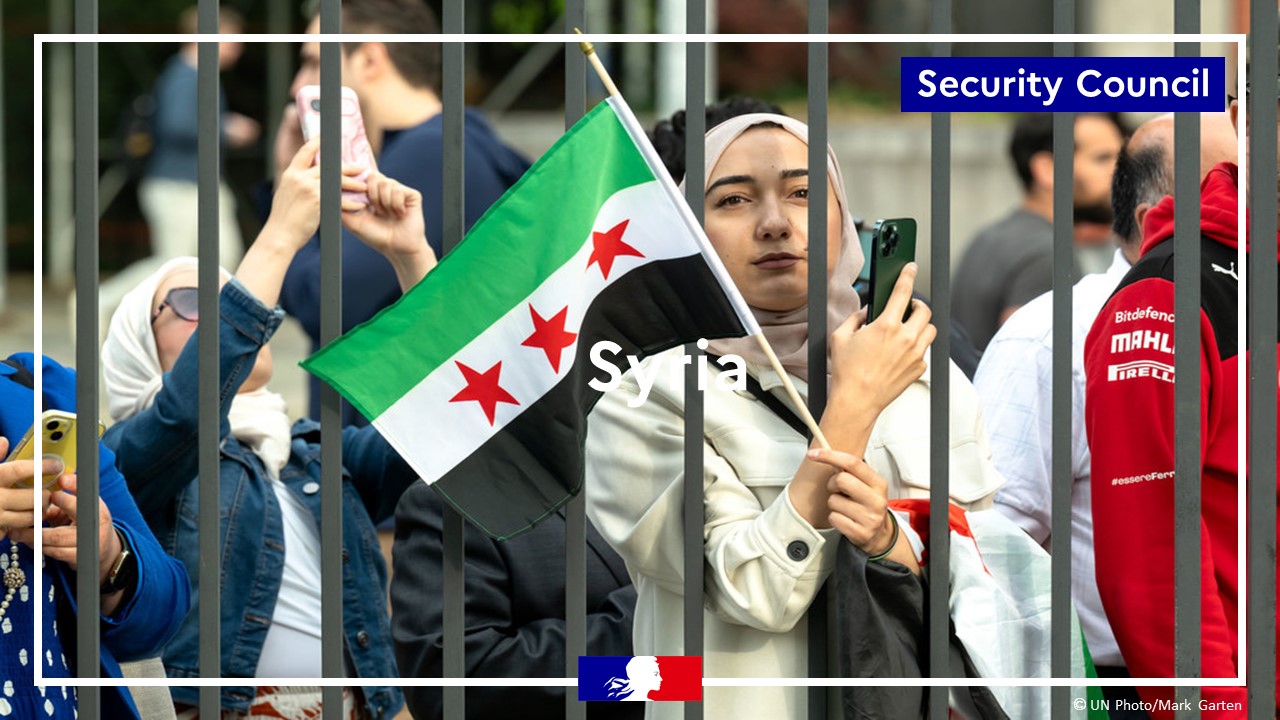
On December 8, the Syrian people commemorated the anniversary of the fall of the Assad regime. Syria has been engaged in a fundamental transition for a year now. Efforts are bearing fruit, as shown by the return of 1.2 million Syrians in recent months, but the task is immense and difficult.
For France, the Council’s visit to Damascus was an opportunity to convey a message of support as well as to listen to the Syrian authorities and civil society. We thank President Al-Charaa for his warm hospitality and our colleague Ambassador Olabi for remarkably organizing this trip.
The Security Council and the United Nations must mobilize to ensure the success of this metamorphisis.
We have see three objectives for 2026:
1/ The first is to eradicate the scourge of terrorism for Syria and Syrians, of course, but also to ensure that Syria can no longer serve as a rear base for terrorist groups.
France strongly condemns the terrorist attack near Palmyra against American military and civilian personnel, which caused several casualties among the American forces and their Syrian escorts.
We offer our condolences to the victims and their loved ones.
In support of the essential efforts of the Syrian authorities, the resurgence of Daesh attacks calls for increased multilateral cooperation, particularly within the framework of the International Coalition against Daesh, in which France is firmly committed alongside the Syrian transitional authorities and 90 other partners.
2/ Secondly, support the policy of national reconciliation, institutional recovery, and rebuilding of Syria.
While the needs of the population remain immense, inter-community tensions remain high, and the socio-economic situation is slow to improve, this Council must continue to engage the international community. To respond to the humanitarian emergency and launch reconstruction, the European Union lifted sectoral sanctions against Syria last May.
The United Nations has a major role to play in supporting these humanitarian, development, and reconstruction efforts. The establishment of new, democratic, and inclusive institutions, and the policy of national reconciliation, and transitional justice must continue in order to enable Syria to bring together all components of its society, all faiths and all communities, women and men on an equal footing. In Damascus, the Council was able to assess the work that remains to be done and the role that the UN can play, while fully respecting Syrian sovereignty. We welcome the new UN Resident and Humanitarian Coordinator in Syria, Ms. Nathalie Fustier, and the next Deputy Special Envoy, Mr. Claudio Cordone.
3/ Thirdly, Syria’s full integration into its environment must be sought, for the sake of peace and stability in the region.
After decades of a threatening Syria under the Assad rule, a major transformation is possible, and it is up to us to support it.
Addressing the Council in Damascus, President Al-Charaa and Minister Al-Chaibani emphasized their desire to establish a relationship with Lebanon based on mutual respect. This is a major change that we must support.
Israel, for its part, must seize the opportunity presented by a Syria that is eager to make peace with its neighbors, as its authorities have stated, by respecting Syria’s sovereignty and territorial integrity, ceasing its incursions, by withdrawing from the territories it has occupied since December 2024, and fully complying with the 1974 agreement.
Mr. President,
This Council must continue to stand alongside the Syrian authorities and people in support of the construction of a free, united and sovereign Syria that is stable, in all of its diversity.
Thank you.