
Released: 2025-07-31
Real GDP by industry
May 2025
-0.1% 
(monthly change)
Real gross domestic product (GDP) edged down 0.1% in May for the second consecutive month, as goods-producing industries declined while services-producing industries were essentially unchanged.
Chart 1

Real gross domestic product edges down in May for the second consecutive month
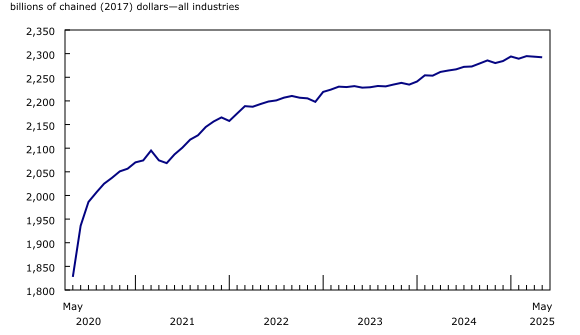
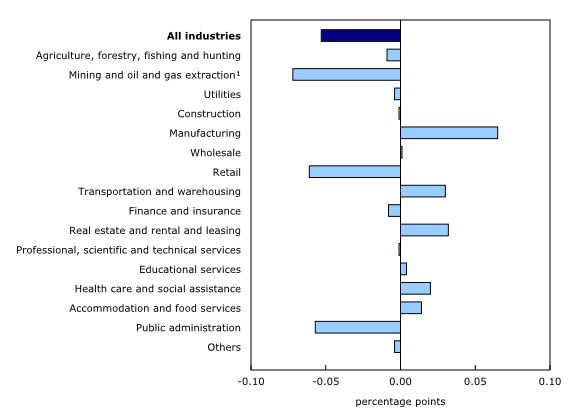
The goods-producing industries edged down in May, driven primarily by a contraction in the mining, quarrying and oil and gas extraction sector, while the manufacturing sector expanded in the month. The services-producing industries were essentially unchanged, as real estate, rental and leasing and transportation and warehousing posted increases while retail trade and public administration contracted. Overall, 7 of 20 industrial sectors expanded in May.
Activity in the manufacturing sector increases in May after contracting in April
The manufacturing sector grew 0.7% in May, partially offsetting April’s 1.8% decline, as higher inventory accumulation largely contributed to the growth. This was the third increase for the sector in five months, with increases recorded in both durable and non-durable goods manufacturing in May. Activity in the manufacturing sector was 1.1% below the March level, the month when US tariffs on Canadian goods officially took effect.
Chart 2
Manufacturing sector rises in May
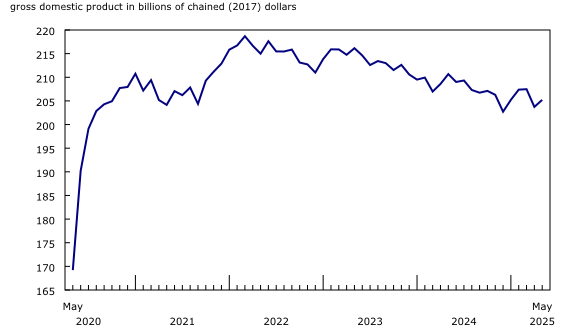
Durable goods manufacturing industries (+1.2%) rose for the fourth time in five months, as 8 of 10 subsectors expanded in May, led by increased activity in the fabricated metal product manufacturing subsector (+2.8%), which rebounded from the previous month’s decline. The machinery manufacturing subsector (-1.7%) tempered the growth in May, posting its fourth decline in five months and bringing activity to its lowest level since March 2022.
Non-durable goods manufacturing industries (+0.2%) increased following two consecutive monthly declines, as activity in most subsectors expanded in May. The chemical manufacturing subsector (+3.2%) led the growth, driven by the pharmaceutical and medicine manufacturing industry (+8.0%) which posted a second consecutive monthly increase. Petroleum refineries (-4.9%) tempered the increase in the non-durable goods manufacturing aggregate in May, since many refining facilities were undergoing maintenance and retooling throughout the month.
Transportation and warehousing up on widespread expansions
Transportation and warehousing increased 0.6% in May, coming off a 0.1% decline in April, as most subsectors expanded in May.
Chart 3
Rail transportation rises in May
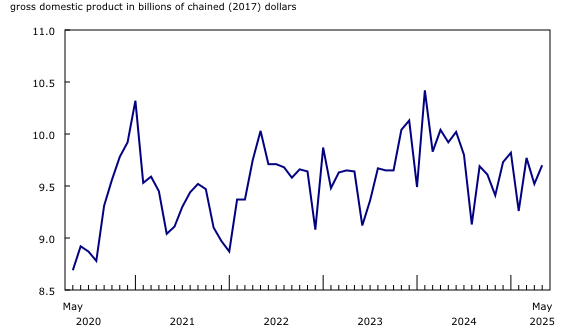
Rail transportation (+1.9%) contributed the most to growth in May as volume and tonnage increased. Intermodal and non-intermodal carloadings increased, after April’s broad-based declines, which were attributed to lower freight movement with US connections.
Pipeline transportation rose 1.3% in May. Higher transportation of crude oil and other pipeline transportation (+1.8%) led the increase following a successful restart to a pipeline that suffered a rupture and a spill in April. Pipeline transportation of natural gas rose 0.9%.
Transit, ground passenger, scenic and sightseeing transportation rose 0.8% in May, more than offsetting the decline recorded in April and driven by an increase in urban transit systems (+1.0%).
Real estate and rental and leasing up on higher activity in home resale market
Real estate and rental and leasing grew for the second consecutive month, rising 0.3% in May.
Activity at the offices of real estate agents and brokers and activities related to real estate (+3.5%) posted a second consecutive increase, reflecting higher home resale activity across the country in May, led by the Greater Toronto Area. The two consecutive increases in the industry partially offset the declines recorded in the previous four months.
Legal services, which derives much of its activity from real estate transactions, rose 0.5% in May.
Retail trade down as lower activity at motor vehicle and parts stores weighs on sales
Chart 4
Retail trade sector contracts in May
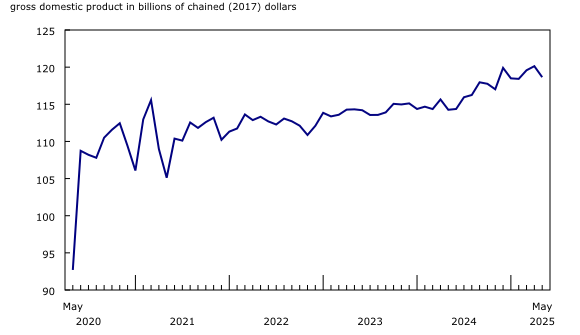
The retail trade sector contracted 1.2% in May, as activity in 7 of 12 subsectors decreased.
Motor vehicle and parts dealers (-4.8%) contributed the most to the monthly decline, reflecting lower activity for new and used car dealers and partially offsetting the increases recorded in the previous two months. The subsector was on an upward trend during most of the second half of 2024. Despite posting its third decline in five months in 2025, the activity in May 2025 was 7.8% above the June 2024 level.
Food and beverage stores (-2.5%) and gasoline stations (-3.1%) further contributed to the decline in retailing activity in May.
Mining, quarrying, and oil and gas extraction sector down
The mining, quarrying and oil and gas extraction sector contracted 1.0%, following two consecutive monthly increases, as most subsectors declined in May.
The mining and quarrying (except oil and gas) subsector was down 2.1% in May, as all industry groups contracted on broad-based declines across the industries.
The oil and gas extraction subsector contracted 0.8% in May, posting its first back-to-back monthly declines since April and May 2023. Oil sands extraction contracted 3.0% in May, driven by lower crude bitumen extraction as well as lower synthetic crude production as several oil extraction and upgrading facilities in Alberta continued maintenance and turnaround work throughout the month. Meanwhile, oil and gas extraction (except oil sands) rose 1.5%, reflecting higher activity in natural gas and crude petroleum extractions.
Public sector down in May, following increased activity in April largely due to the Canadian federal election
The public sector aggregate (comprising educational services, health care and social assistance, and public administration) was down 0.2% in May, following two consecutive monthly increases. The public administration sector (-0.8%) drove the decline in May as federal government public administration (except defence) contracted 3.2%, following the increased activity in April associated with the Canadian federal election.
The health care and social assistance sector rose 0.2% in May, with broad-based increases across all subsectors, while the educational services sector edged up 0.1%.
Arts, entertainment and recreation sector up as three Canadian National Hockey League teams qualify for the second round of the playoffs
The arts, entertainment and recreation sector increased 0.2% in May, a third consecutive increase, driven in large part by performing arts, spectator sports and related industries, and heritage institutions (+1.2%). For the first time since 2004, three Canadian National Hockey League teams qualified for the second round of the playoffs, resulting in a higher than usual number of games taking place in Canada in May and contributing to increased activity in spectators’ sports in the month.
Chart 5
Main industrial sectors’ contribution to the percent change in gross domestic product in May
Advance estimate for real gross domestic product by industry for June 2025
Advance information indicates that real GDP increased 0.1% in June. Increases in retail trade and wholesale trade were partially offset by a decrease in manufacturing. Owing to its preliminary nature, this estimate will be updated on August 29, 2025, with the release of the official GDP by industry data for June.
With this advance estimate for June, information on real GDP by industry suggests that the economy was essentially unchanged in the second quarter of 2025. The official estimate for the second quarter will be available on August 29, 2025, when the official estimate of GDP by income and expenditure is released.
Focus on Canada and the United StatesCanada’s exposure to the US market: Spotlight on chemical manufacturing
The impact of international trade on the Canadian economy can be analyzed using the Value-Added in Exports database, which provides data on the direct and indirect impact of exports on gross domestic product (GDP) and jobs by industry. As described in the document “Value-added exports: measurement framework,” direct impacts refer to the jobs or GDP generated within the exporting industry itself, while indirect impacts pertain to the jobs or GDP created through the demand for the industry’s products by other exporting industries. An industry’s output attributed to foreign demand refers to the jobs and GDP generated through both direct and indirect impact of exports.
For instance, in the steel industry, direct jobs due to exports are those required to produce the industry’s exports. Indirect jobs, on the other hand, are those in the steel industry needed to supply products to the exports of other industries, such as car parts manufacturing and aerospace manufacturing.
The Value-Added in Exports database covers the period from 2007 to 2023 and is derived from the supply and use tables. Due to their comprehensive nature and availability of data sources, these tables are published with a two-year lag.
The manufacturing sector is one of the industrial sectors with the highest exposure to the US market, relying on demand from the United States for 42% of its output and 41% of its workforce in 2023. After primary metal manufacturing and transportation equipment manufacturing, chemical manufacturing was the manufacturing subsector most dependent on exports to the United States, with 38% of its output attributed to direct exports to the United States and 52% of its output (see Table 1) attributed to total demand from the United States. Similarly, 50% of the workforce in the chemical manufacturing subsector was attributed to total demand from the United States.
Within this subsector, the resin, synthetic rubber, and artificial and synthetic fibres and filaments manufacturing and the basic chemical manufacturing industries were by far the industries with the highest reliance on exports to the United States. The resin, synthetic rubber, and artificial and synthetic fibres and filaments manufacturing industry relied on demand from the United States for 77% of its output (see Table 2) and 75% of the industry’s jobs. The basic chemical manufacturing industry relied on demand from the United States for 63% of its output and 60% of the industry’s jobs. In contrast to the resin, synthetic rubber, and artificial and synthetic fibres and filaments manufacturing industry, where reliance on US demand is largely in the form of direct exports (70%), the basic chemical manufacturing industry relied on demand from the United States through a combination of direct exports (35% of output and 36% of employment) and indirect exports (28% of output and 24% of employment) as basic chemical products were also embedded in other exports.
For more data and insights on areas touched by the socio-economic relationship between Canada and the United States, see the Focus on Canada and the United States webpage.
Did you know we have a mobile app?
Download our mobile app and get timely access to data at your fingertips! The StatsCAN app is available for free on the App Store and on Google Play.
Sustainable development goals
On January 1, 2016, the world officially began implementing the 2030 Agenda for Sustainable Development—the United Nations’ transformative plan of action that addresses urgent global challenges over the following 15 years. The plan is based on 17 specific sustainable development goals.
The release on gross domestic product by industry is an example of how Statistics Canada supports monitoring the progress of global sustainable development goals. This release will be used to help measure the following goal:

Note to readers
Monthly data on gross domestic product (GDP) by industry at basic prices are chained volume estimates with 2017 as the reference year. This means that the data for each industry and each aggregate are obtained from a chained volume index multiplied by the industry’s value added in 2017. The monthly data are benchmarked to annually chained Fisher volume indexes of GDP obtained from the constant-price supply and use tables (SUTs) up to the latest SUT year (2021).
For the period starting in January 2022, data are derived by chaining a fixed-weight Laspeyres volume index to the prior period. The fixed weights are the 2021 industry current price estimates.
Statistics Canada also produces expenditure-based GDP estimates at market prices, which are chained quarterly based on a Fisher volume index. Due to conceptual and statistical differences, GDP by industry and GDP by expenditure percent change estimates can diverge slightly.
All data in this release are seasonally adjusted. For information on seasonal adjustment, see Seasonally adjusted data – Frequently asked questions.
An advance estimate of industrial production for June 2025 is available upon request.
For more information on GDP, see the video “What is Gross Domestic Product (GDP)?“
For more information on the impact of tariffs on key economic statistics, please consult: “How tariffs are conceptually reflected in key economic statistics.”
Revisions
Each month, newly available administrative and survey data from various industries in the economy are integrated, resulting in statistical revisions. Updated and revised administrative data (including taxation statistics), new information provided by respondents to industry surveys, and standard changes to seasonal adjustment calculations are incorporated with each release.
With this release of monthly GDP by industry, revisions have been made back to January 2024.
To satisfy the opposing goals for both timeliness and accuracy, Statistics Canada regularly updates (revises) its estimates of GDP. For more information about GDP revision cycles, please consult the “Revisions to Canada’s GDP” article in the Latest Developments in the Canadian Economic Accounts (Catalogue number13-605-X).
Real-time table
Real-time table 36-10-0491-01 will be updated on August 18, 2025.
Next release
Data on real GDP by industry for June 2025 will be released on August 29, including an advance estimate for the July 2025 reference month.
Products
The User Guide: Canadian System of Macroeconomic Accounts (Catalogue number13-606-G) is available.
The Methodological Guide: Canadian System of Macroeconomic Accounts (Catalogue number13-607-X) is also available.
The Economic accounts statistics portal, accessible from the Subjects module of the Statistics Canada website, features an up-to-date portrait of national and provincial economies and their structure.
Contact information
For more information, or to enquire about the concepts, methods or data quality of this release, contact us (toll-free 1-800-263-1136; 514-283-8300; infostats@statcan.gc.ca) or Media Relations (statcan.mediahotline-ligneinfomedias.statcan@statcan.gc.ca).