
Ukrainian air defenses largely impotent against Russian ballistic missiles are increasingly struggling to intercept the latest advanced cruise missile fielded by the Kremlin, data published by Ukraine’s Air Force (UAF) showed.
Less than half of the Iskander-K cruise missiles launched by Russian forces – almost all in overnight strikes against civilian targets in Ukrainian cities – were shot down or rendered ineffective by jamming in recent weeks – Kyiv Post’s review of UAF data for June and July showed.
JOIN US ON TELEGRAM
Follow our coverage of the war on the @Kyivpost_official.
Early on Thursday morning, Russian launched yet another mass missile and drone assault on Ukraine. The attack included eight of the advanced, 8-meter (26-feet) long, two ton weapons from heavy wheeled launchers parked 30-50 kilometers (19-31 miles) from Ukraine’s border, in Russia’s Kursk region.
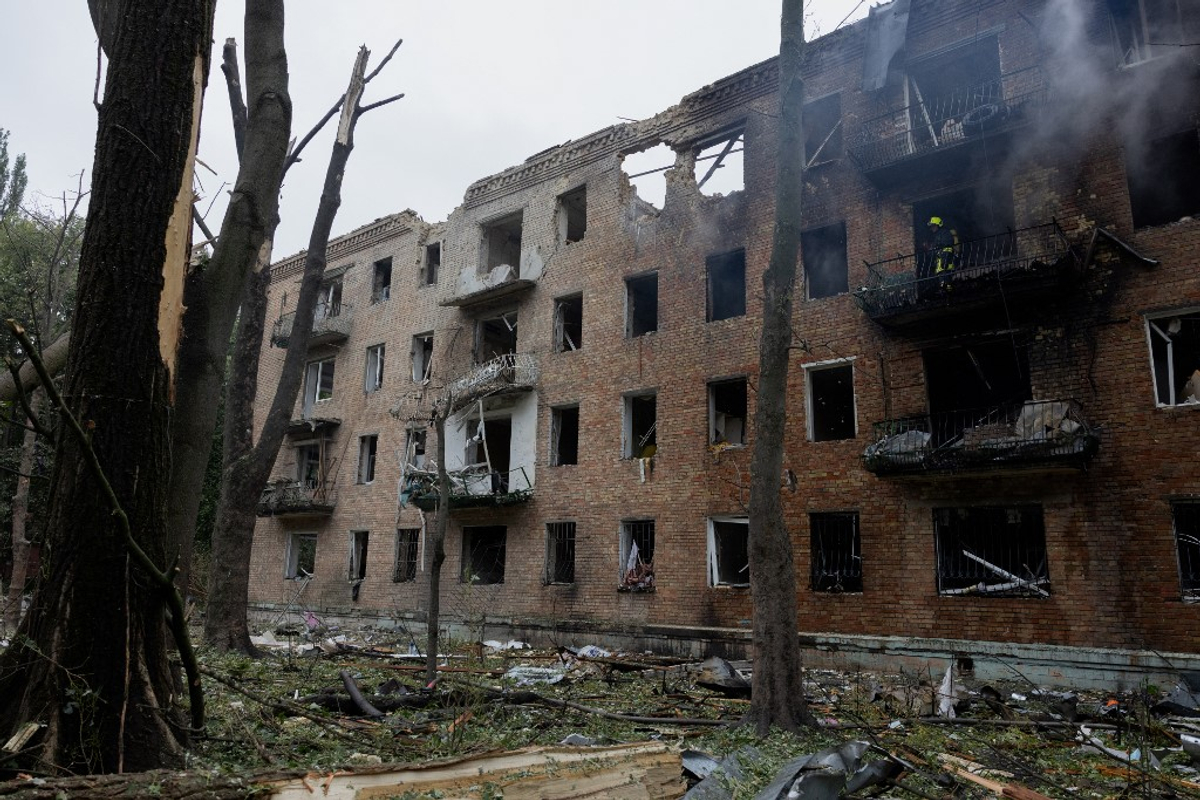
Three of the incoming Iskander-K missiles were shot down but five struck their targets the Ukrainian capital Kyiv, the UAF statement said. It left at least 11 residents dead and dozens more injured, with rescuers still currently digging through the remains of damaged and demolished apartment buildings.
The 28% Ukrainian intercept rate against the Iskander-K highlights a worrying trend for Ukraine’s air defenders and the civilians suffering Russian bombardments. During the previous seven orso weeks Ukraine’s multi-layered air defenses had been able to knock down or spoof incoming Iskander-K missiles two to three times as often.
Other Topics of Interest
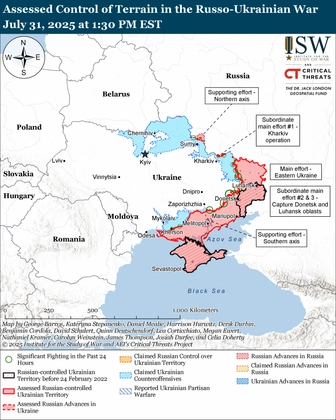
ISW Russian Offensive Campaign Assessment, July 31, 2025
Latest from the Institute for the Study of War.
Over June through to July 21, data revealed that Ukrainian air defenses managed to shoot down more 75% of the weapons fired in nine separate strikes.
In the week July 24-31 shoot-down rates against the Russian missile have plummeted. From a total of 20 incoming Iskander-Ks in three strikes – on July 24, 26 and 31 – no more than 8 were shot down.
Currently during air attacks on Ukraine, Russia typically mixes one to three dozen missiles of various types with one to five hundred kamikaze drones in a bid to overwhelm Ukrainian air defenses.
Since the war began Ukraine has struggled to intercept, Russian, North Korean and Iranian ballistic missiles which fly in a high-altitude parabola before approaching their targets at hypersonic speeds.
Russian ballistic missile strikes against Ukraine have been aided by US embargoes on arms deliveries to Ukraine, which have limited supplies of the US-made Patriot missile, the only interceptor in Ukraine’s inventory that can shoot down a ballistic missile.
Russian cruise missiles compared to a ballistic missile are easier for Ukrainian air defenses to knock out because they fly at altitudes within the range of most air defenses at less than the speed of sound.
The Iskander-K is a flagship Russian strike weapon. Launched from an 8-wheel truck-mounted launcher, it is designed to penetrate air defenses using nap-of-the-earth flight, electronic countermeasures, radar-absorbent construction materials, autonomous navigation, and satellite data links. It carries, depending on the mission, a powerful 480-700-kilogram (1,000-1,500-pound) warhead.
The same truck platform can also be used to fire the 9K720 Iskander-M (NATO: SS-26 Stone) ballistic missile.
According to the British Royal United Services Institute (RUSI), the cruise missile version of the Iskander can fly below most radars at 50 meters (160 feet) above the ground and, when around 20 kilometers (12.5 miles) from its intended target, its on-board radar starts searching for a pre-programmed target. If the on-board satellite receiver is used for targeting, the missile is highly accurate and capable of striking within 1-3 meters of its target.
To engage enemy cruise missiles, Ukraine’s air defenses rely on a mix of man-portable air defense (MANPAD) missiles vehicle-mounted automatic cannons and fighter aircraft. Less sophisticated cruise missiles fired by Russia have, over the course of the war, been relatively easy for Ukrainian gunners to take out – AFU data over the past 12 months showed a near 100 percent success rate against Russia’s older Kaliber ship-launched cruise missile.
According to Ukrainian military intelligence, Russia is using Western and Chinese components to manufacture as many as 70 Iskander-K missiles each month.
The most effective weapons used by Ukraine to take on both old and new cruise missiles have been the state-of-the-art German IRIS-T and US-Norwegian NASMS air defense missiles, as well as the theoretically obsolete US-made HAWK system.
Responsible for protecting an air space roughly the size of France, Ukrainian air defenders say they don’t have enough systems to prevent Russian strikes from finding and exploiting gaps in their defenses.
According to open sources Ukraine has only received around five NASAMS from 13 promised by Kyiv’s allies and seven (four medium-range and three short-range) IRIS-Ts out of 24 pledged.
Ukrainian news reports say that Spain, the US, Taiwan and Sweden have handed over around 15 HAWK Systems as donations with Washington offering to sell Ukraine old HAWK systems for $172 million on July 23 – subject to final approval.
Ukrainian President Volodymyr Zelensky has said that the most important arms support Ukraine needs from the US, is air defense systems. The US unilaterally stopped arms transfers, included air defenses, to Ukraine on three occasions: from December 2023-May 2024, in February 2025 for several days, and in March 2025 for more than a week.