
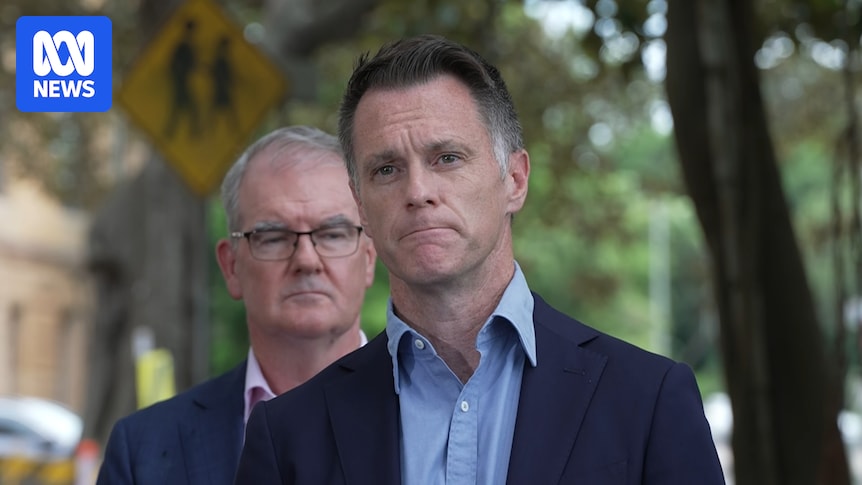
On Wednesday evening, as Sydneysiders paid their respects to the Bondi terror victims, one moment captured the contrast between two Labor leaders and their perceived responses to antisemitism.
NSW Premier Chris Minns sat next to Prime Minister Anthony Albanese on the steps of St Mary’s Cathedral, both clapping at various points during an impassioned speech by the leader of Australia’s oldest synagogue.
Tune into ABC News special coverage on ABCTV and News Channel from 6pm AEDT as the nation honours the victims of the Bondi terror attacks.
But there was one part of the address by Rabbi Benjamin Elton, the head of the Great Synagogue, the PM did not applaud.
“Over the past two years, antisemitism in Australia has run riot,” Elton told the interfaith service.
“It has not been checked. It has not been stopped. Whatever has been done has been insufficient.”
The crowd burst into applause, the premier joining in. Albanese’s hands, however, remained clasped on his lap.
Those few seconds of body language did not go unnoticed by a community in agony, symbolising what has been regarded as inaction on antisemitism.
That same day, Minns attended the funeral of Rabbi Eli Schlanger, the first service to be held after Sunday’s attack. Former prime minister Scott Morrison was there. The current prime minister was not invited.
The premier has now been to the funerals of eight victims. Albanese is yet to attend a single one, saying on Wednesday he would not show up to funerals unless invited.
Loading…Minns quick to respond
Admission of failure to do enough to protect Jews from antisemitic violence came much earlier from the state leader.
On Monday night, 24 hours after the massacre, Minns told 7.30 his government should have done more to prevent the attack.
“I’m sure if we had our time again, we would have responded differently,” he said.
On Thursday, Albanese expressed contrition, telling reporters he was “not perfect”, as he announced tougher hate speech laws.
“I have done my best to respond … anyone in this position would regret not doing more, and any inadequacies which are there,” Albanese said.
Minns is ultimately responsible for the police force whose response to and precautions against the mass shooting have drawn criticism.
And it was his police force which authorised a Neo-Nazi rally outside the NSW parliament in November.
Yet when the premier acknowledged his failures at the Central Synagogue on Thursday night, he received standing ovations.
“The first duty of any state is to protect its citizens. The sad reality for me and our state is we didn’t do that. And I bear a deep responsibility for that as premier,” Minns told the memorial service.
So far, only the NSW parliament has been recalled, despite calls for the federal government to do the same.
The premier is determined to pass the nation’s toughest gun laws and restrictions on mass protests before Christmas.
On Saturday, Minns called for a royal commission into the attack.
Albanese said he would support “whatever actions” the state government took but did not commit to establishing a public inquiry at a national level.
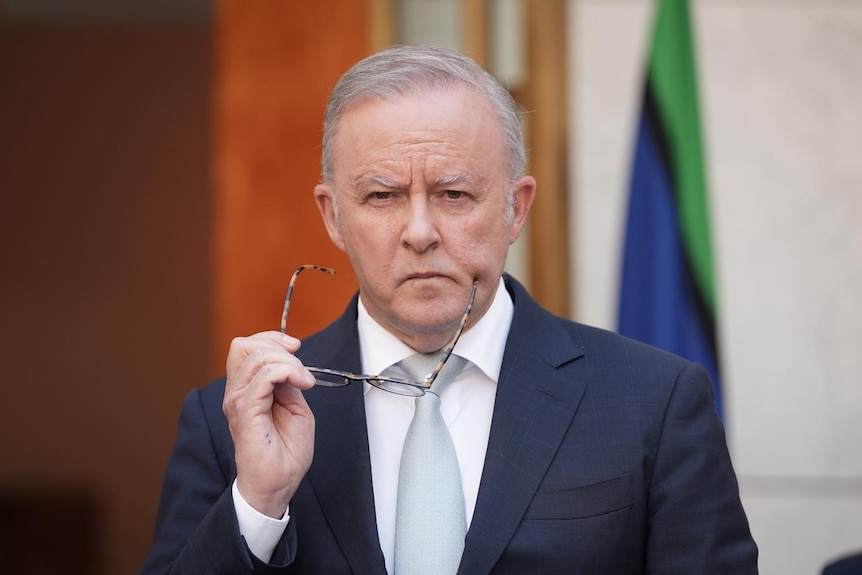
On Thursday, Anthony Albanese expressed contrition, telling reporters he was “not perfect”. (ABC News: Matt Roberts)
Thawing towards Albanese
Putting aside the leaders’ actions following the tragedy, it is unsurprising the premier has had a better reception this week.
Minns, from the Labor’s right faction, has long enjoyed a warm relationship with the Jewish community.
Read more on the Bondi Beach shooting:
He has staunchly opposed rallies against Israel’s war in Gaza, including the pro-Palestine march across the Sydney Harbour Bridge, which some of his own MPs attended.
In the wake of antisemitic graffiti and arson attacks last summer (some of which were later linked to organised crime and Iranian interference), he introduced a raft of reforms including restricting protests near synagogues.
In May, Israeli president Isaac Herzog praised Minns’s “outstanding leadership” on tackling antisemitism, in a letter read at a community event, according to a report by the Australian Jewish News.
By contrast, Albanese, from Labor’s left, has been accused of weakness by Israeli Prime Minister Benjamin Netanyahu, who on Monday said Australia’s recognition of a Palestinian state had fuelled antisemitism.
The Australian PM also faced criticism for being too slow to adopt recommendations made six months ago by antisemitism envoy Jillian Segal.
Friday night appeared to mark a thawing of relations between Albanese and the Jewish community. He donned a kippah and attended a service at the Great Synagogue where he received gifts, including bread baked as part of Hanukkah celebrations.
“It was very positive,” Albanese said on Saturday.
But he cannot expect applause from the Jewish community until his words are followed by action.