
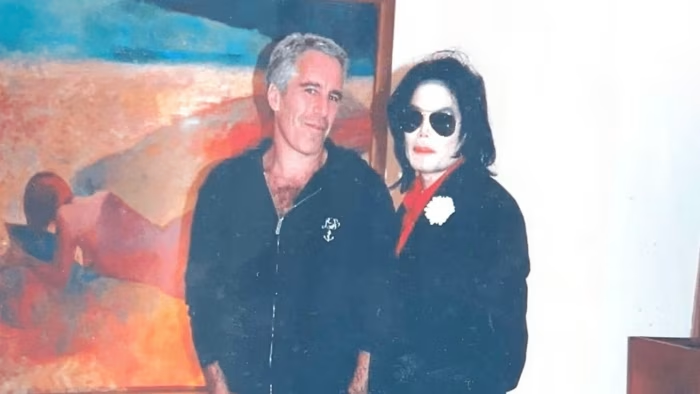
The US Department of Justice has published a limited cache of heavily redacted documents relating to the late child sex offender Jeffrey Epstein, partially fulfilling a congressional order to release the files.
The partial release on Friday appeared to contravene the US Congress’s requirement for the DoJ to release all its documents, drawing criticism from some legislators.
The documents that were released include images of high-profile men such as former president Bill Clinton, Andrew Mountbatten-Windsor, formerly Prince Andrew, Virgin founder Richard Branson and Donald Trump as well as testimony given to FBI investigators.
One picture shows a desk covered in framed photos of Epstein and famous people, including Pope John Paul II. A photograph of Trump appears in the desk drawer.
 Photos of Epstein with famous people from Friday’s release (Image supplied by the DoJ)
The limited disclosures, published on the department’s website on Friday, mark the latest chapter in a saga that has ignited a political firestorm on both sides of the Atlantic amid questions about Epstein’s ties to rich and powerful figures, from the US president to British politician Peter Mandelson.
Trump did not comment on the documents’ publication on Friday and declined to take questions from reporters at a White House event shortly before the files were released.
 Epstein and Ghislaine Maxwell (Image supplied by the DoJ)
“I really don’t want to soil it up by asking questions, even questions that are very fair questions that I’d love to answer,” he said. Trump did not mention Epstein at a rally later in the evening.
The DoJ’s limited and heavily redacted disclosures are unlikely to silence critics who have accused the administration of blocking information about the Epstein case.
Deputy attorney-general Todd Blanche on Friday acknowledged that the DoJ would not release all its materials right away — as the law enacted last month required — saying more files would be made public “over the next couple of weeks”.
While Blanche had discussed releasing “several hundred thousand” items, the release was only of 4,101 documents and covered 9,675 pages. More than 3,800 of the documents released were photographs or albums. The joint-largest item, 119 pages long, was entirely redacted save for the words “Grand Jury-NY”.
 Former US president Bill Clinton (Image supplied by the DoJ)
The release included several pictures of Clinton, including one undated photograph of him in what appears to be a hot tub. Another showed Clinton in a swimming pool with a woman whose face had been redacted and Ghislaine Maxwell, Epstein’s one-time girlfriend who is serving a 20-year prison sentence for child sex-trafficking offences.
There was no suggestion that those pictured in the latest images had committed any wrongdoing.
A spokesperson for Clinton accused the White House of “shielding themselves from whatever comes next”.
“There are two types of people here. The first group knew nothing and cut Epstein off before his crimes came to light,” Angel Ureña said in a statement. “The second group continued relationships with him after. We’re in the first.”
 Maxwell and Clinton (Image supplied by the DoJ)
“Everyone, especially Maga, expects answers, not scapegoats,” Ureña added.
Friday’s release came a day after Democratic legislators published a new batch of photographs from the Epstein estate, showing prominent figures such as Bill Gates and Sergey Brin. The House oversight committee is running its own investigation into Epstein, separate from the DoJ.
Trump and allies had angered parts of his Maga base for months by seeking to block the release of the DoJ’s files, which include evidence gathered during multiple criminal and civil investigations into Epstein and his associates.
 Redacted documents released by the Department of Justice © Mandel Ngan/AFP/Getty Images
But a bipartisan vote in Congress last month compelled the justice department to publish its files. The president signed the measure into law on November 19.
The legislation gave US attorney-general Pam Bondi 30 days to hand over the materials but allowed the department to withhold files that could jeopardise active federal investigations or pose national security concerns. Friday was the deadline.
Democrats criticised the DoJ’s decision to hold back material and redact many documents. Chuck Schumer, the party’s Senate leader, said Friday’s release was “a fraction” of the evidence. “Simply releasing a mountain of blacked-out pages violates the spirit of transparency and the letter of the law.”
 A bin marked ‘JE Personal’, folders and redacted photos (Image supplied by the DoJ)
White House officials said the redactions were designed to protect sex- trafficking victims.
“Why do the sickos in the liberal media want a document called ‘masseuse list’, which was clearly redacted to protect victims, to be public?” Abigail Jackson, a White House spokesperson, said on X, referring to one blacked- out file.
In a letter to lawmakers, dated Friday and obtained by the FT, Blanche said more than 200 DoJ lawyers had been involved in vetting the materials. The DoJ had identified “over 1,200” people who were either victims, or relatives of victims, whose names needed to be redacted, he wrote.
The justice department would continue to publish materials “on a rolling basis” but he anticipated that the review would be completed “over the next two weeks”.
Questions remain about Trump’s links to Epstein, who was found dead in his jail cell in 2019 while he was awaiting trial on federal sex-trafficking charges.
Trump has acknowledged he and Epstein were once friends but said they had a falling out more than two decades ago. He has vehemently denied any involvement in Epstein’s criminal activities.
Recommended

Last month, the House oversight committee published thousands of Epstein estate documents, including a 2011 email in which he said Trump “spent hours at my house” with a woman later identified as a victim of sex trafficking.
Undated photographs published last week by House Democrats showed images of Trump, who appeared alongside the financier in one image.
The president told reporters there were “hundreds and hundreds of people that have photos with him”. A White House spokesperson accused Democrats of publishing “cherry-picked photos with random redactions to try and create a false narrative”.