
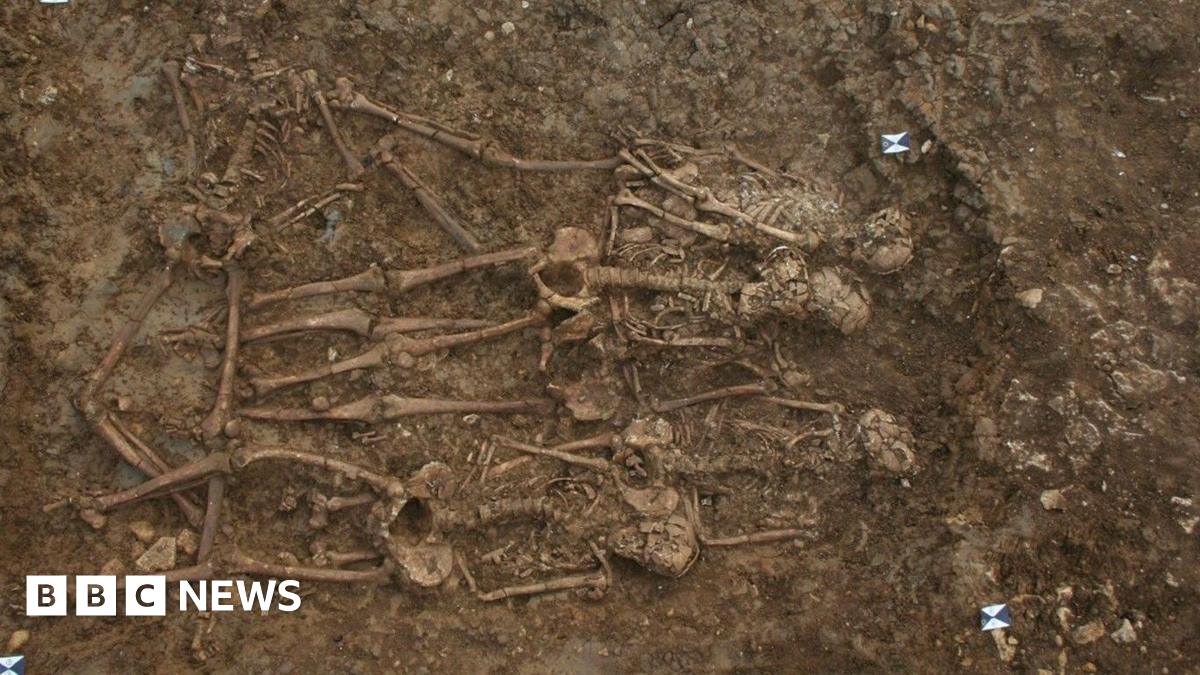
Buckinghamshire Council said the latest report confirmed that at least 73 individual bodies have been found across 34 graves.
No clear order or layout has been discovered with most burials laid in a traditional east-west position.
Twenty-six skeletons were found with their hands tied behind their backs.
The burials were predominantly of adult males, with some juveniles and adolescents, but no females were identified.
Further analysis revealed signs of childhood stress, healed fractures, and diseases such as tuberculosis.
Only a small number of artefacts were found at the site, suggesting valuables were removed before burial.
Two buckles were recovered, one dating to the late Roman period and one dating to the post-medieval period.
Carbon dating of one skeleton provided a date in the late 13th Century, according to Buckinghamshire Council’s archaeology team.
It said that the unusual layout, lack of grave goods, and evidence of bound hands strongly suggested the site was an execution cemetery – a rare type of burial ground historically used for criminals.
These sites, often located on parish boundaries, represent a marginalised sector of medieval society.
Post-excavation analysis will now be undertaken and the results published to ensure a proper record of the discovery is made.
Further research will continue to enhance understanding of the site, the individuals buried there, and life in Buckinghamshire during the Saxon and medieval periods.