

When Israel’s Knesset met in early December to consider legislation that would reintroduce the death penalty, supporters arrived wearing golden lapel pins (new window) in the shape of a hangman’s noose.
They’re a dark twist on the yellow ribbons many Israelis wear in support and solidarity of those captured and held hostage in Gaza after the attacks on Oct. 7, 2023.
Terrorists deserve death, said National Security Minister Itamar Ben-Gvir as he arrived with the other members of the small, far-right party that’s driving the bill through the legislature with the full support of Prime Minister Benjamin Netanyahu.
Given the ethical and moral considerations surrounding capital punishment, such a proposal almost anywhere in the world would be inherently contentious. But the new Israeli legislation, which has already passed first reading, is also explicitly and deliberately discriminatory.
It calls for a mandatory death sentence for any Palestinian who kills a Jewish Israeli citizen — but not for Jews who kill Palestinians.
There is no such thing as a Jewish terrorist, said Limor Son Har-Melech, of the far-right Otzma Yehudit party, as she and the other noose-wearing supporters insisted the measure will deter militant attacks.
As written, the proposed law would apply to individuals convicted of murder motivated by hatred towards the public, where the act was committed with the intent to harm the State of Israel and the rebirth of the Jewish nation.
And it would apply anywhere that Israel controls, including the occupied West Bank and, currently, half of Gaza.
Crucially, the bill (new window) would also eliminate any discretion judges have at sentencing — the death penalty would be the only punishment available, and therefore mandatory.

A close-up of the noose lapel pin worn by far right members of the Israeli Knesset to hearings on the proposed death penalty bill. (Office of Itamar Ben-Gvir)
Photo: (Office of Itamar Ben-Gvir)
Called deeply racist
Civil liberty advocates and human rights groups have eviscerated the proposed legislation, calling it deeply racist. And some fear its provisions could be made retroactive to cover Palestinian prisoners — an estimated 9,000 people, according to Palestinian prisoners’ groups — already in Israeli jails.
There are hundreds of prisoners from the October 7th massacres that are held in Israel, and I think this law is about targeting and doing mass executions of them, said Noa Sattath, executive director of the Association for Civil Rights in Israel.
It’s a celebration of death and revenge and brutality, which is the essence of this law.
The push for the legislation comes during a repeatedly broken ceasefire in Gaza, following two years of war that has left most of the territory unlivable for its civilian population and split in half — one controlled by Israel, the other by Hamas.
And it comes amid the chance that Israel’s coalition government may be facing elections in 2026.
Though Ben-Gvir has multiple convictions in Israel for inciting racism against Palestinians and for glorifying violence against Arabs — and is one of the country’s most toxic political figures — his capital punishment bill has supporters beyond his party’s far-right base.
Many Knesset members supporting the bill argue if Palestinians are sentenced to death, they won’t be released later in prisoner swaps and could not commit potential future offences.
No more ‘nice payments’
A group promoting the proposed legislation is, ironically, called Choosing Life — something one of its members, Dan Lando, says is meant to remind any militant planning an attack that they should reconsider, given the consequence of the death penalty.
Israel is going to show these terrorists we are taking it seriously, said the 77-year-old retired aerospace engineer, who, while disagreeing with the vulgarity of Ben-Gvir’s golden nooses, nonetheless supports the thrust of the legislation.
If they go out with a knife or with a gun and intend to kill somebody, they will not get nice payments from the Palestinian Authority, they will get sentenced to death.
For decades, the Palestinian Authority has paid benefits to the families of Palestinians held in Israeli jails for security offences or those who are killed in attacks on Israelis.
Israel has long viewed the practice as incentivizing terrorism, while Palestinians see it as a social safety net (new window) for families of those who have endured brutality and long detentions, often without charges or trials, under decades of Israeli occupation.
Recently, the Palestinian Authority announced it has abolished the payments.
Lando’s distaste for the practice has a personal connection. In 2017, his son-in-law, Elad Solomon, was one of three Israelis stabbed to death in the settlement of Halamish, or Neve Tzuf, in the Occupied West Bank, where Israeli settlements are considered illegal under international law and continue to be a source of conflict.
Lando’s daughter and three grandchildren survived the attack by a 19-year-old Palestinian man by barricading themselves inside a room, until an off-duty soldier shot the attacker through a window.
WATCH | Canadian injured while helping Palestinians in occupied West Bank:
Début du widget . Passer le widget?
Fin du widget . Retour au début du widget?
Canadian beaten during attack in West Bank
A Canadian was among four international volunteers who were beaten and had their passports stolen during an attack in the West Bank. The activists were part of a group trying to help Palestinians during a rise in settler violence.
The man survived and was sentenced to four life terms in prison.
The incident received extensive media coverage in Israel, including widespread condemnation that the attacker and his family stood to receive millions of dollars in support payments from the Palestinian Authority.
A double standard
When asked about the double standard of not including Jews who kill Palestinians in the proposed death penalty legislation, Lando said there is no pandemic of Jews killing Palestinians.
The Israeli government puts into jail Jews who kill Palestinians, he said. So I think there is justification to say only Palestinian terrorists will be executed.
Both of those assertions — that it’s unusual for a Jew to kill a Palestinian and that those who do are jailed for the crime — are blatantly false.
In Gaza, the Hamas-run health ministry says the Israeli offensive following the Oct. 7, 2023, attacks has killed more than 70,000 people, including 20,000 children (new window), with the UN describing Israel’s actions as amounting to genocide. Since the ceasefire brokered in October, nearly 400 other Palestinians have been killed.
In the occupied West Bank, the violence instigated by Jewish settlers or carried out by Israeli security services against Palestinians has also reached unprecedented levels.
‘We are killed everywhere, every day’
In the last two years, 999 Palestinians have been killed (new window) in the occupied West Bank, according to UN figures (new window); of those, 20 were murdered by Israeli civilians. In a further 12 cases, the agency says it’s unknown whether the perpetrators were members of Israel’s military or settlers.
Israeli human rights group B’Tselem (new window) says no Jewish perpetrators were convicted in any of those killings — and it suggests that Israel’s government effectively condones and encourages violence by giving settlers immunity for these crimes.
Additionally, human rights groups say almost 100 Palestinian prisoners have either been tortured to death or were killed while being held in Israeli jails.
We are killed everywhere, every day, without any reason, said Qaddura Fares, a former minister for detainees with the Palestinian Authority, saying that the death penalty is simply another tool for Israel to kill another 40 or 50 Palestinians each year.
The only difference is that instead of being killed by shooting or by a settler … it will come from the courts.
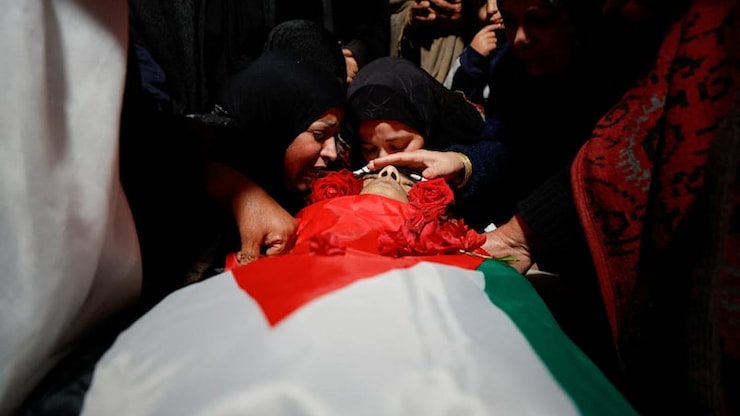
Sameeha Sabbah, mother of 16-year-old Palestinian Ammar Sabbah, who was killed by Israeli soldiers in a West Bank raid, reacts next to her son’s body during his funeral near Bethlehem in the Israeli-occupied West Bank, on Tuesday. (Mussa Qawasma/Reuters)
Photo: (Mussa Qawasma/Reuters)
The vast majority of Palestinians being held in Israeli jails are so-called administrative detainees, according to prisoners’ groups. Israeli law allows security services to hold Palestinians without charge or conviction for months. Only in very rare cases (new window) have Jews have been held under the law.
Law risks Israel’s isolation
Still, Fares said he believes some of the less extreme members of Netanyahu’s coalition may ultimately block the death penalty measure from becoming law — not to spare Palestinians but out of concern it could exacerbate Israel’s already significant diplomatic isolation.
While some far-right members of the Knesset may see political advantage in pushing the death penalty, he said others may conclude the risks outweigh potential gains.
The legislation is being reworked and rewritten in a Knesset committee.
A new version of the bill may emerge, but Sattath, the Israeli civil rights advocate, says she believes any new draft will still exempt Jews.
The last execution in Israel was Adolf Eichmann, one of the architects of the Nazi Holocaust during the Second World War.
He was captured in Argentina and brought back to Jerusalem for a trial, and he was hanged in 1962. The draft legislation contains no mention of the means of execution — although some Israeli publications (new window) speculate that lawmakers are poised to agree on lethal injection, not hanging, should the law be ratified by a simple majority of the Knesset’s 120 members, something that could happen as early as January.
Chris Brown (new window) · CBC News