
PARIS — In Suwayda, little remains as it was when residents of the Druze-majority southern province celebrated the end of the Assad regime last December. A year of false starts, bloodshed, shifting balances of power and foreign intervention has produced a complicated landscape, one in which the voices calling for secession and self-rule are growing louder.
Balances of religious and traditional power that held sway in Suwayda for decades have disintegrated, giving birth to something new, while the province has shed the neutrality it once maintained throughout years of revolution and war.
For the first several months after Assad fell, relations between Suwayda and the new authorities in Damascus were a fraught push and pull, as a series of attempted political and security agreements broke down. In July, everything changed with an explosion of violence marked by sectarian killings and the displacement of Druze and Bedouin residents of the province.
In response—led by Druze spiritual leader Sheikh Hikmat al-Hijri and factions loyal to him and bolstered by vows of protection from neighboring Israel—the province has staked out a position in sharp opposition to Damascus.
Today, Suwayda stands at a crossroads, caught between calls for secession and lackluster attempts to bridge a deep rift that has opened not only with the authorities in Damascus, but with other parts of Syria.
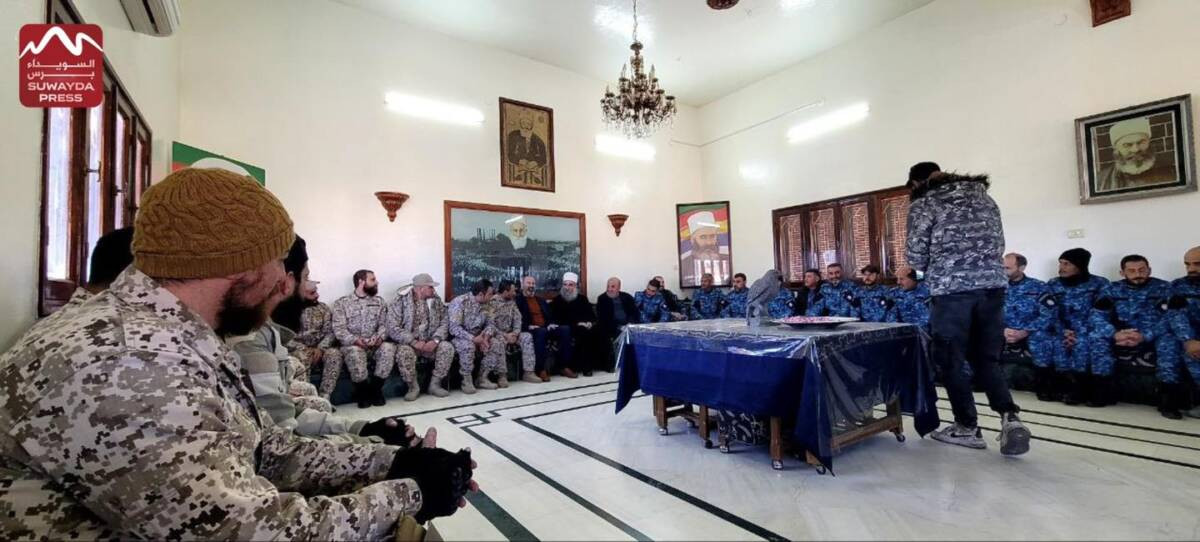
Al-Hijri has been able to neutralize the other two top Druze spiritual authorities, Sheikhs of Reason Yousef Jerboa and Hamoud al-Hanawi. Suwayda’s military factions are united within a single military body aligned with al-Hijri, known as the National Guard.
Over the past months, al-Hijri’s statements have been a central factor shaping the course of events. While it took years for the sheikh to openly oppose Bashar al-Assad, he was swift to take an adversarial stance towards the new administration in Damascus, led by President Ahmad al-Sharaa.
As early as mid-March, three months after Assad fell, al-Hijri was clear: “No understanding or agreement with the government in Damascus,” he vowed, calling it an “extremist government” in the first of a series of sharply-worded statements directed at the new authorities.
But while al-Hijri’s stance played a key role in shaping the landscape in Suwayda, the bloodshed four months later was the pivotal event that complicated the local political and security landscape and produced calls for independence and autonomy.
The July clashes and killings left 1,013 dead and 900 injured, a toll that includes Druze and Bedouin civilians and fighters from armed groups on both sides, as well as government-affiliated security forces.
What changed in Suwayda over the first year after Assad fell? What factors paved the way for secession to be put forward as an option?
What happened in Suwayda?
On December 11, 2024, three days after Assad fell, a group of retired officers and defectors in Suwayda announced a new military formation: the Suwayda Military Council. The group was marginal until February 2025, when it changed its logo and branding in a way that resembled that of the Manbij Military Council and the Asayish, bodies affiliated with the Syrian Democratic Forces (SDF) in northeastern Syria.
The next day, the first local military groups in Suwayda began to join the council, which soon swelled to become one of the largest formations in the southern province. Today, the Suwayda Military Council forms the backbone of the Suwayda National Guard, formed on August 23. The umbrella group includes all military factions in the province, and follows al-Hijri’s guidance.
On February 24, the Suwayda Military Council adopted the idea of a “secular, decentralized state” in a statement released during a military parade in al-Ghariya, a Suwayda countryside village near the border with Jordan. Not long afterwards, it escalated its stance towards Damascus, accusing then-unaffiliated Druze military groups on March 5 of providing assistance to Hayat Tahrir al-Sham [HTS]” by bringing government forces into the province “without coordinating with the military council, civil society or religious authorities.”
HTS is the faction al-Sharaa led in Idlib, which was formally dissolved after the Assad regime fell and now forms the backbone of Syria’s new government.
In its statement at the time, the council condemned “these actions,” emphasized its rejection of “the de facto authority in Damascus” and warned that any “attempt to impose de facto authority over the land and people of Suwayda will have dire consequences and threaten civil peace.”
Still, efforts aimed at integrating with the new state continued for a time. Up until mid-July, the Damascus government and the Sheikhs of Reason in Suwayda—including al-Hijri—had signed at least three security agreements. These included a May agreement on a decentralized security approach that was signed by the Sheikhs of Reason, as well as traditional social leaders and the Syrian government.
That agreement stipulated that the Ministry of Interior’s General Security—today known as the Internal Security Forces—would not enter Suwayda, and that the judicial police would be limited to “sons of Suwayda, in coordination with the three Sheikhs of Reason, the governor and the Ministry of Interior.”
The May agreement went into effect and police officers from Suwayda were deployed, but al-Hijri publicly rejected the deal, as he had done in response to earlier agreements.
Then, on July 14, Syrian government forces deployed to Suwayda province in what Damascus said was an effort to quell clashes that broke out the day before between local Druze and Bedouins. Many in the province saw the move as an attempt to forcibly bring the province under state control.
Far from bringing security, the intervention touched off new fighting, as local Druze forces battled government forces and their allies, who included tribal Bedouin fighters. At this stage, during heavy clashes in Suwayda city and beyond, Damascus-aligned forces carried out sectarian killings of Druze civilians.
In response, Israel intervened, bombing government forces and the Syrian Ministry of Defense and forcing a withdrawal. When government forces pulled out, they left a trail of destruction behind: burned and looted homes, and bodies in the streets. Druze forces immediately retaliated with a new wave of sectarian attacks, killing and displacing Bedouin civilians and burning their homes. Tribal forces from around Syria mobilized in response, flowing into Suwayda unimpeded for a new round of fighting.
On July 19, an internationally sponsored ceasefire agreement ended the immediate violence. The deal included the evacuation of hundreds of Bedouin families from Suwayda to neighboring provinces. Over the months since, Suwayda has experienced a “fragile calm,” punctuated by regular ceasefire violations and increasing calls for the province to secede.
“Damascus has politically isolated Suwayda. It has not been represented in any of the transitional working committees,” Mohib Salha, a writer and academic from the province, told Syria Direct. Additionally, it “refused to appoint a governor of Suwayda from its own people, instead appointing governors from other provinces.
“The government signed the February agreement with Suwayda’s factions—including a faction affiliated with al-Hijri—and he withdrew from it. Then the May agreement was signed and it failed,” Salha said. “No one told us what caused them to fail, but both addressed the issue of weapons and integrating Suwayda into the state.”
Suwayda on the anniversary of the fall
As Syrian cities marked the first anniversary of the fall of the Assad regime earlier this month, there was no sign of celebration in Suwayda, as was the case in SDF-controlled parts of northeastern Syria.
“Suwayda is going through worse conditions than in the days of Assad. Electricity comes for half an hour, compared to six hours, while the internet is poor, prices are obscene and salaries are low,” Maarouf Salem (a pseudonym), a civil society activist living in the Suwayda countryside, told Syria Direct on condition of anonymity for safety reasons.
“Suwayda experienced great joy at the fall of the regime last year, but it was not long before the situation between Suwayda and Damascus soured,” Salem added.
While economic burdens and high prices are affecting all of Syria, the situation in Suwayda is particularly “severe” given the restricted entry of goods and the province’s “isolation” since July, Salem explained. “A family needs between $250 and $350 a month as a minimum to get by, compared to $200 in Assad’s time.”
“The Assad regime has not fallen in Suwayda, because the province is at the mercy of military security gangs and drug traffickers,” one journalist living in Suwayda city told Syria Direct on condition of anonymity. Still, responsibility falls with the Syrian government, he added, which “failed to deal with the crisis, while military security and drug gangs succeeded in hijacking Suwayda and isolating it from the rest of Syria.”
Over the past year, “the province has been transformed by unprecedented transformations that touched the centers of religious and social power, prompting the emergence of a discourse of separatism and self-determination as a reaction to deep feelings of betrayal and the collapse of the political contract promised to Syrians after Assad fell,” Shaqiq Amer, a psychiatrist and activist from Suwayda, said from his residence in Germany.
“The old balance of power in Suwayda has collapsed,” he added. “At the level of religious authority, Sheikh al-Hijri’s role has strengthened in an unprecedented way. [He] has turned from a religious reference to a socio-political authority representing the voice of the province in confrontation with the new authority in Damascus.”
“People’s trust [in al-Hijri] resulted from his firm position refusing to relinquish weapons without a clear political contract that guarantees the future of the mountain [Jabal al-Arab] and the rights of all Syrians,” Amer said.
Al-Hijri’s “position is more clear and steadfast,” Amer said. “He rejected any authority that categorizes Syrians by religion, refused to hand over weapons without constitutional and civil guarantees, openly expressed gratitude to the countries that prevented genocide [in July] and gained [both] internal respect and international support.” These positions “were not merely reactions, but a transformation of religious leadership into moral and political leadership.”
For the journalist in Suwayda, the “division of the Druze religious establishment” was clear as early as March. “Sheikhs of Reason Yousef Jerboa and Hamoud al-Hanawi aligned with the state, while Sheikh Hikmat al-Hijri categorically rejected the new government.”
“The Syrian government helped al-Hijri marginalize al-Hanawi and Jerboa, who had great popularity and political and military strength in Suwayda, with its attack in July,” activist Salem added. As a result, “al-Hijri became the final authority, while their positions were weakened.”
“Before the invasion, 95 percent of people in Suwayda supported the state. After, all the popularity shifted to al-Hijri,” Salem said.
Changes to the balance of power within Suwayda extended to military factions and the local social structure as well, as “a kind of internal sorting took place,” Amer said. He characterized it as “widespread popular support for the stance rejecting submission to a new central authority based on a single religious reference, and the emergence of a major role for youth, local factions and the new National Guard.”
The province also saw an “intellectual shift, as society moved from a discourse of demanding reform to one of protecting its existence,” he added. “This is a profound change that has left the idea of secession or self-determination open for discussion, not taboo as it was before.”
“Sheikh al-Hijri managed to bring the factions in Suwayda under his authority within the National Guard,” in place of the different military currents the province previously contained, the journalist in Suwayda said. He also “succeeded in sidelining the leader of the Men of Dignity movement, Sheikh Abu Hassan Yahya al-Hajjar, in a military coup, appointing Abu Diab Mazid Khaddaj—a figure close to al-Hijri—as its leader, bringing the largest military faction under his control.”
Consolidating power in this manner would not have been possible, he added, “without the Syrian government’s failure to manage the Suwayda crisis.”
The problem, as the journalist sees it, is that “the government is not fighting al-Hijri and the drug and weapons gangs in Suwayda, but rather the people, through their daily sustenance and basic services,” he said. “I believe al-Hijri and the gangs have satellite internet, solar power networks and money—they do not need government services, unlike me and others who struggle for our daily bread. It is as if we are the enemies of the state.”
The longstanding nonviolent protest movement based in Suwayda city’s downtown al-Karama Square, known as the hirak, which began in the last years of the Assad regime, “was raising slogans against federalism and secession after it fell,” activist Salem said. “We rejected separatism before July 15. After this date, the Syrian government is the one that has helped Israel be a protector of the Druze.”
“The vast majority of Suwayda residents today view Israel as a protector,” Salem added. ‘They say it defended us from our own government.”
‘The government has not extended its hand’
Five months have passed since the July violence, and “the government has not extended its hand to Suwayda, has not built bridges of trust with its people,” activist Salem said. “Every day, state media talks about al-Hijri’s gangs,” he added. “Suwayda is not al-Hijri’s gangs, and cannot be reduced to anyone’s gangs.”
“The state must build trust with Suwayda’s people” through “improving the situation of electricity, internet, bread and salaries, and [ensuring] the return of the displaced. People must feel there is a responsible state that protects them,” he added. “It is the state that must support its citizens even if they err ten times—not the other way around.”
“People do not see al-Hijri’s rhetoric as elegant or political, but the state’s rhetoric toward Suwayda is provocative, and not good. Both sides are bad, but in the end al-Hijri is one of them—a Druze—and he protects them,” Salem added.
As writer Salha sees it, “there is an organic functional convergence between al-Sharaa, al-Hijri and Netanyahu when it comes to the future of southern Syria—the geopolitical situation in the south serves their intersecting interests.”
While Damascus, represented by the governor of Suwayda, should have worked to “win over the political street that revolted against Assad,” it “isolated it and contented itself with the Sheikhs of Reason and traditional leaders,” Salha said. “This behavior aligns with its mentality and ideological origin, which corresponds with al-Hijri’s mentality and background. Suwayda is reaping the results of these similar mentalities, which is what has strengthened the position of both parties with their respective constituencies. This led to a deterioration in realities and discourse, and both allowed this divergence and division.”
Meanwhile, “Netanyahu has strengthened his position inside Israel with its Druze, and in the entire Syrian south, allowing him to play the Druze card in any negotiations with Damascus,” Salha added.
He accused Damascus of being complicit with Israel through “the July invasion, which brought with it war crimes and genocide, with the purpose of pushing the Druze to seek protection that Netanyahu would provide, and then demand secession from mother Syria.” The way events played out won “immense popularity [for al-Hijri] among Druze worldwide, and contributed to the fall of the revolutionary political street” in Suwayda, Salha added.
Suwayda’s future
What has happened over the past year in Suwayda “paves the way toward dividing Syria into sectarian and ethnic cantons,” writer Salha said. “Dismantling it requires concerted Syrian national efforts, built on a clear program of action and an unambiguous, transparent political vision” aimed at “preserving the country’s unity and building a modern, democratic, secular state.”
Such a vision, including “all of Syria, not only Suwayda, is fundamental if Syrians—especially moderate patriotic Sunnis—wish to build this state, for they alone are capable of uniting the scattered Syrians,” Salha said. “Suwayda, like other regions, can only be integrated within this inclusive national framework, which can be formulated by a national dialogue conference, with warm hearts and open minds.”
Looking to the future, Amer sees a number of possible scenarios. “Separation or self-determination is one of the closest scenarios” after the events of July, as “secession became a life-saving option, not a political project.”
A second scenario could take the form of “a long-term struggle with the authority [in Damascus], fueled by ongoing provocations and security breaches, and by the backing of some regional powers for the new regime, which means years of instability.”
Third, and least likely, in his view, is the “reintegration of Suwayda into a unified Syria.” This prospect “is the most difficult, and can only be achieved under clear conditions, most importantly: overthrowing the current authority, establishing a civil constitution and genuine political decentralization and [forging] a new social contract,” he said.
“Unless Syria is built on the foundation of a new contract that guarantees the rights of all without exception, secession will not be an abnormal option, but the only option available for a people engaged in a struggle for survival,” Amer said.
Activist Salem does not know what the future holds for Suwayda. What he knows for certain is that “the rift is no longer between the people of Suwayda and the Damascus government, but with the [other] Syrian people themselves.”
“I hope trust can be rebuilt, and the rift will heal,” he added.
This report was originally published in Arabic and translated into English by Mateo Nelson.
