
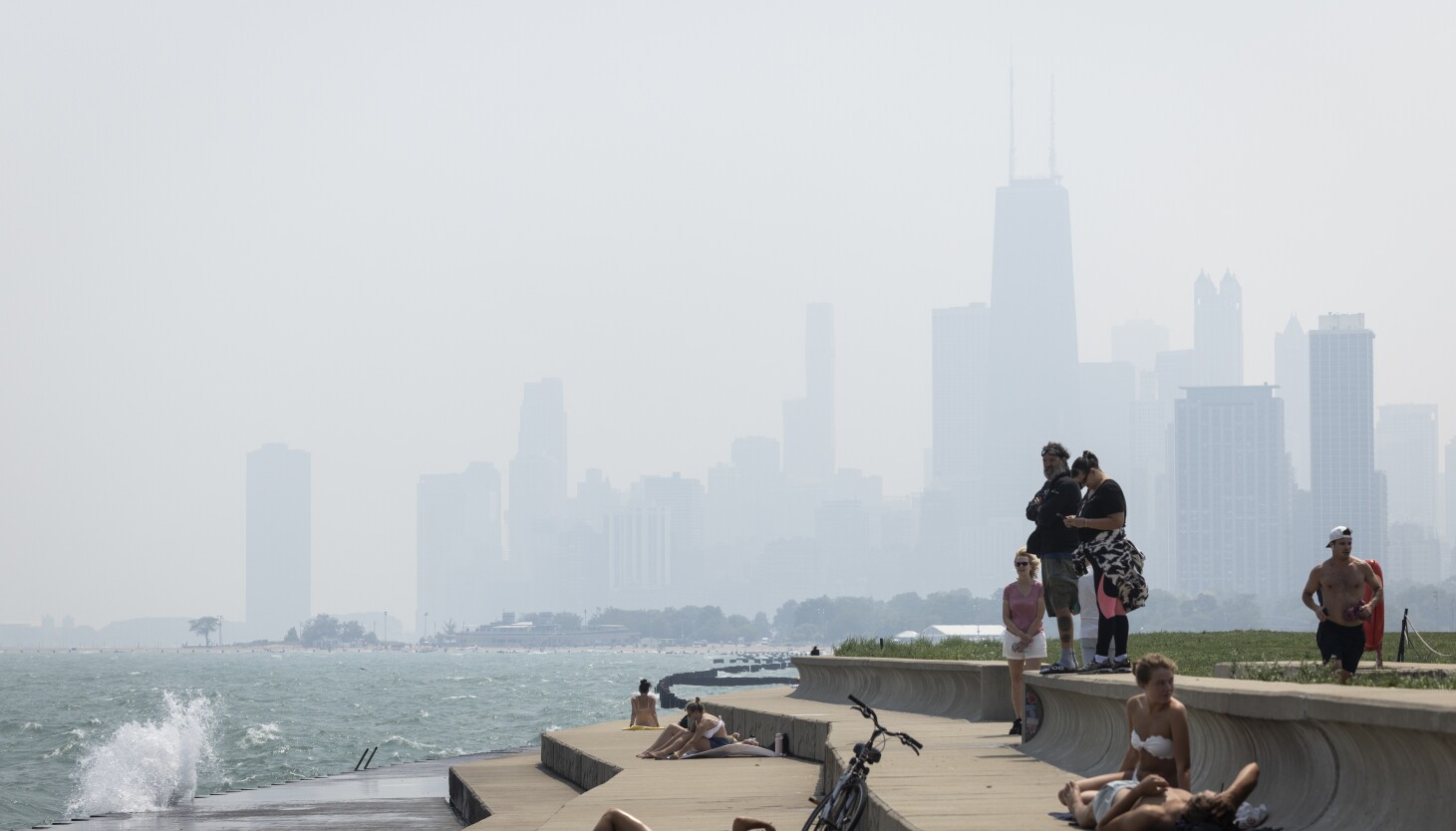
Chicago officially had the worst air quality in the world for a few hours Thursday.
As a haze of Canadian wildfire smoke blanketed the metro area, no other major city in the world had air pollution worse than Chicago midday Thursday, according to a ranking by IQ Air, a Swiss air-technology company.
“The air quality is officially dangerous in Chicago,” said Brian Urbaszewski, director of environmental health programs at the Chicago-based Respiratory Health Association.
“It’s going to send people to the emergency room. Some people may die because of what they’re breathing,” he said.
The National Weather Service issued an air quality alert for all of Illinois through the end of Friday.
By 3 p.m. Thursday, Chicago was overtaken in its title for worst air quality by the city of Kinshasa in the Democratic Republic of Congo.
Earlier in the day, Minneapolis ranked third and Detroit seventh. Both U.S. cities were also covered in the haze of Canadian wildfire smoke.

An air quality map at 1 p.m. Thursday by AirNow.gov
People may remember the last time Chicago topped the world in most polluted air in June 2023, when Canadian wildfire smoke smothered Chicago, Urbaszewski said.
Chicago has mostly avoided ranking at the top of the most polluted list since then. The city rose to the top three most-polluted city once this summer, Urbaszewski said. In early June, Chicago ranked among the worst air-polluted cities in the world, also due to Canadian wildfire smoke.
Thursday’s unhealthy air is a reminder that Canadian wildfire smoke can be felt acutely across half the continent.
“We’re over a thousands miles away, and we’re breathing all this smoke. It’s just off the charts,” Urbaszewski said.
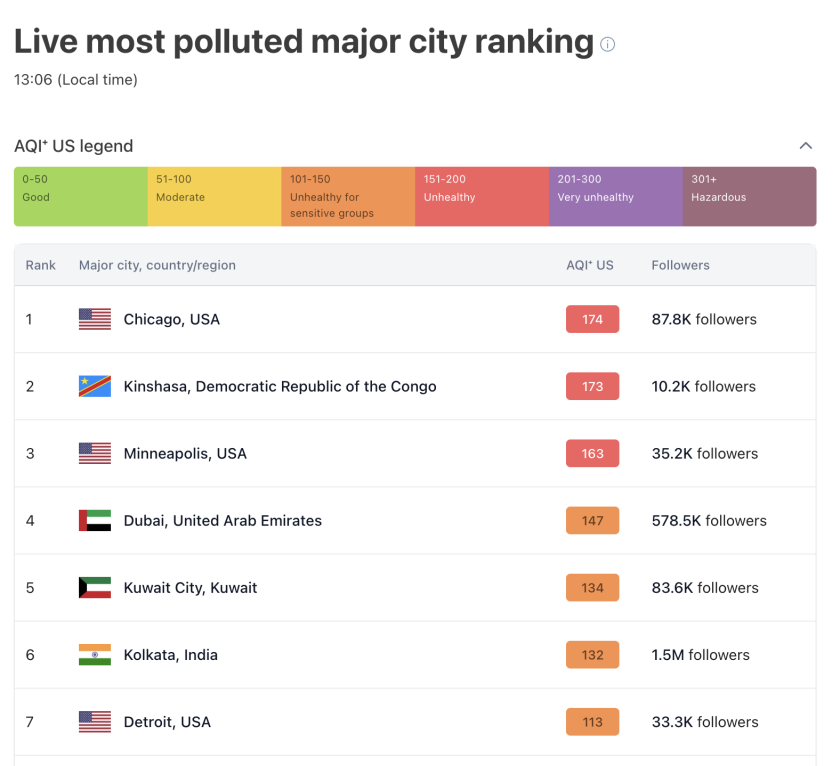
The world rankings for worst air quality by IQ Air, a Swiss air-technology company.
Experts have predicted that the climate-driven fires may be the new normal. Many health officials agree.
People should limit time outdoors as much as possible, Urbaszewski said. Wearing an N-95 mask can help filter out some of the smoke’s dangerous particulate matter. Running an air purifier at home also helps, as does using a high quality filter in central air-conditioning units.
Chicago’s air quality is expected to improve slightly by Friday, when the level should change from “unhealthy” to “unhealthy for sensitive groups,” according to the Illinois Environmental Protection Agency forecast. Saturday is expected to improve further, to a “moderate” level of air pollution.
Festivalgoers attend the first day of Lollapalooza at Grant Park, Thursday, July 31, 2025.
|
Pat Nabong/Sun-Times
A haze can be seen in the sky from the North Dearborn Street Bridge, Thursday, July 31, 2025.
|
Anthony Vazquez/Sun-Times
People sun tan on the Lakefront Trail on the North Side as a haze of Canadian wildfire smoke blankets the Chicago area and creates poor air quality, Thursday, July 31, 2025.
|
Ashlee Rezin/Sun-Times
A hazy chicago skyline can be seen in the background as fans cheer for the Chicago band The Symposium on day one of Lollapalooza in Grant Park, Thursday, July 31, 2025.
|
Candace Dane Chambers/Sun-Times
A haze can be seen in the sky from the Chicago Avenue bridge over the Kennedy Expressway, Thursday, July 31, 2025.
|
Anthony Vazquez/Sun-Times
People walk through Grant Park on the first day of Lollapalooza, Thursday, July 31, 2025.
|
Pat Nabong/Sun-Times
People sun tan in grass off the Lakefront Trail on the North Side as a haze of Canadian wildfire smoke blankets the Chicago area and creates poor air quality, Thursday, July 31, 2025.
|
Ashlee Rezin/Sun-Times
Hazy skies are seen on the first day of Lollapalooza at Grant Park, Thursday, July 31, 2025.
|
Pat Nabong/Sun-Times
A haze can be seen in the sky from the Dearborn Street Bridge over the Chicago River, Thursday, July 31, 2025.
|
Anthony Vazquez/Sun-Times