
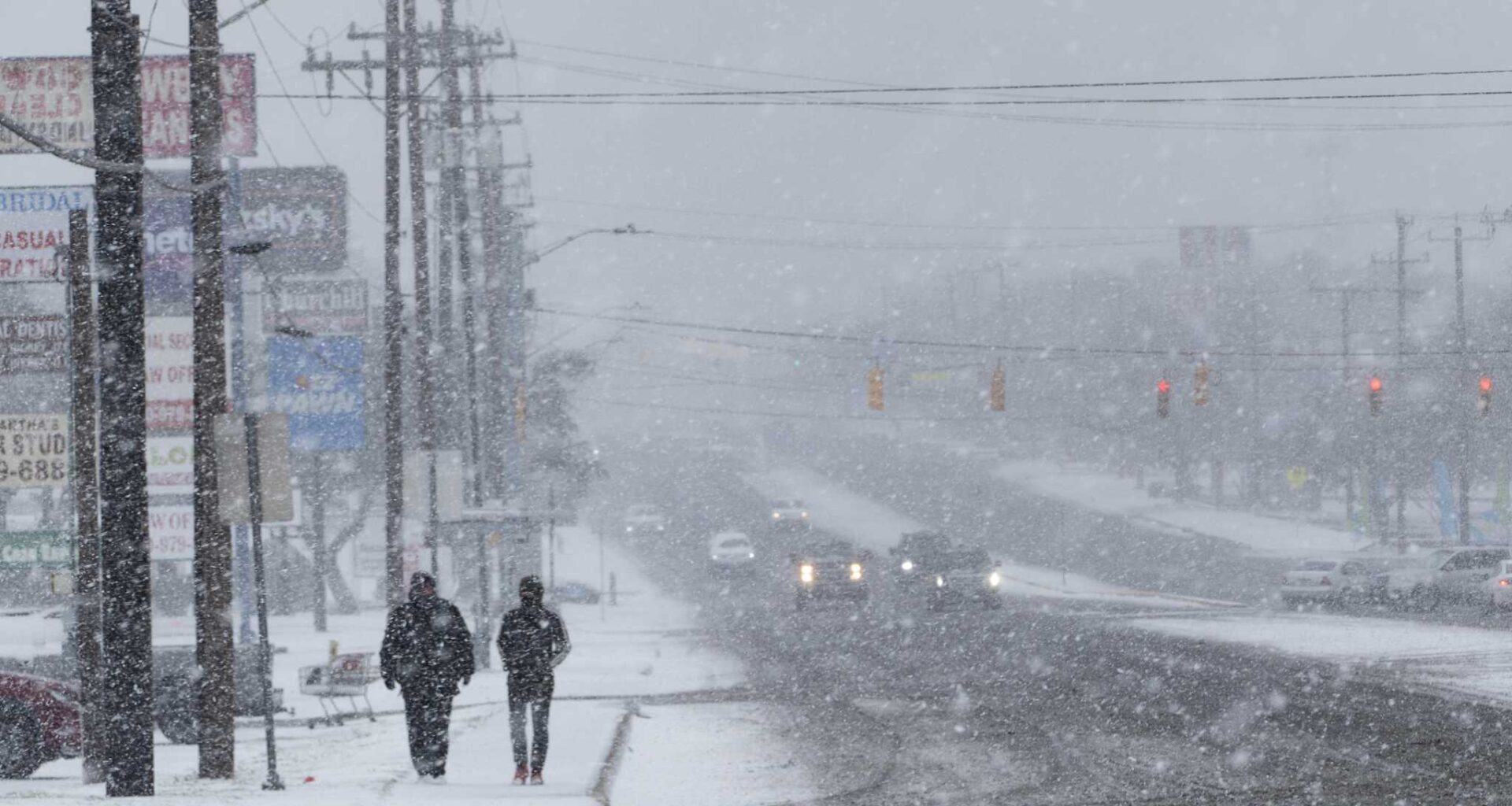
People walk along Blanco Road as a brisk snow falls in San Antonio on Feb. 18, 2021.
Billy Calzada, Staff / Billy Calzada
The winter solstice, occurring at 9:03 a.m. Sunday, marks the traditional start of winter. It’s also the shortest day of the year in San Antonio, with only 10 hours and 15 minutes of daylight.

The winter solstice is the moment when the Northern Hemisphere (where Texas is) is tilted farthest away from the sun, limiting the amount of solar energy that reaches the ground. That’s why temperatures drop in the winter months. The opposite happens in the Southern Hemisphere, where it’s the first day of summer.
Article continues below this ad
Colder weather alone doesn’t always mean snow. For that to happen, Texas needs just the right mix of atmospheric conditions — arctic air diving down from the north, abundant moisture from the Gulf or Pacific, and a source of rising motion in the atmosphere, often provided by a system of low atmospheric pressure.
It’s a rare combination to get right, especially considering every atmospheric ingredient needs to be timed up perfectly. However, Texas snow does happen from time to time. So when during winter is it most likely to happen? Mid-January? Late February? We dug into the historical record to find out.
When does Texas snow happen most often?
San Antonio: It doesn’t snow very much in San Antonio. In the past 100 years, at least an inch of snow has fallen just 16 times, roughly once every six years. Still, there is a time of winter when snow becomes slightly more likely.
Article continues below this ad
Historically, 61% of all snow in San Antonio has fallen in January, more than double the amount of snow the city has seen in February. Breaking it down even farther, much of that snow occurs in mid- to late January, coinciding with the city’s coldest period of the year.
It should be noted that San Antonio has a secondary peak in snowfall during mid-February, especially between Feb. 15-22. While average temps are warmer during this time, the atmosphere can become more active, leading to occasional arctic weather systems.
Article continues below this ad
Dallas: Pushing into North Texas, the Dallas-Fort Worth metroplex typically sees much higher snow chances because of average wintertime low temperatures being about 5-6 degrees colder than San Antonio. DFW Airport averages 2.4 inches of snow each year.
January still typically brings the most snowfall to North Texas, but February is a close second. Over the past century, Dallas has recorded 31 days with at least an inch of snow in January and 25 such days in February. Historically, the period with the highest likelihood of snow falls between Jan. 20 and Feb. 15.
Amarillo: By far, the most snow in Texas falls across the Panhandle. Amarillo averages 16.5 inches of snow each year, with snowfall fairly evenly distributed throughout the winter, thanks to consistently subfreezing temperatures.
Article continues below this ad
Like other Texas cities, Amarillo still gets its most snow in January, when the city averages 3.9 inches of snowfall. February follows closely with 3.7 inches, and December produces the third-most snow at 3 inches. Amarillo also receives notable snowfall in March, when it averages 2.8 inches, and even sees some snow in November, when it averages 2 inches.
Snow is never a guarantee across Texas, but when it does fall, it usually occurs between mid-January and mid-February, with the highest historical likelihood during the last week of January.
This year, La Niña is expected to bring above-average temperatures across the state, reducing the chance of significant snow. Still, it only takes one winter storm system, like the historic statewide freeze of February 2021 that happened during La Niña, to change the pattern, so be sure to stay updated with expressnews.com/weather for updates on potential winter weather throughout the season.
Article continues below this ad