
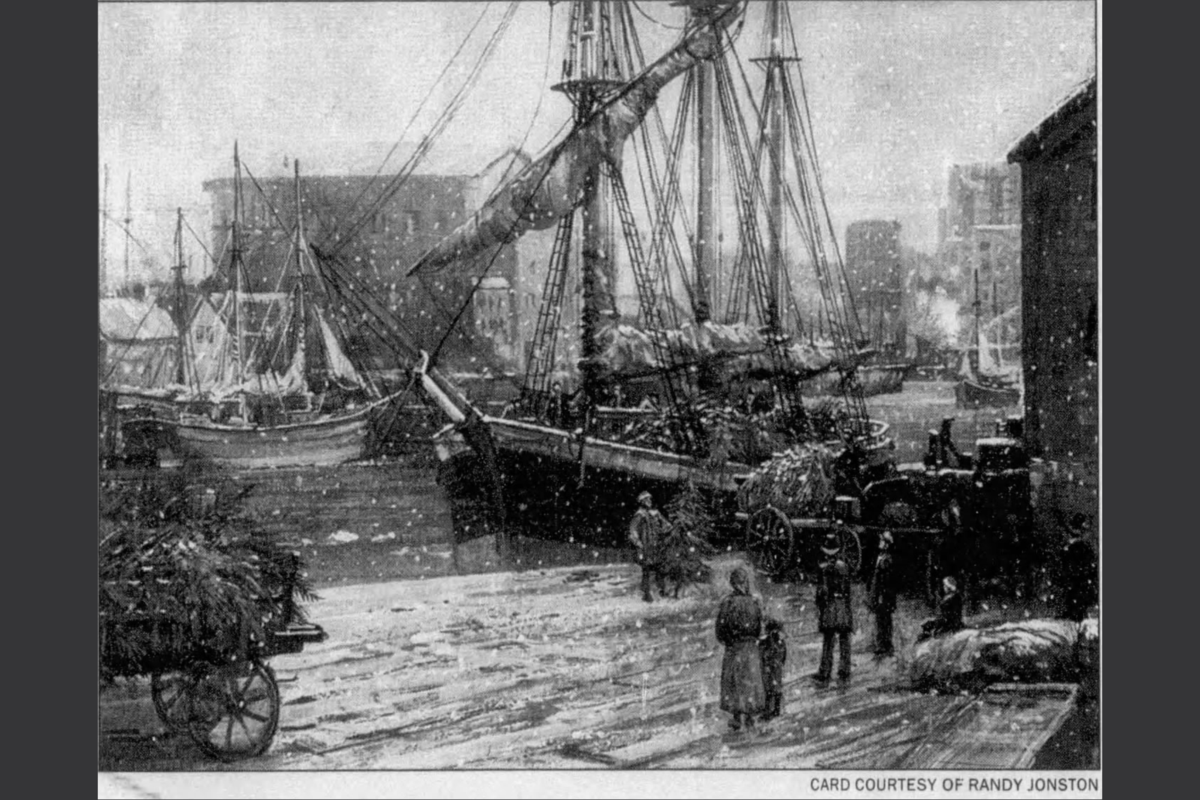
‘Captain Santa’ was more than just a nickname for Herman Scheunemann — he was a symbol of joy for many, until one fateful November storm changed everything
From the archives of the Sault Ste. Marie Public Library:
When Captain Herman Scheunemann set sail to transport trees from the Lake Superior region to the residents of Chicago by boat every holiday season, he was all too aware of the potential perils – his older brother, August Schuenemann’s tree ship, the S. Tahl had fallen victim to the Great Lakes, sinking in 1898 and leaving no survivors.
It was the kind of history you hope won’t repeat itself when 12 years later, Captain Herman Scheunemann’s own ship, a three-masted schooner called the Rouse Simmons, also devastatingly succumbed to the notorious gales of November. The storm took all estimated 17 members on board in Lake Michigan near Two Rivers, Wisconsin.
The Scheunemanns had taken great pride in the family business since the late 1800s, overseeing the sourcing of thousands of trees, chopped all fall long by Northern Michigan lumberjacks. The crew would then cargo the trees to the residents of Chicago by boat – a trip that took around seven weeks.
H. Scheunemann told an interviewer he was but thirteen when, with his father’s consent, he helped load their very first shipment of 800 small trees. The cargo grew by the thousands in following years, filling all crevices of the ship from the hold to the galley to the wheelhouse, and piled high on the deck. Crowds of Chicagoans came to expect the three-masted schooner every holiday season, joyfully herding their families to the dock for their one-dollar balsam or pine tree as soon as the Rouse Simmons entered the harbour.
Built in 1868, Scheunemann expected the Rouse Simmons to have one or two more years left in her when they set sail in 1912; it was last seen sending distress signals off the coast of Kewaunee, Wisconsin. With each passing day beyond the expected arrival time, all hopes of “Captain Santa’s” return to Chicago were diminished.
Surely no one was as nervously anticipating the return of the Rouse Simmons as Scheunemann’s own family: wife, Barbara, and three young daughters, Elsie, Hazel and Pearl.
They were an integral part of the business, greeting customers and weaving evergreen garlands right on deck. And this was not the only time they were seen aboard: H. Scheunemann had often taken his wife and daughters on expeditions where they inherited his seafaring skills.
What devastated their family on November 23, 1912, became a resilient battle to endure a legacy. Amidst her grief, Captain Scheunemann’s widow, Barabara, picked herself up and captained her own tree ship called the Hackly. According to a 1915 newspaper, eldest daughter, Elsie Scheunemann, joined as the first mate, while Pearl Scheunemann grew to maintain a tree shop along the docks.
Barabara Scheunemann continued operating the business until she fell ill in 1925, and trees began to be transported by rail and highway. She died in 1933, and the headstone she shares with her husband bears an engraved Christmas Tree between their two names.
This tragic but beautiful Great Lakes story is preserved, not only by the tattered-sail phantom sightings of the Christmas tree ship still reported on Lake Michigan, but also by the US Navy, which annually transports 1200 Christmas trees to Chicago families in need in honour of the lives lost on the Rouse Simmons.
This article was prepared using information compiled from the following newspaper sources: the Sault Star, the Inter Ocean, the Jackson Citizen Patriot, the Saginaw News, the Times (Shreveport), and the Chicago Tribune.
Each week, the Sault Ste. Marie Public Library and its Archives provide SooToday readers with a glimpse of the city’s past.
Find out more about what the Public Library has to offer at www.ssmpl.ca and look for more “Remember This?” columns here.