
At least 16 files disappeared from the US Justice Department’s public webpage for documents related to disgraced financier and convicted sex offender Jeffrey Epstein less than a day after they were posted, according to reports, with no explanation and no notice to the public.
The missing files, which were available Friday and no longer accessible by Saturday, included images of paintings depicting nude women and one showing photographs along a credenza and in drawers.
Inside a folder among other photos was a photograph of US President Donald Trump alongside Epstein, Melania Trump and Epstein’s longtime associate Ghislaine Maxwell.
The US Justice Department did not answer questions Saturday about why the files disappeared but said in a post on X that “photos and other materials will continue being reviewed and redacted consistent with the law in an abundance of caution as we receive additional information.”
The released files included never-before-seen photographs of former US President Bill Clinton in a swimming pool and wearing cultural garb with Epstein, as well as images showing Clinton with musicians Mick Jagger, Michael Jackson and Diana Ross, alongside pictures of Epstein with actors Chris Tucker and Kevin Spacey and Andrew Mountbatten-Windsor lying across the laps of several women.
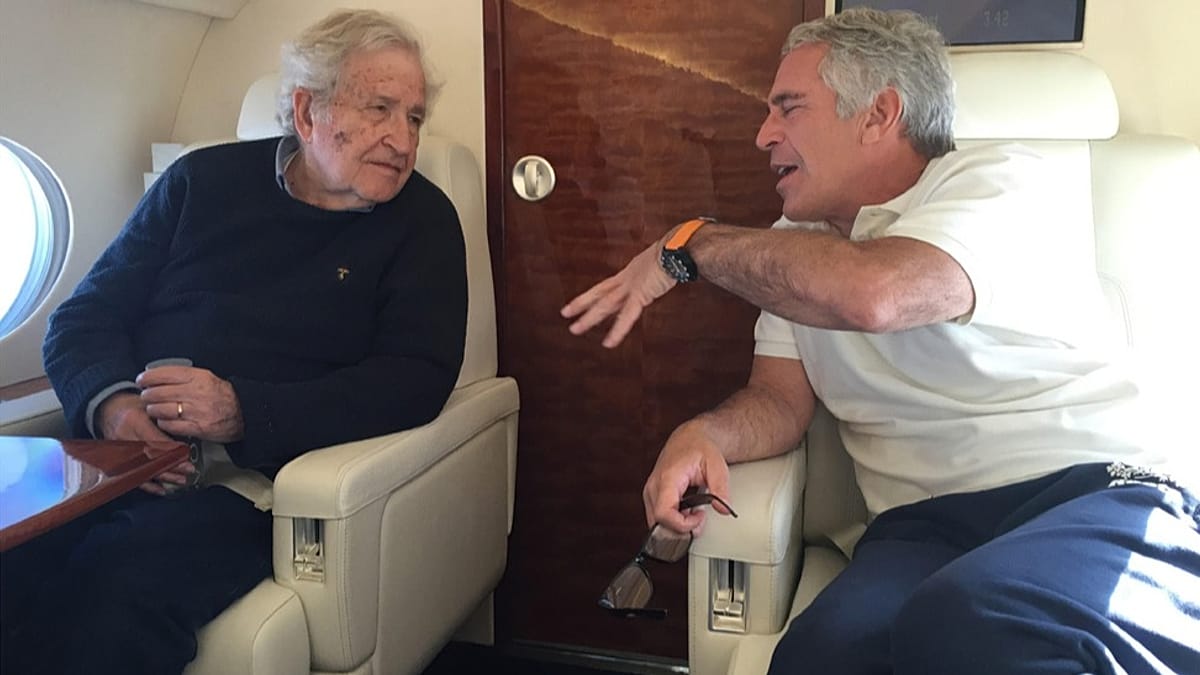
Famed left-wing political scientist Noam Chomsky also appears in Epstein’s company in multiple released photos.
None of those pictured has been accused of wrongdoing in connection with Epstein’s crimes.
The unexplained disappearance fuelled speculation about what was taken down and why the public was not notified, compounding longstanding intrigue about Epstein and the powerful figures who surrounded him.
Democrats on the House Oversight Committee pointed to the missing image featuring Trump in a post on X, writing: “What else is being covered up? We need transparency for the American public.”
The episode deepened concerns that had already emerged from the Justice Department’s much-anticipated document release Friday, the deadline set under the Epstein Files Transparency Act signed into law 19 November.
The tens of thousands of pages made public offered little new insight into Epstein’s crimes or the prosecutorial decisions that allowed him to avoid serious federal charges for years, whilst omitting some of the most closely watched materials.
Key documents missing
Missing from the Justice Department’s initial disclosures are FBI interviews with survivors and internal Justice Department memos examining charging decisions — records that could have helped explain how investigators viewed the case and why Epstein was allowed in 2008 to plead guilty to a relatively minor state-level prostitution charge.
The records make little reference to several powerful figures long associated with Epstein, raising questions about who was scrutinised and how much the disclosures advance public accountability.
The releases so far have been heavy on images of Epstein’s homes in New York City and the US Virgin Islands, with some photos of celebrities and politicians.
Despite Friday’s deadline set by Congress to make everything public, the Justice Department said it plans to release records on a rolling basis, blaming the time-consuming process of obscuring survivors’ names and other identifying information. The department has not said when more records might arrive.
1996 complaint surfaces
Among new disclosures was a 1996 complaint to the FBI about Epstein allegedly possessing and distributing child pornography, more than a decade before federal investigators launched their probe into his predatory behaviour.
The complaint, stamped 3 September 1996, was filed by Maria Farmer, an artist who worked for Epstein. Farmer’s attorney, Jennifer Freeman, confirmed that her client filed the complaint, which the FBI had not publicly acknowledged until Friday’s release.
The complaint states Farmer took photos of her sisters, aged 12 and 16, for her personal artwork and that Epstein stole the pictures and negatives and was believed to have sold them to potential buyers.
The document indicates Epstein threatened that if Farmer told anyone about the photos, he would burn her house down, and that Epstein asked her to take pictures of young girls at swimming pools.
“We’ve never seen anything before corroborating her 1996 report. But we just saw it yesterday for the first time in 30 years, which is remarkable,” Freeman said Saturday.
Freeman said the report does not say what, if anything, the FBI did after Farmer spoke with them, but the FBI could have intervened and prevented Epstein from harming others.
“They could have avoided 30 years of trauma if they had just done their job,” Freeman said.
Lawyers for Farmer say she told the FBI in August 1996 she observed explicit images of children inside Epstein’s home, a “modelling book” of child pornography kept in Epstein’s safe and Epstein’s theft of nude images of her sisters.
Farmer filed a lawsuit in May seeking damages from the federal government for alleged negligence by authorities.
Survivors express frustration
The approach angered some Epstein accusers and members of Congress who fought to pass the law that forced the department to act.
“I feel like again the DOJ, the justice system is failing us,” said Marina Lacerda, who alleges Epstein started sexually abusing her at his New York City mansion when she was 14.
Lacerda was identified as “Minor-Victim 1” in Epstein’s 2019 indictment and provided key information that helped prosecutors charge him with sex trafficking.
Freeman alleged the Justice Department has mishandled the release, with significant redactions and the withholding of documents that survivors and their lawyers are still awaiting.
“One of the key things we want to accomplish with this release of files is transparency,” Freeman said.
Epstein died by apparent suicide in a Manhattan jail in August 2019 while awaiting trial on sex trafficking charges.