

Kian Boyle,Bedfordshire, Hertfordshire and Buckinghamshireand
Danny Fullbrook
 Torus
Torus

Torus said a track on Spotify appears to use AI to extend a clip they uploaded online
An indie band has claimed their music was stolen and recreated by artificial intelligence (AI) after they shared a short teaser online.
Milton Keynes group Torus decided to release a grunge-style cover of Billie Eilish’s Ocean Eyes after a clip of them performing the song began to “blow up a little bit” on TikTok.
Before they could release their version, a similar track appeared on Spotify, uploaded by an artist called Independent Lemon, who predominantly uploads covers and has no social media presence, record label or live show dates.
Torus believed someone used generative AI on their snippet to “predict what the rest of the song was going to be”.
The Independent Lemon version began with what sounded like a clip of Torus performing the song, but it continues for a few more minutes longer, the band claimed.
Singer and guitarist Alfie Glass said: “I thought it was somebody doing a cover of our cover, like a real person doing it, and I thought they actually did a pretty good job, but obviously they were like American or something.
Drummer Jack Orr said: “It was just before we dropped it, I remember seeing the AI version on Spotify, my sister showed me, and it was weird.
“It took me a minute to realise that came from our initial clip, someone had just taken that clip and looped it a few times, but then I think AI had done something to it to – it added a riff or something.”
The account has nearly 700,000 monthly listeners and has uploaded about 100 singles over the last year.
Many of these are covers, and some have earned millions of streams.
There were versions of Michael Jackson, Lorde and the Macarena – sometimes done in a different genre, sometimes sped up or slowed down.
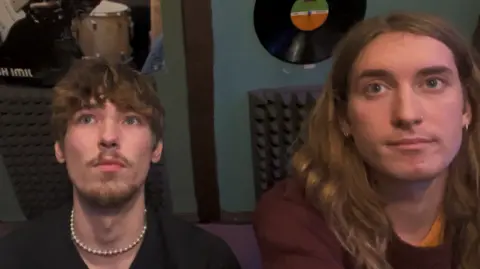
The band planned to report the suspected AI track to Spotify
For Torus, it took about a month to record their Ocean Eyes cover that “captures the same vibe we had on TikTok”.
Mr Glass admitted it was “pretty annoying” that somebody else had seemingly made their own version in seconds.
Mr Orr added: “You can do covers of covers and that’s fine… I don’t really think AI in music is great. It kind of loses the soul of music. But I think it’s more the crediting thing that is the important part.
“They literally copied it, like the drum pattern is exactly the same… they could have done a lot to it. At least bring inspiration from the original and do their own thing, but it’s not inspiration when it’s exactly the same”.
The band planned to report the artist to Spotify in the hopes that it could be taken down.
Spotify were approached for a comment; However, the BBC has been unable to contact representatives of Independent Lemon for comment on these claims.
How AI makes music
Simon Holland is a professor of music and human-computer interaction at the Open University, based in Milton Keynes.
While he completed his PhD in AI and music, he stated that he does not use AI himself for music and instead focuses on finding ways of using technology to encourage people to engage more deeply with music.
He explained that there are apps users can pay for where they can generate songs from just a few words of description or a short audio demo.
The professor said: “You could drop in a sound file for a song that you’ve written yourself, and a bit more controversially, you can drop in files made by someone else.
“Generally, the quality can be not that good, but if you put in a good demo of music you had created and asked it to do a demo in a certain style, it could produce something quite polished.
 Torus
Torus
Torus said AI generated music “loses the soul of music”
After listening to tracks by Independent Lemon, he concluded it was not possible to say with certainty if they were AI-generated, but the songs had hallmarks of AI, such as how the vocals and music were “less clear.”
Overall, he was optimistic that the existence of musicians was not threatened by the rise of AI.
He explained: “Would you want a helicopter to drop you on the top of Everest? Would you be happy with that? Or would you want to be learning how to climb, how to push yourself?
“In this case, figuring out how to make music yourself, for musicians, that’s the important thing. I don’t think that’s going to go away.
“I think musicians will probably react by changing the kind of music that they make. So AIs won’t have enough training data to work on it.
“It’s definitely going to make big changes. Some will be good, some will be bad… But it’s not a good situation where people appear to be ripping off of music by original musicians. This is obviously not good.”