
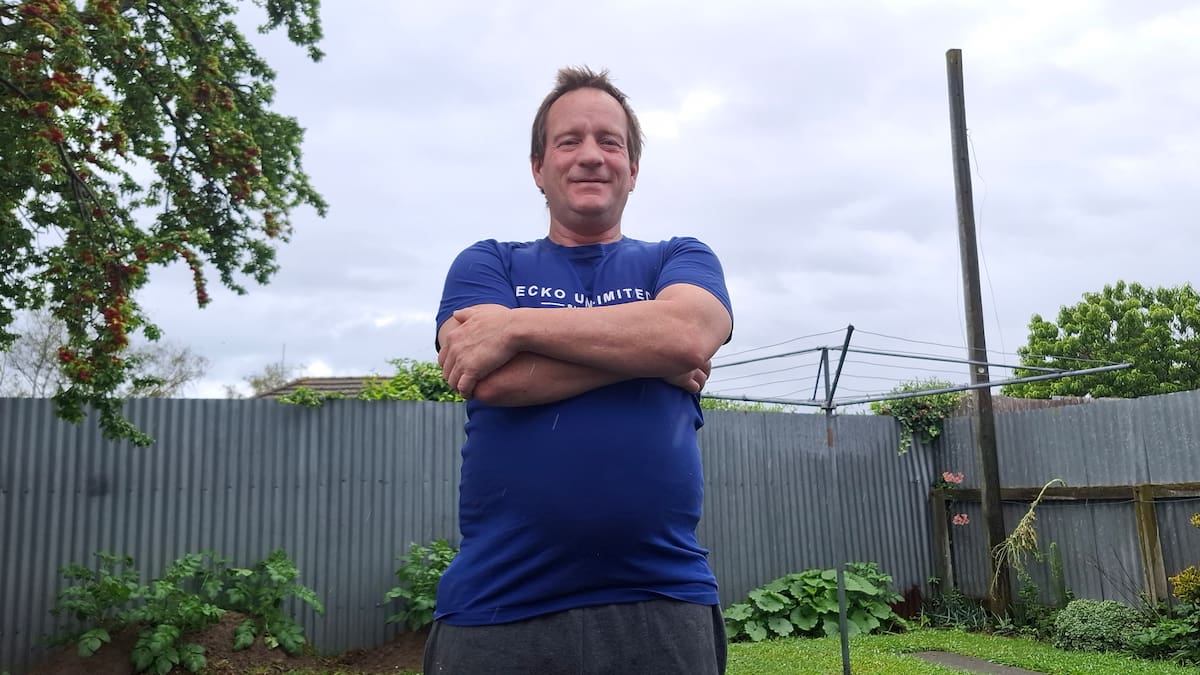
On a bright, sunny afternoon, sitting outside, clearly garden and house proud, he sees things as starting to come together.
He had always wanted to work, started at 15 shifting supermarket trolleys in Caboolture, Queensland. He’d travel with “the show people”, and ultimately would have many jobs.
“I wanted to be a boxer,” he says, with a scent of wistful thinking of a man wondering what might have been. “I reckon I could have been.”
But mishaps were part of life, unsurprisingly.
“The only thing that scared me was my own stupidity: 10-feet tall and bulletproof,” he says.
Unable to work for years because of injury received while riding a bike while working on a dairy farm, a big contributor to his demise, he would, in 2026, like to get back to work, especially if it is helping others.
It was like an “epiphany”, he says, having suddenly realised that a lot of people were trying to help him, and then that at some stage he would like to be returning the favour to the community.
“But,” he says, “I can’t help anyone else if I can’t help myself.”
The opportunity presented, like the light at the end of the tunnel, when, as one of eight of the most vulnerable men living rough in Napier, plucked from the streets as the first residents for the shelter, which was, itself, evolving at similar rapid pace.
It was established by the Napier Ahuriri Homeless Shelter Society, which had been established only few months earlier, sparked most by the tragedies which had seen at least three deaths in short order in the fraternity.
It would raise and source six-figure money, a site, staffing and case-study monitoring, aimed at trying to resolve issues of street homelessness, while the men would be helped into turning their lives around, without the move-on, make it someone else’s problem approach.
He had been using methamphetamine for possibly 20 years, but having lost his mum, “fur baby”, best friend and border collie cross, George, a few months apart, and pretty much everything else, the mind was still capable of helping himself.
“I had George for about eight years,” he says. “He showed me what unconditional love was.”
George was one well-fed pooch, but most of the money Turner would spend on himself was spent on drugs or alcohol.
“When I moved to Āhuru Mōwai, it showed me I needed to get off the meth, or it was going to kill me,” he said. “It was a coping mechanism, but I wasn’t coping.”
Growing up as a young boy in Ahuriri, he hadn’t had the happiest of childhoods, but it was carefree, and he recalled he and his brother would just “take off”, an up-and-down lifestyle where pinching granddad’s alcohol was an up-side, memories of a walloping and the wooden spoon on the down-side.
There’s a lot of “shit” in between, he says, but there was another moment of dawning, as his mum battled illness, leading to her eventual passing last year.
After the Toyota in which he and George were living broke down in a carpark where they’d spend the nights in Hamilton, the last vehicle he had, the “council” came to see him, putting him in touch with The People Project, which helped him get to Whanganui and Palmerston North, where he could spend time with her.
When she was moved back to Hastings, the moteliers where he had been staying got their handyman to drive him to Hawke’s Bay.
“I have been helped a lot along the way,” he says. ”If it wasn’t for the help along the way I’d probably be dead by now.
“Once I started getting the fog clear, I started realising there were people who still loved me. They gave me the tools and a safe place to do better for myself.”
Doug Laing is a Napier-based Hawke’s Bay Today reporter with more than 50 years in journalism, mostly in the region, covering most aspects of news, including community and social issues.