

Released: 2025-12-22
Industrial Product Price Index
November 2025
0.9% 
(monthly change)
Industrial Product Price Index, excluding energy and petroleum products
November 2025
0.4%
(monthly change)
Raw Materials Price Index
November 2025
0.3%
(monthly change)
Raw Materials Price Index, excluding crude energy products
November 2025
0.6%
(monthly change)
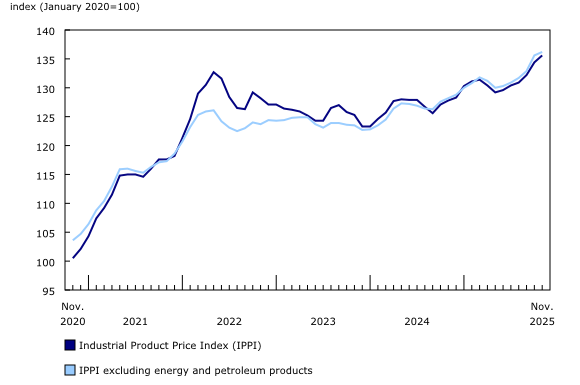
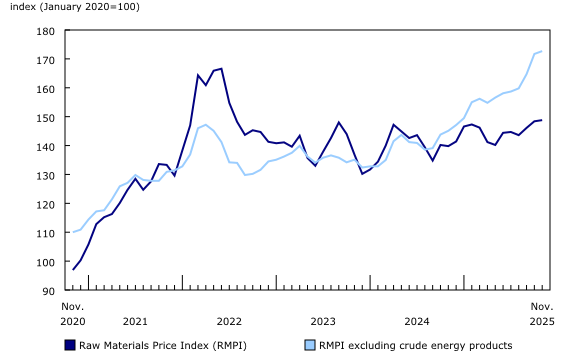
Prices of products manufactured in Canada, as measured by the Industrial Product Price Index (IPPI), increased 0.9% month over month in November and were up 6.1% year over year. Meanwhile, prices of raw materials purchased by manufacturers operating in Canada, as measured by the Raw Materials Price Index (RMPI), increased 0.3% month over month in November and rose 6.4% year over year.
Chart 1

Prices for industrial products increase in November
Industrial Product Price Index
The IPPI increased 0.9% month over month in November, marking the sixth consecutive monthly rise, following a 1.7% gain in October. Most commodity groups registered month-over-month gains in November, though prices rose most notably for energy and petroleum products. Excluding energy and petroleum products, the IPPI increased 0.4% in November.
The prices of energy and petroleum products led the IPPI‘s monthly increase in November, rising 4.3%. This was the largest month-over-month increase for the group since January 2025. Higher prices for refined petroleum energy products (+4.8%) drove the increase in November. Diesel fuel (+7.9%) recorded a substantial increase in the month, while finished motor gasoline (+1.5%) increased as well. Prices for refined petroleum energy products rose due to increased refiner margins, especially for diesel fuel. Concerns regarding tighter global diesel supply contributed to the rise in prices. These concerns arose mainly from events affecting Russia, one of the world’s top diesel exporting countries. The United States imposed sanctions on Russian oil producers in late October. Moreover, Russian petroleum infrastructure has been impacted by the ongoing conflict between Russia and Ukraine, causing supply disruptions. Increased domestic demand for home heating oil, a similar distillate fuel oil to diesel, also put upward pressure on diesel fuel prices in November.
Prices for primary non-ferrous metal products rose 0.8% in November, posting their seventh consecutive monthly increase. The gain in November was primarily driven by higher prices for unwrought gold, silver, and platinum group metals, and their alloys (+1.4%). Unwrought silver and silver alloys (+3.2%) recorded a more notable price increase, while unwrought gold and gold alloys (+1.2%) recorded a more modest increase. Gold and silver prices were supported by traders anticipating another interest rate cut announcement from the United States Federal Reserve in December. Furthermore, concerns regarding silver supply tightness in the global market contributed to silver prices increasing in November.
Prices for fruit, vegetables, feed and other food products increased by 1.3% month over month in November, after a 1.8% gain in October. The upward movement in November was led by higher prices for grain and oilseed products, not elsewhere classified (n.e.c.) (+7.3%). Oilseed product prices were pushed higher in November after China purchased a notable quantity of soybeans from the United States. China had previously limited its purchases of US soybeans amid trade tensions between the two countries.
Year over year
The IPPI gained 6.1% year over year in November, the index’s 14th straight year-over-year increase.
In November, 16 of 21 commodity groups posted year-over-year increases. The year-over-year increase in the IPPI was driven by price movements in unwrought gold, silver, and platinum group metals, and their alloys (+58.7%), the largest year-over-year increase for this product group since September 2011. Other product groups that were key upward contributors in November 2025 included fresh and frozen poultry of all types (+37.9%) and fresh and frozen beef and veal (+28.1%).
Raw Materials Price Index
The RMPI increased 0.3% on a month-over-month basis in November. Higher prices for metal ores, concentrates and scrap were largely offset by a decline in animals and animal products. Excluding crude energy products, the RMPI increased 0.6%.
The prices of metal ores, concentrates and scrap increased 1.5% from October to November. The main contributor to the increase was the gold, silver, and platinum group metal ores and concentrates subcategory (+4.0%), which registered its 15th straight monthly gain.
Prices for animals and animal products decreased 2.0% on a month-over-month basis in November. This was the largest monthly decline for this commodity group since September 2024, and it was mainly driven by declining prices for hogs (-7.5%). The price decline for hogs was partially caused by lower production costs, leading producers to increase supply. This created downward pressure on prices, in addition to a seasonal decrease in demand for pork after the summer grilling season.
Prices for crude energy products fell 0.5% in November, mainly on lower prices for conventional crude oil (-0.9%). Synthetic crude oil prices fell 0.3% compared with October. The decrease in conventional crude oil prices in November was primarily driven by ongoing global oil oversupply, while geopolitical risks stemming from the conflict between Russia and Ukraine partially counteracted this downward trend.
Year over year
The RMPI rose 6.4% on a yearly basis in November. Excluding crude energy products, the RMPI posted a 19.0% year-over-year rise in the month.
The RMPI‘s year-over-year increase in November was led by higher prices for gold, silver, and platinum group metal ores and concentrates (+57.5%). Cattle and calves (+20.9%) also made a significant contribution to the yearly increase of the index.
In November, prices notably declined on a year-over-year basis for conventional crude oil (-15.2%) and synthetic crude oil (-16.1%), largely moderating the RMPI‘s year-over-year increase. Increased global supply in 2025 put downward pressure on crude oil prices.
Chart 2
Prices for raw materials increase in November
Note to readers
The Industrial Product Price Index (IPPI) and the Raw Materials Price Index (RMPI) are available at the Canada level. Selected commodity groups within the IPPI are also available by region.
A Technical Guide for the Industrial Product Price Index is now available. This guide provides additional details regarding the methodology used to calculate the index.
With each release, data for the previous six months may have been revised. The indexes are not seasonally adjusted.
The IPPI reflects the prices that producers in Canada receive as goods leave the factory gate. The IPPI does not reflect what the consumer pays. Unlike the Consumer Price Index, the IPPI excludes indirect taxes, such as sales taxes and tariffs, and all costs that occur between the time a good leaves the plant and the time the final user takes possession of the good. This includes transportation, wholesale and retail costs. Although the IPPI does not measure the direct effect of tariffs on prices, tariffs may indirectly influence prices measured in the IPPI. For example, inputs used in the production process that are imported and on which Canada imposes a tariff may raise the prices charged by Canadian producers. Tariffs on Canadian imports or exports may also indirectly influence prices in the IPPI through their impact on supply and demand dynamics.
The RMPI reflects the prices paid by Canadian manufacturers for key raw materials. The RMPI includes all charges purchasers incur to bring a commodity to the establishment gate, including transportation charges, net taxes paid and customs duties and tariffs paid on imported raw materials.
Products
Statistics Canada launched the Producer Price Indexes Portal as part of a suite of portals for prices and price indexes. This webpage provides Canadians with a single point of access to a variety of statistics and measures related to producer prices.
The video “Producer price indexes” is available on the Statistics Canada Training Institute webpage. It introduces Statistics Canada’s producer price indexes: what they are, how they are made and what they are used for.
Next release
The industrial product and raw materials price indexes for December 2025 will be released on January 21, 2026.
Contact information
For more information, or to enquire about the concepts, methods or data quality of this release, contact us (toll-free 1-800-263-1136; 514-283-8300; infostats@statcan.gc.ca) or Media Relations (statcan.mediahotline-ligneinfomedias.statcan@statcan.gc.ca).