
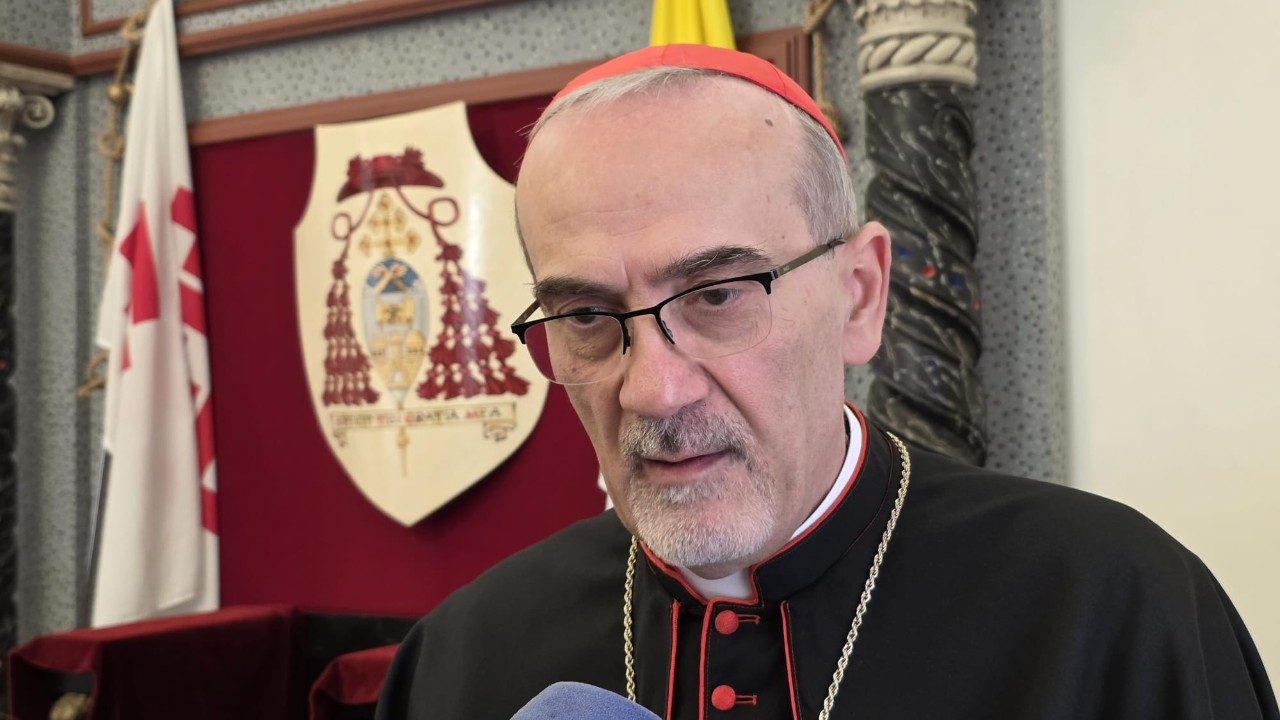
Following his second visit in six months to the Gaza Strip—the first since the ceasefire—the Latin Patriarch of Jerusalem speaks of a strong desire to return to normal life.
By Jean-Charles Putzolu – Jerusalem
Cardinal Pierbattista Pizzaballa met with the press the day after he visited the Gaza Strip, where he went to offer his support—and through him, that of the entire Church—to the people of Gaza, exhausted by more than two years of war. It was also the first visit by the Latin Patriarch of Jerusalem to the autonomous territory since the ceasefire.

The Latin Patriarch of Jerusalem is on a pastoral visit to the Parish of the Holy Family and will preside over the Christmas Mass on Sunday.
His assessment is sobering: 80 percent of infrastructure has been destroyed; what remains standing risks collapse or is practically uninhabitable. The severe deterioration of some buildings has not, however, prevented a few families from returning to their homes. Four hundred people are still being sheltered on the grounds of the Holy Family parish, led by Father Gabriel Romanelli. But most residents continue to live in tents. “It is cold—I felt cold—so think of the children,” the Cardinal said.
Despite everything, “I saw a desire to return to life,” he noted. Shops remain closed, and the challenges are immense, yet some rudimentary stalls have appeared in tents, where fruit and vegetables are available.
“The situation of famine is behind us,” Cardinal Pizzaballa affirmed. Nevertheless, few Gazans can afford to purchase food. With no work and no income, the majority have no option but to rely on humanitarian assistance, which, thanks to international aid agencies, is finally arriving.
A catastrophic economic situation
Economic activity has come to a halt. The Patriarch laments a “catastrophic situation,” while at the same time observing a desire to recover and, for Christians, to celebrate Christmas. Since Christmas is the feast of children, the Cardinal’s attention turns to them: “Of course, we are concerned for the children and their future.”
“The number of children in the streets struck me,” he continued, noting that “they should be in school.” One of the priorities of the Latin Patriarchate, he added, will be to enable the resumption of classes.
What the Cardinal witnessed was, for him, “a lesson”: the enthusiasm of the children, “full of joy, full of life… they will save our communities. I believe this,” he said.
Witnessing the hope of Christ’s birth

The only entirely Christian village of the West Bank is getting ready to celebrate the Lord’s coming in an atmosphere halfway between the joy of the festivity and the fear of new …
“We also ask ourselves when reconstruction can begin. The war has stopped, but the conflict is still present,” Cardinal Pizzaballa observed with bitterness.
Problems are everywhere, he noted, also referring to the West Bank and the tensions between Palestinian villages and Israeli settlements. “In this context, it appears difficult to speak of hope, but it is our duty to do so during this Christmas season.”
The Cardinal points to the deep exhaustion of Christian communities, who are “tired from the war,” he said.
Yet, he continued, “Christ himself entered history through a complex reality. Today, once again we must welcome Him and work for the reconstruction of homes and of hope.”
Doing everything possible to rebuild
After more than two years of human devastation, the Cardinal urges looking as far ahead as possible: “We cannot ignore what has happened, nor believe that peace will arrive tomorrow, but we must move from a situation of opposition to a constructive one.”
Listen to Cardinal Pizzaballa
The Latin Patriarchate of Jerusalem is ready to do everything possible to respond to the spiritual and material needs of the people of Gaza. At present, medicines are lacking. Hospital infrastructure has been severely damaged, and medical equipment will need to be brought in. “We must be active in responding to this situation and accompany the people,” the Patriarch said.
“We must remain Church,” the Cardinal continued, explaining the spiritual and pastoral support that must be offered to the people of Gaza.
As Church, he concluded, “We will do everything possible to bring stability back to Gaza, and wherever we can… we must be the voice of all the poor and of all those who suffer because of war.”