
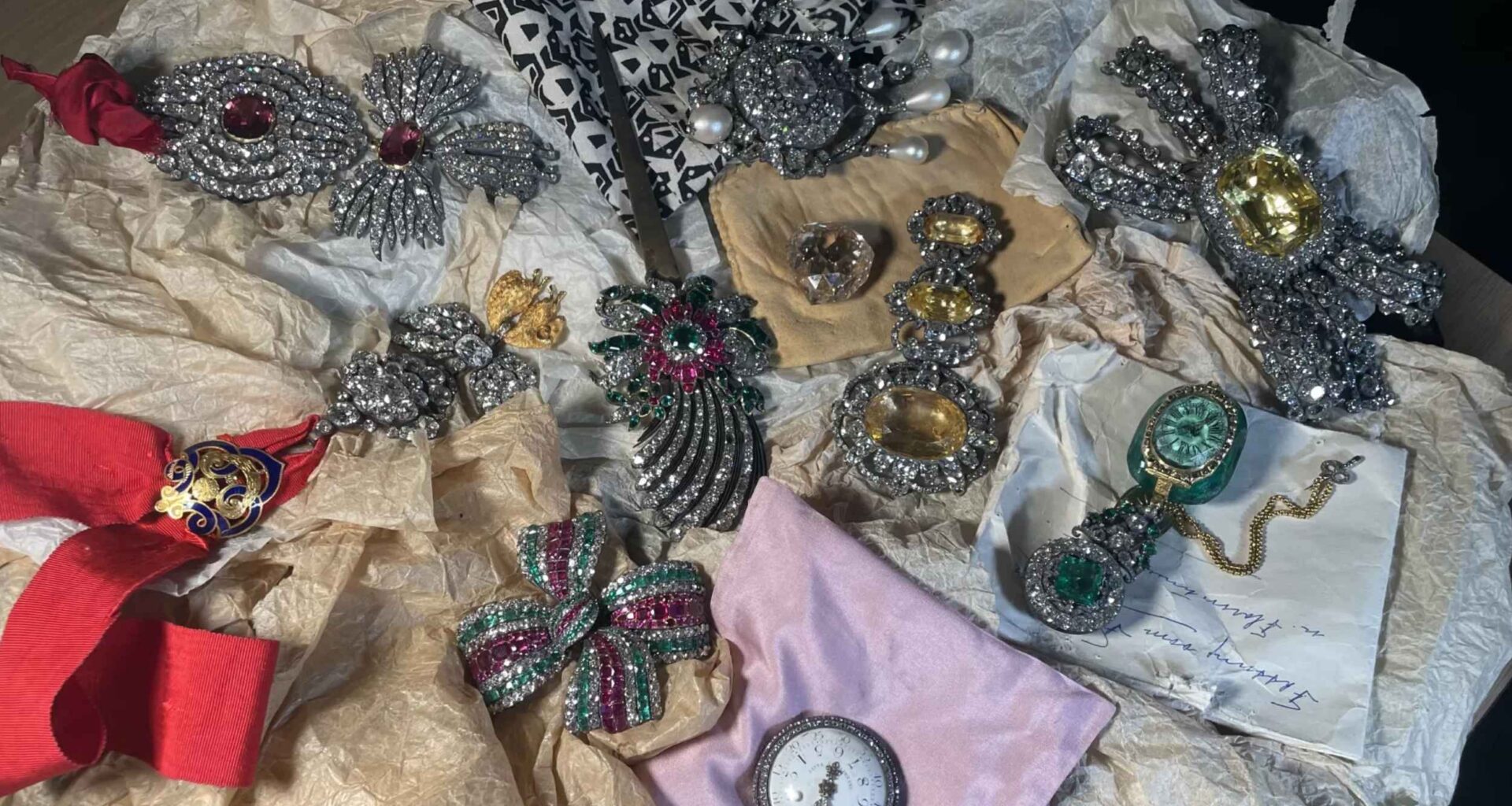
A forgotten suitcase in a Canadian bank vault, opened after more than 100 years, contained famous royal jewels and treasures believed to have been lost forever. This was the private jewel collection of the Habsburg family, and the most valuable piece was a light-yellow diamond that weighs just under one ounce.
This suitcase once belonged to Empress Zita, the last empress of Austria-Hungary. She carried it while her family fled war, revolution, and dictatorship across Europe.

Zita was born into an Italian ducal family and married Archduke Karl of Austria in 1911. She became empress during the final years of the Habsburg monarchy.
Karl von Habsburg-Lothringen, grandson of Empress Zita, has taken the lead in revealing the suitcase and its contents. He has argued that the jewels now belong in a trust.
In 1940, as German troops entered Belgium, Zita and her children escaped the country within hours and avoided arrest.
From there they traveled through Portugal and then sailed to Canada, where the family settled in Quebec so younger children could study in French.
Zita told relatives where the suitcase was stored and asked them to stay silent until 100 years after Emperor Karl’s death in 1922.
They passed the secret to the next generation, who finally opened the vault and asked an expert to examine what had been hidden.
Hapsburg jewels in a Canadian vault
The Florentine Diamond entered European history in Italian courts, where the Medici family displayed it before it moved into the Hapsburg jewels collection through marriage.
In the eighteenth century, it became part of the Austrian crown jewels and appeared on ceremonial dress worn by rulers including Empress Maria Theresa.
Modern measurements describe the stone as weighing about 137 carats, with a pale yellow color. For decades, gemologists described the Florentine Diamond as a double-rose cut stone, a faceting style with small triangular faces on both sides.
After the First World War and the collapse of the Austro Hungarian empire, Emperor Karl sent many family jewels to Switzerland.
Soon after, the Florentine Diamond disappeared from public records, and stories spread that it had been stolen, recut, or sold in secret.
Alongside the diamond, Zita’s suitcase held jeweled badges, hat pins in Hungarian national colors, and bows set with old-cut diamonds and yellow sapphires.
Each object carries clues about uniforms, rituals, and tastes, which helps historians match the jewels to portraits and written descriptions from the time.
New home for the yellow diamond
In Quebec City, Zita chose a French-speaking Catholic university for her children and settled the family in the suburb of Sillery.
Life there stayed modest, but she gave talks and built ties with supporters while her sons worked in North America for the Allied cause.
After arriving in Canada, Zita placed the suitcase in a bank safe-deposit box and chose not to tell staff what it contained.
Successive generations kept paying the rental fees and honored her request for silence even when scholars and journalists speculated about the missing diamond.
“It is our heartfelt desire to make our historically significant private jewelry accessible to the public,” stated Archduke Habsburg.
He has also stressed that exhibiting the Hapsburg jewels in Canada is a way to thank the country that sheltered his family during the war.
The family will lend the jewels for an exhibition in a Canadian museum, then the pieces will return to storage unsold.
Austrian officials are reviewing who should own the Florentine Diamond, a question that could lead to disputes over heirlooms and state authority.
Lessons from the Hapsburg jewels
For historians, seeing the diamond and the other Hapsburg jewels confirms that some items dismissed as legends or rumors did survive the twentieth century.
Physical objects can reveal details that written documents miss, including metal quality, wear marks, and repairs that suggest how a piece was used.
For scientists who study gems, having access to the stone allows non-destructive tests that check whether its chemistry matches diamond deposits in India.
Modern instruments can measure trace elements, tiny amounts of atoms inside the diamond, and record facet geometry to test ideas about its origin.
For lawyers and ethicists, the story raises hard questions about when royal property should be treated as national heritage and placed in public institutions.
The answers differ from country to country, yet each new rediscovered object forces governments, museums, and families to explain their choices in more detail.
The story links one object’s survival to themes of war, migration, and the choices families make about remembering or hiding the past.
When the Florentine Diamond leaves its suitcase for a museum case in Canada, it changes from a private escape plan into shared evidence about how power, art, and identity crossed continents.
—–
Like what you read? Subscribe to our newsletter for engaging articles, exclusive content, and the latest updates.
Check us out on EarthSnap, a free app brought to you by Eric Ralls and Earth.com.
—–