
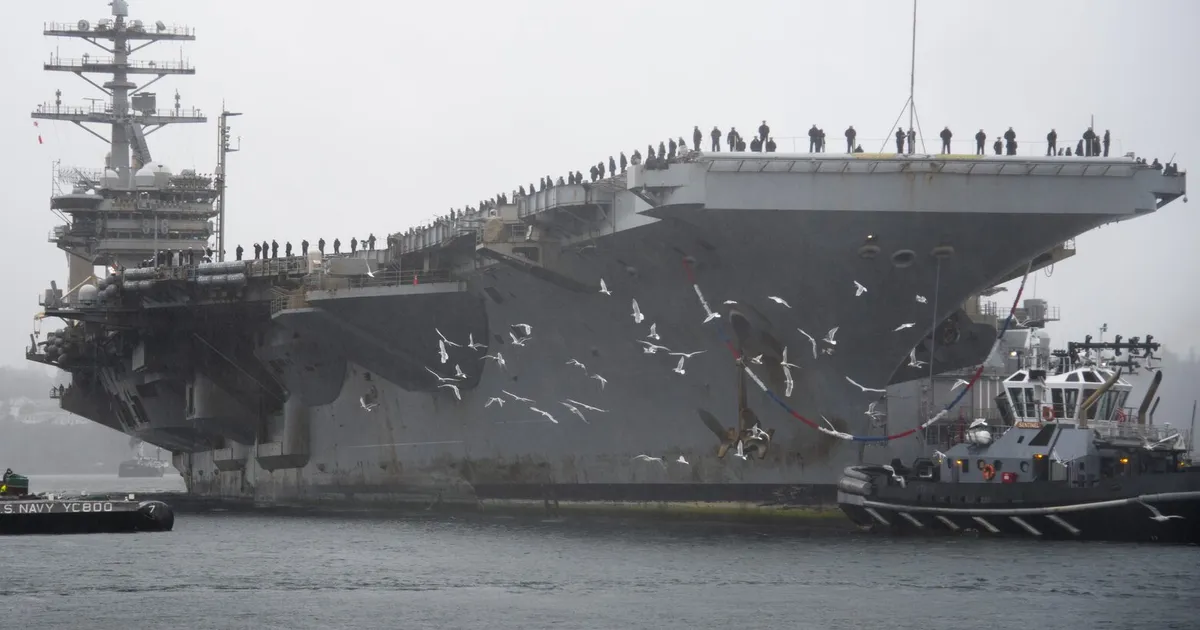
BREMERTON — The rain poured and the wind howled as dozens of loved ones of sailors onboard the USS Nimitz stood on the pier under a pavilion. Their clothes drenched as the rain blew in sideways, many still waited eagerly for hours, holding signs, balloons and flowers for those they hadn’t seen in nine months.
As the ship approached, the crowd cheered, and cheered again as the sailors finally disembarked.
Back in 2014, I was one of those sailors. Now I’m a political reporter for The Seattle Times, and watching the ship come back to Bremerton on such a gloomy, blustery day brought back memories of the times I returned to Washington after weeks away, unfazed by the weather and just happy to be home.
This return is different, however. Tuesday likely marked the final time the Nimitz (CVN 68) — the oldest aircraft carrier in the U.S. Navy fleet — will return from a deployment before she is retired.
It has been widely reported that the Nimitz will be decommissioned in 2026, but Commanding Officer Joseph Furco did not say Tuesday when that might happen. He told reporters they were looking forward to “continuing operations” in the meantime.
Commissioned in Norfolk, Va., in 1975, the Nimitz became the first of the 10 Nimitz-class carriers in operation today, and will eventually return to Norfolk to be decommissioned. This means retiring a ship from service and typically involves removing hazardous materials and usable parts before dismantling the ship itself. The Nimitz has been homeported in Bremerton since 2015, and was previously homeported in Everett from 2012 to 2014. From 1987 to 2001 she was also stationed in Bremerton before moving to San Diego.
Although I did not do a full deployment with the Nimitz, I did go out to sea for weeks at a time for various training exercises before the ship had to undergo long-term maintenance in the shipyard.
My job was to be a Navy photographer and reporter and it was in this job that I found a love for journalism. While on the Nimitz, I flew on helicopters to photograph the ship as part of training exercises, photographed jets taking off from the flight deck and wrote stories for our ship’s newspaper about the hardworking people who made the “Mighty Nimitz” run.
The job also gave me the chance to see the Nimitz for what she is — an aging ship that requires many hands to keep her maintained. Even then it was easy to see the toll the years had taken on her, and I often thought about the sailors from previous decades who worked tirelessly to keep her running. I had some of the hardest, most exhausting days of my life while on the Nimitz. I’m sometimes grateful, and often conflicted, about being a part of her history, if only briefly.
Kimberly Seavey was one of dozens of people I met getting pummeled by the rain Tuesday as she waited for her husband, Tyler, to disembark. As part of a raffle he was one of the first off the ship to meet his wife for the traditional “first kiss” on the pier. Seavey said it was a “roller coaster” of emotions leading up to seeing her husband again after nine months, and said she cried as she saw the ship pulling in.
“When I first got here I was shaking because I was very anxious, but now I’m just shaking because I’m cold,” she laughed. “And I’m very excited and looking forward to this moment.”
Maria Villegas, who traveled from Sacramento, Calif., looked for her boyfriend of four years, holding a sign that read “I’ve waited 270 days for this moment! Welcome home my love.” Villegas said the deployment meant a lot to her and her boyfriend because she knows how hard he has worked.
“Coming from the background that we came from makes me very proud of him,” she said.
Hearing the Nimitz was coming back, likely for the final time, spurred me to reach out to others I served with while on the Nimitz to swap stories and reminisce.
A former mass communication specialist, Eli Buguey said he first arrived at the Nimitz in 2013. Now a barbecue cook and aspiring comedic writer in South Carolina, Buguey recalled facing challenges such as trying to quickly improve as a photographer by shooting thousands of photos a week during his time on the ship. He said he worked hard and also had the help of good mentors. He joked that his time in the Navy was the “greatest experience” he never wants to have again.
Buguey handled repair parts for the ship as part of his duties. He said he was “constantly thinking of things breaking down” and would blame it on the Nimitz’s age. But now he’s more reflective, saying the planned decommissioning is like “watching your first car get towed away.” There’s a “bittersweet” sense of loving something regardless of it being a hard thing in one’s life.
“She’s not the prettiest girl at the ball,” he said, “but she’s our girl.”
During the final deployment, Furco said the Nimitz went to locations including the Pacific Ocean, the South China Sea, Africa and the Middle East. The Nimitz also had several port calls, including Guam, Malaysia, Bahrain, Oman, Dubai, Hawaiʻi and San Diego.
All told, the Nimitz traveled about 82,000 nautical miles, and had some complications. During an April port call in Guam, a sailor went missing and has yet to be found. The Navy paused efforts to locate him five days after he disappeared, but the case remains open.
In October, a fighter jet and a helicopter crashed within 30 minutes of each other into the South China Sea, prompting an investigation. All five crew members involved were rescued.
The Nimitz was also redirected to the Middle East in June amid rising tensions between Iran and Israel. The Nimitz has often found itself as a key player in conflicts in the Middle East, including in Iraq in 1990 and 2004, Afghanistan in 2001, and Syria in 2014, according to reporting by Stars and Stripes.
Additionally, the ship’s carrier wing participated in attacks on alleged Islamic State targets in Somalia during a time when airstrikes there have substantially increased over the years as part of efforts that have long been criticized by groups such as Amnesty International for lack of accountability in civilian deaths.
Still, Rear Adm. Fred Goldhammer, commander for Carrier Strike Group 11 of which the Nimitz is a part, called the effect of the strike group “positive,” and claimed its actions promoted “prosperity and security, deterring aggression and protecting the American way of life,” in a news release.
During deployment, life aboard the ship is not easy for sailors because of a number of factors, including being away from home and exhaustion from long hours.
Marco Hernandez was an aviation boatswain’s mate during his time onboard the Nimitz in the early 2010s, a job that required long hours on a hot flight deck while out at sea, and keeping one’s “head on a swivel.” Flight deck jobs are considered some of the hardest on an aircraft carrier.
“I think it’s a time of my life that I will always cherish, as difficult as it was,” he said.
Despite the long hours, he fondly recalled returning to “American soil” in Hawaiʻi after both of his deployments and doing honors from the flight deck as the Nimitz passed the Pearl Harbor Memorial, a memory that choked him up as we spoke. Hernandez, now a Ph.D. student in biology at the University of South Carolina, said he remembers himself and other sailors at the time — now more than a decade ago — questioning how the ship was still operating due to her age, but added he’ll be sad to see the Nimitz decommissioned.
How do I feel, seeing the Nimitz come into a Washington port for likely the last time? It made me reflect on my whole time in the Navy. I often feel conflicted about feeling like I had no other choice but to join the military for better opportunities but I appreciate the discipline the Navy provided, the experiences I had and the people I met.
Aiyana Wangler is a former mass communications specialist, like me, who first got to the ship when she was 19. She said that she “was really kind of growing up on the Nimitz” from 2013 to 2016, and said it was a “unique experience” for her as she was away from family for the first time and traveling the world. She attributed her success in her current role as a public affairs specialist to her time on the Nimitz.
Wangler said covering the first landing of the F-35 was one of her favorite memories, and said she enjoyed escorting media outlets to the flight deck to watch a “piece of history.” Although most new sailors are required to go “cranking,” which is performing unpleasant ship duties for a set amount of time outside of one’s actual duties, Wangler said she now looks back on that time “fondly” as well, laughing at the harmless pranks she liked to pull to pass the time.
She said, “It kind of feels like you’re a part of history being on the oldest carrier.”
Shauna Sowersby: 206-652-7619 or ssowersby@seattletimes.com. Shauna Sowersby is the state politics reporter for The Seattle Times. She covers the state Legislature, government agencies and the inner workings of state government from Olympia.