
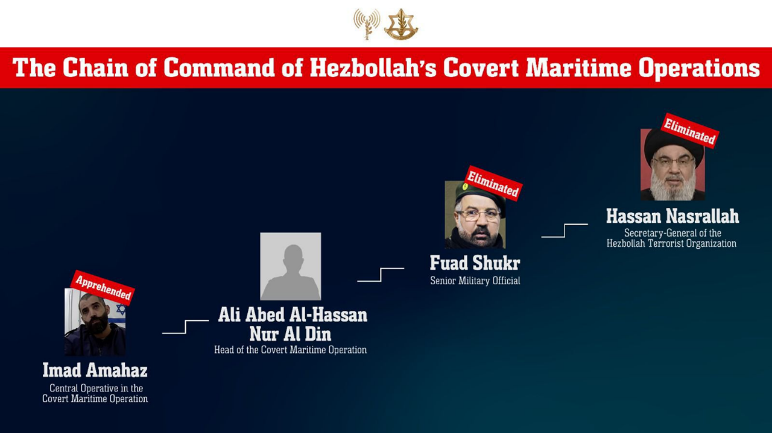
 The command chain of Hezbollah’s secret maritime project, revealed in Amhaz’ interrogation (IDF spokesperson, December 19, 2025)
 Mahmoud Qamati (Lebanon On TV, December 18, 2025)
 The prime ministers of Lebanon (right)and Egypt (Lebanese National News Agency, December 19, 2025)
 commander of the Lebanese army, Haykal, with his French counterpart (X account of the Lebanese army, December 18, 2025)
 al-Mousawi (al-Manar, November 19, 2025)
 The shipment of confiscated RPGs (Telegram channel of the Syrian Interior Ministry, December 17, 2025)Overview[1]
The IDF continued attacking Hezbollah targets in south Lebanon to enforce the ceasefire agreement, which prohibited the organization’s presence south of the Litani. The IDF reported that in the year since the ceasefire, more than 370 terrorist operatives, most of them from Hezbollah, had been eliminated and there had been approximately 1,200 targeted ground operations to destroy terrorist infrastructure and damage the organization’s military capabilities.
The IDF continued its activity to enforce the ceasefire agreement and prevent Hezbollah’s military buildup, attacking targets in south Lebanon and in the northern Beqa’a Valley, including a training camp. Two Hezbollah terrorist operatives and one from Amal were eliminated. The IDF revealed details about a covert Hezbollah project for attacking Israel from sea.
Hezbollah said the “resistance” was prepared to defend itself and Lebanon if attacked and would operate from anywhere in the country even if it had no presence south of the Litani River.
According to reports, the monitoring meeting of the Israeli and Lebanese delegations ended without progress because Israel refused to withdraw from the points it held in south Lebanon until the Lebanese army implemented the disarmament plan as required.
A UNIFIL spokesperson claimed that UN forces had not identified any Hezbollah presence or new facilities in south Lebanon since the ceasefire at the end of November 2024.
Lebanon’s prime minister, Nawaf Salam, said he expected to announce the disarmament of the area south of the Litani River at the beginning of 2026, after which the second stage would begin, disarming the area between the Litani River and the Awali River. However, Hezbollah rushed to state that it was committed only to disarmament south of the Litani and that there was pressure on the Lebanese government to impose new “rules of engagement.”
The commander of the Lebanese army met with the envoys of the United States, France and Saudi Arabia and briefed them on the progress of the army’s plan to ensure a state’s monopoly on weapons. France is reportedly working with the United States and Israel to expand the Lebanese army’s freedom of action south of the Litani, but the Lebanese army said it would not conduct searches in private homes without consent or a warrant.
Power struggles reportedly continue in Hezbollah between the moderates, headed by secretary general Na’im Qassem and the conservatives, concerning the issues of disarmament and military buildup, affecting appointments in the organization’s top ranks and eroding Hezbollah’s public legitimacy.
Hezbollah figures in the Beqa’a Valley region were suspended on suspicion of embezzling $9 million from funds earmarked for Lebanese who were displaced in the war with Israel.
Al-Qard al-Hassan Association, Hezbollah’s financial arm, denied reports that it intended to change its current name to circumvent American pressure.
Two London residents were charged with membership in Hezbollah and training at a base used by Hezbollah’s aerial wing for UAV activity.
Israel-Hezbollah Tension
The IDF
This past week the IDF continued attacking Hezbollah targets in south Lebanon and the northern Beqa’a Valley to enforce the ceasefire agreement of November 2024, prevent Hezbollah’s renewed military-terrorist buildup and keep it from replenishing its arsenal. The IDF attacked military facilities and launch sites at a Hezbollah training camp, and buildings used to store weapons. Two Hezbollah terrorist operatives were eliminated (IDF spokesperson, December 15–22, 2025). Media outlets in Lebanon reported three fatalities in the IDF attacks, including two Hezbollah operatives and an Amal operative, and ten wounded (al-Nashra and the Telegram channel of South Lebanon – Watching the Enemy, December 15–22, 2025).
The IDF revealed that Hezbollah had developed a covert maritime project for maritime terrorist activity under a civilian cover to attack Israeli and international targets. The information was revealed during the interrogation of Imad Amhaz, a leader of the project who was captured in a naval commando operation in north Lebanon in November 2024 during the war with Hezbollah. Amhaz underwent military training in Iran and Lebanon, and at the Lebanese Marseti civilian maritime institute. During questioning Amhaz said the project was directly managed by Nasrallah and Hezbollah’s former military commander Fuad Shukr, who was eliminated in July 2024, and under the command of Ali Abd al-Hassan Nour al-Din (IDF spokesperson, December 19, 2025).
The command chain of Hezbollah’s secret maritime project, revealed in Amhaz’ interrogation
(IDF spokesperson, December 19, 2025)
Hezbollah
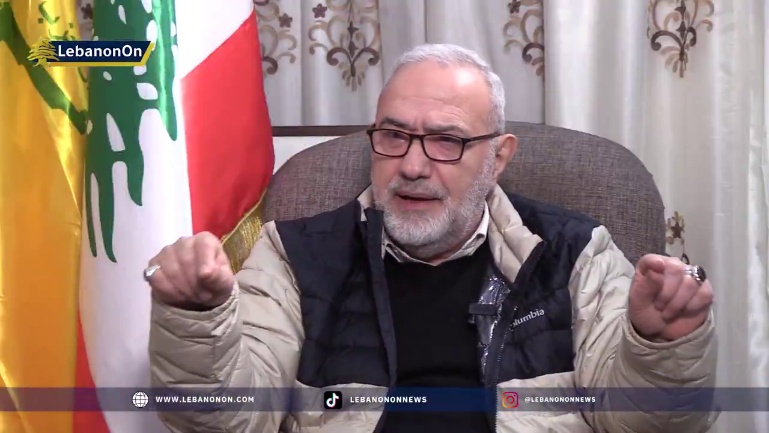
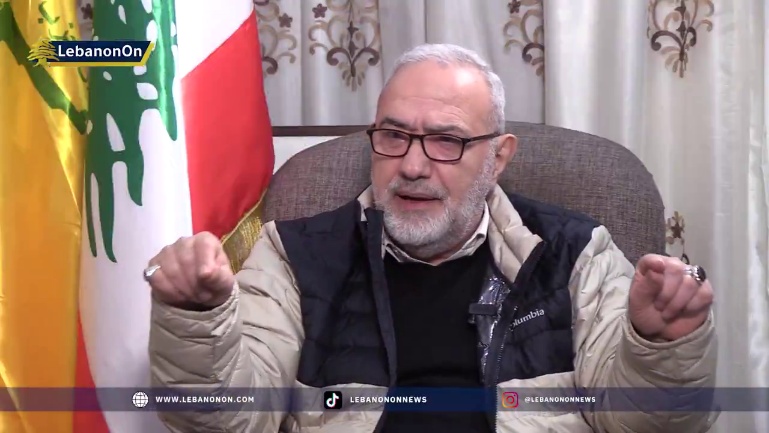
The deputy head of Hezbollah’s political council, Mahmoud Qamati, said that in any future confrontation the organization would immediately act “defensively,” without consultations, and would “defend Lebanese land under all circumstances,” even if it was not deployed south of the Litani. He claimed Hezbollah operated as “ghosts” and would act from anywhere required. He rejected the demand to disarm and claimed Hezbollah did not sanctify the weapons themselves but their role “in defending Lebanon,” which he claimed faced existential threats. He called on Arab states to support Hezbollah, claiming that the “resistance”[2] was “a first line of defense” against Israel and the consequences of its regional activity, while at the same time criticizing American pressure to disarm the organization while extensive military aid was being funneled to the Lebanese army (Lebanon On TV, December 18, 2025).
Mahmoud Qamati (Lebanon On TV, December 18, 2025)
Hussein al-Hajj Hassan, a member of the Hezbollah faction in the Lebanese Parliament, also accused that the “Zionist enemy” of exerting security, military and political pressure to eliminate the “resistance” and its weapons, but rushed to add that the “resistance” was still ready to defend Lebanon and its interests. He said Hezbollah had no intention of surrendering and the “resistance” had the right to defend itself if attacked (al-‘Ahed, December 21, 2025).
Ali Fayyad, a member of the Hezbollah faction in the Lebanese Parliament, said it would be “dangerous” if during negotiations with Israel, Lebanon moved from discussing Israeli withdrawal from the “occupied” sites, the cessation of “aggression” and the release of Lebanese prisoners to discussing an economic or political issue. He said the unconditional return of village residents to south Lebanon, the application of state sovereignty over all its territory, the deployment of the army, particularly in the south of the country, and Lebanon’s right to defend itself had to be the pillars of the Lebanese position and should not be retreated from. Fayyad claimed that Lebanon’s agreement to negotiate despite the continuation of daily Israeli eliminations and aerial attacks exposed “the magnitude of futile concessions to the enemy” (al-‘Ahed, December 21, 2025).
Ali Haidar, the Israel affairs commentator at Hezbollah’s daily al-Akhbar, wrote an op-ed piece claiming that since the beginning of the ceasefire in November 2024, Israel had been trying to remove Hezbollah from controlling the internal Lebanese arena and overseeing the direct confrontation with Israel. According to Haidar, Israel had failed to leverage tactical achievements into strategic decisions and to end the war on its own terms or fundamentally change the rules of engagement. Israel changed its strategy to garnering achievements after the war, with American assistance, while trying to defeat Hezbollah through the internal Lebanese arena. However, he claimed, that also failed, since Hezbollah did not disarm, dismantle its facilities or change its “operational concept.”[3] Haidar argued that Hezbollah’s lack of response did not indicate collapse or loss of capability, but rather a strategic calculation of cost versus benefit, whose objective was to prevent comprehensive escalation, preserve internal stability, enable rehabilitation and “renew preparation,”[4] while Israel was acting without a clear horizon (al-Akhbar, December 16, 2025).
The Lebanese Government
On December 19, 2025, another meeting of the ceasefire monitoring mechanism was held in Naqoura with the participation of Israeli and Lebanese delegations. Before the meeting, Lebanon’s president, Joseph Aoun, instructed the head of the Lebanese delegation, former ambassador Simon Karam, to present Israel with four demands: an official commitment to halt the attacks, the return of Lebanese prisoners, a gradual or full withdrawal from Lebanese territory and initiating a discussion on amending the Blue Line, while Beirut would not agree “to be dragged” into discussion about politics or normalization (al-Madan, December 18, 2025). After the meeting Karam briefed Aoun, who said the return of border village residents to their homes was a precondition for any further discussion (X account of the Lebanese presidency, December 19, 2025). Hezbollah’s daily al-Akhbar claimed that the meeting ended in a stalemate after Israel refused to withdraw from the points under its control in south Lebanon, to halt the attacks or to release Lebanese prisoners, arguing, with American backing, that the Lebanese army was not implementing the disarmament plan as required (al-Akhbar, December 20, 2025).
Nabih Berri, speaker of the Lebanese Parliament, referring to the Israeli attacks on Hezbollah facilities in south Lebanon and in the Beqa’a Valley on December 18, 2025, called them a message sent by Israel before the meeting of the Lebanese army commander, Rodolph Haykal, with representatives of France, the United States and Saudi Arabia, which took place in Paris shortly afterwards. Berri called the attacks a “belt of fire” in honor of the monitoring mechanism meeting the following day (Telegram channel of the Amal Movement, December 18, 2025).
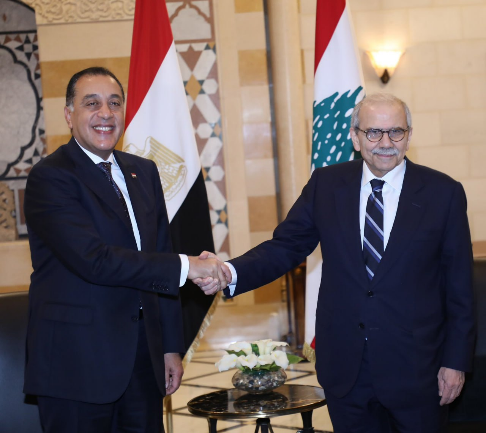
Meanwhile, Egypt continued its efforts to prevent further escalation between Israel and Hezbollah. Egypt’s prime minister, Mostafa Madbouly, visited Beirut and met with President Aoun, Prime Minister Nawaf Salam and Parliament Speaker Berri. Madbouly stressed Cairo’s opposition to Israeli “violations” and the continuation of the “occupation” in south Lebanon and called on Israel to respect the ceasefire agreement and UN Security Council Resolution 1701, and to withdraw immediately from Lebanese territory. He also expressed support for the Lebanese army’s expanding the authority of the state (Lebanese National News Agency, December 19, 2025). Egypt’s ambassador to Lebanon met with Muhammad Raad, head of the Hezbollah faction in the Lebanese Parliament, who said the organization was not prepared to discuss the “containment of weapons” north of the Litani River, claiming that Resolution 1701 and the ceasefire agreement applied only south of the river (al-Madan, December 19, 2025). According to reports, contacts took place between Egypt and Hezbollah “at the highest levels and through back channels, away from the media,” to find common denominators that would make it possible to emerge from “the current deadly stalemate.” “Sources” said that understandings were at an advanced stage due to mutual desire, “Egyptian admiration” for the organization’s “realism” and understanding of Hezbollah’s concerns in light of Israel’s “continued obstinacy” (al-Diyar, December 21, 2025).
The prime ministers of Lebanon (right)and Egypt
(Lebanese National News Agency, December 19, 2025)
The Lebanese Army
A Lebanese army force located a Hezbollah tunnel on the outskirts of the town of Toulin in south Lebanon. According to reports, army soldiers arrived at the site accompanied by UNIFIL forces in accordance with a request by the ceasefire monitoring mechanism, after information received from Israel indicated the existence of the tunnel. During the digging, an opening was found that led to a small room that was empty of weapons and equipment (al-Mayadeen, al-Akhbar and Lebanon Debate, December 17, 2025).
The commander of the Lebanese army, Rodolph Haykal, met with the state secretary at the German Ministry of Defense, Nils Hilmer, to discuss bilateral military cooperation. They signed two agreements to support the Lebanese army’s facing the “current challenges,” which included the supply of fuel to the army and the strengthening of the military medical corps (X account of the Lebanese army, December 15, 2025).
UNIFIL
UNIFIL spokesperson Candice Ardell claimed that UN forces had not found evidence of the entry of new weapons into Lebanese territory since the ceasefire agreement went into force at the end of November 2024, nor were new facilities built by non-state actors or military movements by non-state actors found. She said the situation in south Lebanon remained fragile, but the peacekeepers continued their efforts to maintain stability (German News Agency, December 19, 2025).
Challenges for Hezbollah[5]
Disarmament
Lebanon’s prime minister, Nawaf Salam, said in practice, the state had authority south of the Litani River to the border except for the points still held by Israel. “Lebanese sources” reported that the Lebanese army had confiscated and destroyed thousands of tons of weapons and uncovered about a hundred tunnels. Salam said the completion of the first stage would be declared at a government meeting held at the beginning of 2026 and afterward the second stage of the army’s plan was expected to begin, focusing on the area between the Litani River in the south and the Awali River in the north. The third stage is supposed to be carried out in Beirut and Mount Lebanon, the fourth in the Beqa’a Valley, and afterward the rest of the country. According to Salam, the transition to the second stage was supposed to occur even without parallel Israeli steps, but he noted the need to halt the attacks. He also linked progress in the next stage to cooperation from Hezbollah and said the state’s monopoly on weapons was a core condition for the rehabilitation of the south, the operation of state institutions and freedom from the cycle of violence and instability (al-Sharq al-Awsat, December 20, 2025).
In response to Salam’s remarks, an article criticizing him was published in Hezbollah’s daily al-Akhbar, claiming that he was rushing to announce the transition to the second stage of the plan “having received nothing in return from the Israeli enemy,” which was “capitulation” to external pressure and to threats that Israel would escalate its attacks. According to the article, at the government meeting scheduled for January 5, 2026 Salam planned to announce that the area south of the Litani River had been disarmed, even though the army commander, Rodolph Haykal, said he could not declare it before Israel completed its withdrawal from the five points it holds in south Lebanon. “Political sources” said Salam’s statement regarding the transition to the second stage was not surprising, it had been discussed behind the scenes and was known to Hezbollah, but the organization intended to make clear that it did not intend to hand over “even a single bullet” north of the Litani as it was committed only to the area south of the river (al-Akhbar, December 22, 2025).
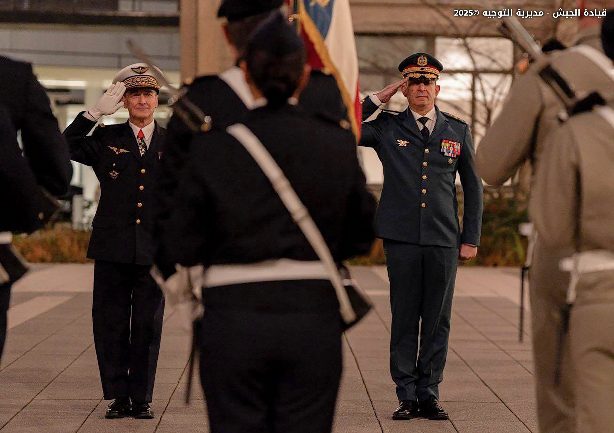
The commander of the Lebanese army, Rodolph Haykal, met in Paris with the three envoys to Lebanon, Jean-Yves Le Drian of France, Morgan Ortagus of the United States and Prince Yazid bin Farhan of Saudi Arabia, to brief them on the progress of the army’s plan to ensure the state’s monopoly on weapons. According to a statement from the Élysée, the three expressed support for Lebanon’s efforts to implement the ceasefire agreement and agreed to establish a committee to prepare an international conference to support the Lebanese army and internal security forces during February 2026. They also expressed support for the Lebanese armed forces and their sacrifices (al-Sharq al-Awsat, December 18, 2025). Earlier, Haykal met with his French counterpart, Fabien Mandon, who noted his country’s commitment to continuing assistance to the Lebanese army to maintain the country’s security, alongside appreciation for the efforts made by the Lebanese army in the first stage of the plan south of the Litani (X account of the Lebanese army, December 18, 2025).
commander of the Lebanese army, Haykal, with his French counterpart
(X account of the Lebanese army, December 18, 2025)
“Sources” reported that France was working with the United States and Israel to grant the Lebanese army broader freedom of action in disarming south Lebanon, while devising a “verification mechanism” under which the army would examine Israeli claims regarding the presence of weapons and military sites in south Lebanon. According to the report, in several cases already examined, no evidence was found supporting the Israeli claims. “Sources in the Lebanese army” said the army would not conduct searches in private homes without the owners’ consent or a warrant and rejected demands to act as an “enemy policing arm” (al-Akhbar, December 20, 2025).
“A source in Hezbollah” said that the organization was under political pressure from Arab and international actors whose objective was to neutralize or disarm Hezbollah. According to “the source,” Israel and the United States were working to advance a gradual move towards freezing the use of weapons and expanding the disarmament zone from south of the Litani River up to the Awali River, to distance Hezbollah from northern Israel and impose new rules of engagement. The “source” claimed that the pressures were meant to achieve Israel’s objectives without a full-scale war, by exploiting Lebanon’s adherence to the ceasefire and the deployment of the Lebanese army in the south. However, the “source” claimed that Hezbollah did not view itself as weakened and rejected any further concessions or disarmament (al-Joumhouria, December 19, 2025).
A “government source” said Hezbollah did not reveal its true positions and was careful to harden its political demands, while fundamentally opposing the state’s monopoly on weapons, despite its formal support for the government declaration and its participation in it. According to the “source,” mediation efforts by Egypt and France had stagnated, partially due to the absence of an Iranian response to proposals raised by the head of Egyptian intelligence, Hassan Rashad, to accept the Lebanese army’s plan for implementing Resolution 1701. He added that the organization wanted to preserve its weapons as an asset in Iran’s hands for regional purposes, even at the price of worsening isolation and deepening the internal crisis (al-Sharq al-Awsat, December 20, 2025).
A further expression of Hezbollah’s intransigence came from Ihab Hamada, a member of the Hezbollah faction in the Lebanese Parliament. who said Hezbollah would not disarm or have its weapons frozen and that discussions on the issue could take place only after a full implementation of the ceasefire and within the framework of a national defense strategy. He also attacked Foreign Minister Youssef Rajji and claimed that his remarks against the organization’s weapons and Iran’s policy did not represent Lebanon and were intended to divide the public (al-Mayadeen, December 17, 2025). His colleague in the faction, Ali Fayyad, also said Hezbollah would be prepared to discuss a national defense strategy only after an Israeli withdrawal, the cessation of attacks and the release of prisoners. He also sharply criticized the Lebanese foreign minister, claiming that he was damaging national interests and taking a hostile stance toward the “resistance” and its allies (Sputnik Agency, December 18, 2025).
Internal Hezbollah Tensions
“Sources close to Hezbollah” said the organization’s leadership had recently been dealing with internal tensions. According to “sources,” there were power struggles within the Shura Council, which were also influenced by the split between pragmatic and conservative elements in Iran, paralyzing decision-making and casting doubt on the ability of the current leadership to impose consensus. One example is the delay in formally appointing the chairman of Hezbollah’s parliamentary bloc, Mohammad Raad, as deputy Hezbollah secretary general, which is perceived as a sign of hesitation by secretary general Na’im Qassem and pressure from conservative elements opposing renewal in the structure of the leadership, especially the appointment of a political figure who is not a cleric. “Sources” said the appointment, should it occur, would cause a struggle over the leadership of Hezbollah’s parliamentary bloc and worsen the internal turbulence (Janoubia, December 16, 2025).
According to reports, Hezbollah secretary general Na’im Qassem was trying to strengthen his control and promote a more moderate approach, including on the weapons issue, but was opposed by an extremist faction which adhered to preserving and rehabilitating military-terrorist capability. The meeting of the senior advisor to Iran’s leader for international affairs, Ali Akbar Velayati, with Hezbollah’s representative in Tehran, Abdallah Safi al-Din, was remarkable and perceived by “informed sources” as a signal of strengthening Iranian support and even as laying the groundwork for the future appointment of Safi al-Din to a senior leadership role. However, it was reported that Qassem was making broad appointments in the military and security forces to preserve his standing (al-Jarida, December 17, 2025).
Other reports quoted “sources close to Hezbollah” who said the organization was at a particularly sensitive point caught between the hard-liners and the more pragmatic leaders, the internal and external pressures surrounding the weapons issue and the status of the state. There was also criticism of secretary general Qassem’s leadership, due to the failure of managing the crisis of the displaced persons, the cessation of compensation to families of the dead and poor economic management. In addition, the criticism had also damaged relations with the Amal movement and its leader Nabih Berri. According to the reports, despite calls to replace Qassem, there was concern that such a move would deepen the split, while his continued leadership could accelerate the erosion of the organization’s public legitimacy (Aram News, December 17 and 19, 2025).
Reorganization of Hezbollah
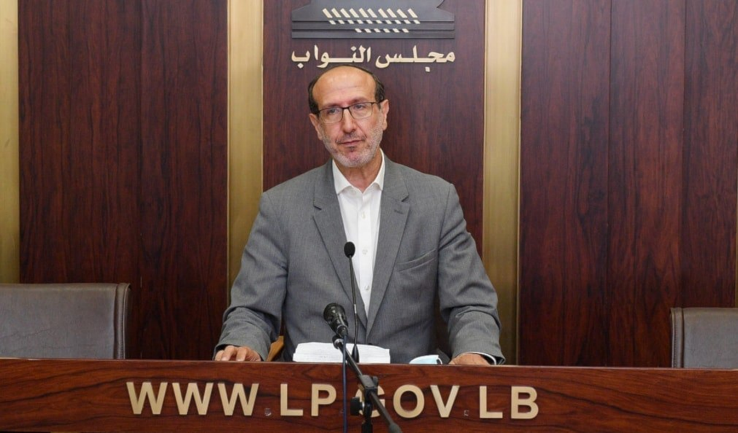
Hezbollah’s Shura Council voted to establish a central information authority which would consolidate all the organization’s media outlets under it, television, radio, digital platforms and public relations. It will be headed by Ibrahim Mousawi, a member of the Hezbollah faction in the Lebanese Parliament. The move is regarded as applying lessons learned from the elimination of the previous head of the information apparatus, Muhammad Afif, about ten days before the ceasefire in November 2024. The general assessment is that Israel will not eliminate members of parliament, a consideration that influenced choosing Mousawi in an effort to stabilize and strengthen the organization’s propaganda apparatus in the post-war era (al-Akhbar, December 16, 2025).
al-Mousawi (al-Manar, November 19, 2025)
Iranian Involvement
Iran’s ambassador to Lebanon, Mojtaba Amani, met with Nabih Berri, speaker of the Lebanese Parliament, to discuss the Israeli “violations” of the ceasefire and the resumption of flights between Tehran and Beirut via Lebanese or Iranian airlines (X account of Iran’s ambassador to Lebanon, December 17, 2025).
The Economic Challenge
Al-Qard al-Hassan Association, Hezbollah’s financial arm, said it would continue to operate under its current name and provide financial services while “complying with legal requirements.” The statement was issued in response to a report claiming that the association used alternative names in financial documents to circumvent restrictions of the Lebanese bank and evade American pressure to halt its activity. Previous reports also claimed Hezbollah was considering changing the association’s name and transferring it to the supervision of the Central Bank (al-Manar, December 17, 2025).
The Challenge of Reconstruction
Reportedly, several Hezbollah figures in the Beqa’a Valley, including the official responsible for the eastern sector, Abbas Ali Hassan Mohammad al-Mousawi, were suspended because they were suspected of embezzling from Hezbollah’s Samidoun (“steadfastness”) program for assistance in rebuilding the destruction and providing housing for residents affected by the Hezbollah-Israel war. According to the report, $9 million was embezzled from public and private funds and donation money allocated to residents. Al-Mousawi and three other figures received the support of Talal Hamiya, a close aide of the organization’s secretary general, Na’im Qassem (Lebanon Debate and al-Arabiya, December 21, 2025).
According to reports, 100,000 Lebanese Shi’ites who were displaced from their homes following the Hezbollah-Israel war were still living in various areas more than a year after the ceasefire. In addition, about 90,000 of the displaced left the area near the border with Israel, half of them moved to other villages and towns in south Lebanon, including Tyre and Nabatieh, and others moved to the Dahiyeh al-Janoubia south of Beirut and other areas in the city. About 10,000 residents of the Dahiyeh al-Janoubia are still displaced, half of them remaining in the capital and the rest having moved to nearby areas, including suburbs of Mount Lebanon adjacent to Beirut. Beyond the delay in reconstruction, most of the displaced chose not to return to their homes due to fear of renewed fighting. In addition, hundreds of displaced families were still waiting for a new cash grant for rent and housing which Hezbollah was supposed to transfer to owners of homes that had been destroyed, after similar sums were transferred about a year ago (al-Sharq al-Awsat, December 21, 2025).
Foreign Relations
According to reports, Ammer al-Mousawi, in charge of Arab and international relations in Hezbollah, paid a secret visit to Saudi Arabia, mediated by Turkey. The visit was coordinated with Parliament Speaker Nabih Berri and with the full knowledge of President Joseph Aoun. “Sources” said that the talks in Saudi Arabia did not deal with disarming Hezbollah, but included proposals for Saudi guarantees and the possibility of postponing the parliamentary elections scheduled to take place in May 2026 until the situation in Lebanon stabilized (Nidaa’ al-Watan, December 17, 2025).
Prevention of Weapons Smuggling
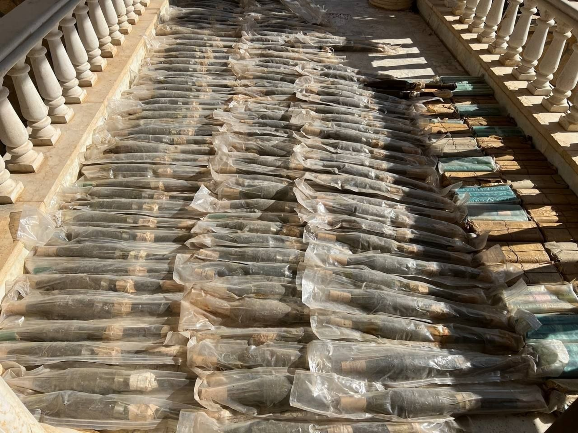
A Syrian internal security force prevented a weapons shipment from being smuggled into Lebanon. The security forces waited in ambush near the border and ten confiscated a cache of RPGs packed in preparation for smuggling across the border, and transferred them to the relevant authorities. The area is known as a smuggling zone with informal border crossings (Telegram channel of the Syrian Interior Ministry, December 17, 2025).
The shipment of confiscated RPGs
(Telegram channel of the Syrian Interior Ministry, December 17, 2025)
International Activity Against Hezbollah
The British police stated that two London residents were charged with terrorism offenses, membership in Hezbollah and receiving military training in Lebanon. The two, Anis Makki (40 years old) and Muhammad al-Hadi Qassir (33 years old), were arrested in April 2025 and released on bail, but were rearrested in early December 2025 and indicted. According to the indictments, Makki had belonged to Hezbollah at least since the beginning of 2020, supported Hamas after the October 7, 2023, attack and massacre, and was involved in preparing terrorist activities, while Qassir had belonged to Hezbollah since February 2015. According to the indictments the two underwent terrorist training at the Birkat Jbour airbase in south Lebanon in September 2021. The airfield was used by Hezbollah’s aerial wing for UAV activity, as revealed by former defense minister Yoav Gallant in September 2023, and which was attacked by the IDF in January 2024 (Metropolitan Police Service website of London, December 16, 2025).
Palestinians in Lebanon
The Arab University for Political Sciences held a two-day conference in Beirut dealing with “resistance” movements and independence in the third world and drawing lessons for the Palestinian arena. Representatives from organizations identified with the “resistance axis,”[6] including Hezbollah, Hamas, the Palestinian Islamic Jihad and Amal, participated in the conference. Hamas’ representative in Lebanon, Ahmed Abdelhadi, stated that the Palestinians would not disarm but would “flexibility” to advance the next stage of the ceasefire agreement in the Gaza Strip. Ihab Hamada, a member of the Hezbollah faction in the Lebanese Parliament, noted the need to exhaust all means of “resistance”[7] (al-‘Ahed, December 17, 2025).
[1] Click https://www.terrorism-info.org.il/en to subscribe and receive the ITIC’s daily updates as well as its other publications.
[2] Hezbollah and the other terrorist organizations operating in Lebanon.
[3] The destruction of the State of Israel.
[4] Continue its military buildup and replenish its arsenal.
[5] For further information, see the December 2025 ITIC report, Hezbollah: One Year After the Ceasefire.
[6] Iran, Hezbollah, the Palestinian terrorist organizations, the Houthis in Yemen and the Shi’ite militias in Iraq
[7] Anti-Israel terrorism and violence.
Related Articles