
Unlock the Editor’s Digest for free
Roula Khalaf, Editor of the FT, selects her favourite stories in this weekly newsletter.
For the first time since the Reformation about 500 years ago, Roman Catholics in Dublin will this month attend Christmas services and mass in their own official cathedral.
The 200-year-old St Mary’s Cathedral in a relatively poor part of Ireland’s capital, where many of the city’s Catholics worship, was until recently only designated a “procathedral” — “pro” standing for pro tempore, or temporary.
But the Archbishop of Dublin, Dermot Farrell, recently told mass-goers that it was “with great joy” that Pope Leo had agreed to turn the “pro” into a proper cathedral, ending a long-running debate in the city over whether to locate a permanent Catholic cathedral elsewhere.
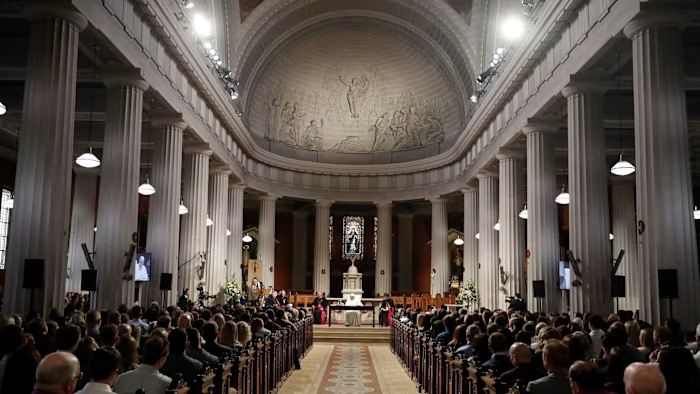
 What is now St Mary’s Cathedral was built in the 1820s © Borisb17/Dreamstime
The designation brings Dublin’s cathedral count to three. Christ Church and Saint Patrick’s, where Jonathan Swift, the author of Gulliver’s Travels, was dean from 1713 until his death in 1745, had been Roman Catholic until the Reformation. But as Protestant English settlers were sent to Ireland in what became known as the “plantations”, Christ Church and Saint Patrick’s were taken over by the minority Church of Ireland — part of the Anglican tradition.
What is now St Mary’s Cathedral was built in the early 1820s, shortly before penal laws limiting the rights of Catholics were finally lifted. The building, with its Greco-Roman columns, also reflected the growing power of a developing Catholic professional class.
The construction simply became known as “the Pro”, with many unaware that it was only a provisional cathedral until Archbishop Farrell’s recent announcement.
There have been several attempts during Dublin’s history to locate a Catholic cathedral elsewhere.
There were proposals in the early 1920s to establish one at the General Post Office, one of Dublin’s most famous landmarks, which was the nerve centre of the Easter uprising against Britain in 1916 — events that ultimately paved the way for the creation of the Republic of Ireland.
But there were legal issues over its ownership. In 1929 it reopened as a post office.
The archdiocese of Dublin then in 1930 bought a site very close to Government Buildings, Ireland’s equivalent of Downing Street, with a view towards building a cathedral on it. Not a single brick was laid — for which no official reason has ever been given — and the proposed site is a popular public garden.
As time passed the procathedral became the main location for religious and state ceremonies for the city’s Catholics. Pope Francis visited it during his 2018 trip to Ireland.
 Pope Francis at St Mary’s in 2018 © Stefano Rellandini/AFP/Getty Images
St Mary’s is situated less than 100 metres behind Dublin’s main thoroughfare, O’Connell Street, but is in an area often linked to crime and drug dealing.
Diarmaid Ferriter, professor of modern Irish history at University College Dublin, who sang in the procathedral’s Palestrina choir in the 1980s, said the building “always had the feeling of being run down”.
But Archbishop Farrell said “the fact that we are making this cathedral the centre of the archdiocese of Dublin, the mother church of Dublin in one of the poorest areas of Dublin, I think that’s significant”.
Recommended

The news of St Mary’s upgrade has been welcomed by daily mass-goers Ann Rafter, 77, and her sister, Brigid Hunt, 74. Their parents were married there, as were they, and it is where they made their first religious sacraments.
“I’m delighted as it’s full of memories for us and its location is perfect for us, too,” Hunt said.
Rafter added: “We always say we’ll meet at ‘the Pro’, so the fact that it has a new name is going to take some getting used to.”