
On most mornings for the past five years, Ronny Tabash has opened the doors of his family’s souvenir shop in Bethlehem despite knowing he would not see a single customer, as Covid and then war in Gaza almost entirely stopped the flow of tourists to the Palestinian city.
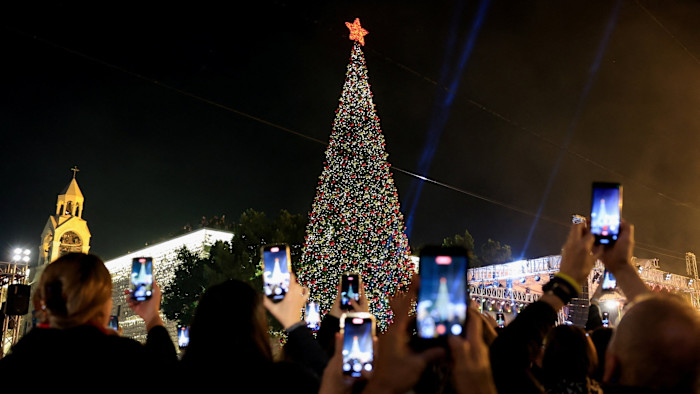
But now he is hoping the hardship could finally start to ease. Earlier this month, the town revered by Christians as the birthplace of Jesus lit its giant Christmas tree for the first time since the outbreak of the war and, after a two-year gap, public celebrations are once again set to take place.
“Every day I opened the store, and it was strange, because no one entered,” said Tabash, sitting in a café just off Bethlehem’s famous Manger Square. “But now I am feeling that life is slowly, slowly coming back. And this is what gives me the power to continue.”
Bethlehem’s authorities decided to reinstate the Christmas festivities — which in past years drew thousands of people to the hilltop city in the occupied West Bank — after a fragile truce brokered by US President Donald Trump halted the war between Israel and Hamas in Gaza.
 The celebrations started with the lighting of the tree and also include a Christmas market and processions involving the local community © AFP via Getty Images
Carmen Ghattas, head of public relations at Bethlehem’s municipality, said that the resumption of the celebrations after two years of mourning was meant to be a message that the city, which has a sizeable Christian population of its own, “remains a beacon for hope, for light, for peace”.
The celebrations started with the lighting of the tree and also include a Christmas market and processions involving the local community.
But like many in the city, Ghattas has deeply mixed emotions about holding any kind of celebration when the situation in Gaza — most of which has been reduced to uninhabitable rubble by the ferocious offensive launched by Israel in response to Hamas’s October 7 attack — remains so desperate.
“Our celebration of Christmas is an act of existence and resistance. This is our country, and we will remain here,” she said. “We will celebrate Christmas here and we want to show the world that there are people here who deserve life, who deserve to celebrate.”
 Bethlehem’s authorities reinstated the Christmas festivities after a fragile truce brokered by US President Donald Trump halted the war © Mahmoud Illean/AP
“But my heart is broken because [of the situation in Gaza] . . . I feel guilty that I have this luxury of food, of a home, of a decent life, of having Christmas celebrations while people just a few kilometres from Bethlehem are deprived of clothes, of food.”
Beyond the symbolism, Bethlehem’s residents are desperately hoping that the ceasefire in Gaza — and another between Israel and Hizbollah in Lebanon — will allow the resumption of the tourist trade, which officials say accounts, directly and indirectly, for 80 per cent of the city’s economy.
More than 8,500 families in Bethlehem depend on visitors for their income, and the collapse in tourism — in combination with intense pressure from Israel’s far right government on the West Bank’s economy — has taken an enormous toll on locals’ livelihoods.
Unemployment, which stood at 15 per cent before the war, has spiralled to 65 per cent, according to Ghattas, and many businesses have had to close.

Among those affected was Kamal Mukarker, a tour guide and part-owner of a guest house in Bethlehem. Before the war, in the high season, he would have three or four tour groups a day. But within days of the outbreak of hostilities, his bookings had evaporated for more than a year in advance.
“Everything was cancelled,” he said. “And every time I saw a cancellation, I was devastated because really we had hopes and dreams and things to build them and to grow.”
What made the situation particularly difficult for many in Bethlehem, he added, was that 2023 had been expected to be the year in which tourism and pilgrimages rebounded after Covid, prompting many small business owners to take out loans that they were now unable to repay. “It was two years that got stolen away from us in prosperity and growth,” he said.
So far, though, there is little sign of tourists returning in significant numbers. In the run-up to Christmas, Manger Square would normally be packed with tourists from around the world milling between market stalls, taking pictures of the giant Christmas tree and paying visits to the city’s holy sites.
 In the days before the festival, Bethlehem’s most famous sites, such as the Church of the Nativity, have been deserted © Atef Safadi/EPA/Shutterstock
But in the days before this year’s festival, Bethlehem’s most famous sites, such as the Church of the Nativity, which marks the spot where Christians believe Jesus was born, and the nearby Milk Grotto — where, according to Christian tradition, the Holy Family hid during a massacre — have been deserted. On the narrow streets around Manger Square, many of the shops are closed and those that are open have found business hard to come by.
Abood Suboh, whose family owns a store selling textiles and wooden goods on the north end of the square, said he had not sold a single item for a week and a half. The few tourists who were coming, he said, were staying in Israel rather than Bethlehem, which meant that they spent far less time browsing for souvenirs than in years gone by.
“It’s really crazy, we never had this situation before,” he said. “Only God knows how we survived.”
But others are determined that despite the difficulties, this year will be more upbeat than the two that have come before.
Earlier this month, Sandra Dallal organised a Christmas market on the roof of a supermarket next to the café she owns with her husband and father. The event drew thousands of Palestinians, and she is now planning to repeat it. “It was a very, very, difficult four years for us. Bethlehem is very tired. It is exhausted from Covid and from the war,” she said.
“So we wanted to do something different to tell people that we are still alive, and that even if we are tired, we can still spread love . . . It was our first Christmas market, but it will not be the last.”