
Unlock the White House Watch newsletter for free
Your guide to what Trump’s second term means for Washington, business and the world
The US labour market slowed sharply over the past three months, according to data released on Friday that intensified pressure on the Federal Reserve to bow to Donald Trump’s calls to slash borrowing costs.
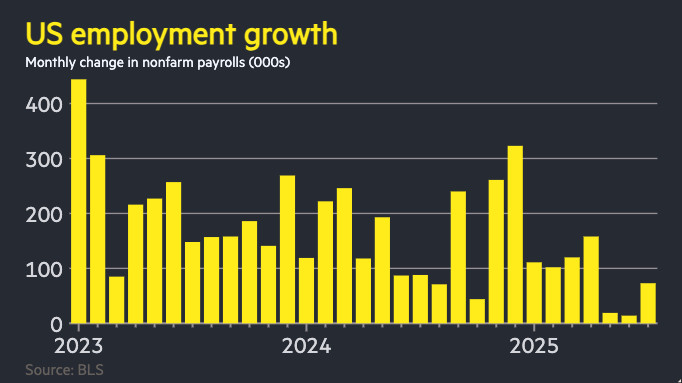
The world’s biggest economy added just 73,000 jobs in July, while hiring figures for May and June were lowered by a combined 258,000, in an unusually large revision by the Bureau of Labor Statistics.
The 106,000 posts added from May to July marked a plunge from the 380,000 added in the previous three months. Friday’s report comes just days after GDP data suggested that the economy is losing momentum, with consumer spending cooling in the first half of 2025.
Trump, who has mounted an aggressive campaign urging Fed chair Jay Powell to cut rates, said following the data release on Friday: “Too Little, Too Late. Jerome ‘Too Late’ Powell is a disaster. DROP THE RATE! The good news is that Tariffs are bringing Billions of Dollars into the USA!”
“Powell could resist pressure to cut rates because the labour market was solid,” said ING analyst Chris Turner. “Payrolls data has rather pulled the rug from under him.”
The weak employment figures, which were well below Wall Street expectations, come as Trump slaps a host of new levies on US trading partners. Powell said this week that the central bank needs to wait and see the effects of tariffs on inflation before taking action on rates.
But short-term US government debt rallied sharply on Friday as traders bet that the Fed would now take more aggressive action to buttress the economy. That pushed yields on two-year Treasuries down 0.19 percentage points to 3.76 per cent, their biggest drop in almost a year.
“The headline miss and large revisions put a Fed cut in September back on the agenda,” said Nicolas Trindade, a senior portfolio manager at Axa’s asset management arm.
Traders in futures markets upped their bets on interest rate cuts over the coming months, pushing up the chance of a quarter-point cut at the meeting next month from 45 per cent to 95 per cent. The market is now fully pricing in two such cuts by the end of 2025.
That shift in expectations knocked the dollar, which dropped 1.1 per cent against a basket of peers.
“The hints of softness in today’s report will likely embolden the doves on the [Federal Open Market Committee], as reflected in market pricing for the September meeting, though there’s still a good amount of data between now and then,” said Michael Feroli at JPMorgan.
The Fed earlier this week held interest rates steady at 4.25 per cent to 4.5 per cent, a level considered to be restrictive, defying Trump’s insistence that they should be lowered imminently to cut government borrowing costs and juice up the economy.
While most rate-setters backed that decision, Powell faced dissent from Fed governors Michelle Bowman and Christopher Waller, who said the central bank should have cut rates by a quarter percentage point. It marked the first time since 1993 that two governors formally objected to a rate decision.
Waller warned before the jobs report on Friday morning that “when labour markets turn, they often turn fast. If we find ourselves needing to support the economy, waiting may unduly delay moving toward appropriate policy.”
The revisions to the May and June numbers were driven by a fall in government hiring — largely at the state and local level — which were slashed by 129,000. Private payrolls were lowered by 139,000, led by retail, leisure and construction.
Friday’s figures also showed a slide in the foreign-born labour force, which has shrunk by 1.2mn over the past six months as Trump leads a crackdown on immigration and a mass deportation campaign.
“Signs are mounting that the foreign-born labour force is shrinking due to the Trump administration’s immigration policies,” said Nancy Vanden Houten at Oxford Economics.