
Much of the updated plan resembles what came out of recent talks in Berlin involving US negotiators Witkoff and Jared Kushner with Ukrainian and European leaders. The setting then moved to Miami last weekend where US President Donald Trump’s team spoke separately to Russian envoy Kirill Dmitriev and then Ukrainian and European officials.
There now appears to be far more detail on the territorial issue, although it is clear the Ukrainian side was unable to reach a consensus with the Americans.
Zelensky explained that if Ukraine was prepared to pull its heavy forces back by five, 10 or 40km in the 25% of Donetsk it still held to create an economic zone, making it virtually demilitarised, then Russia would have to do the same “accordingly by five, 10, or 40km”.
Russian troops are currently about 40km (25 miles) east of Ukraine’s “fortress belt” cities of Sloviansk and Kramatorsk, having captured the town of Siversk.
Russian President Vladimir Putin is unlikely to be impressed by the kind of compromise being proposed for Donetsk. He said this month that Russia would take control of the entire east of Ukraine by force if Ukrainian troops did not pull out.
However, Trump is pushing for a deal to end almost four years of full-scale war and the Ukrainian president believes Russia cannot afford to reject the US plan.
“They cannot tell President Trump, ‘look we’re against a peaceful settlement’,” Zelensky told reporters. “If they try to obstruct everything, then President Trump would have to arm us heavily, while imposing all possible sanctions against them.”
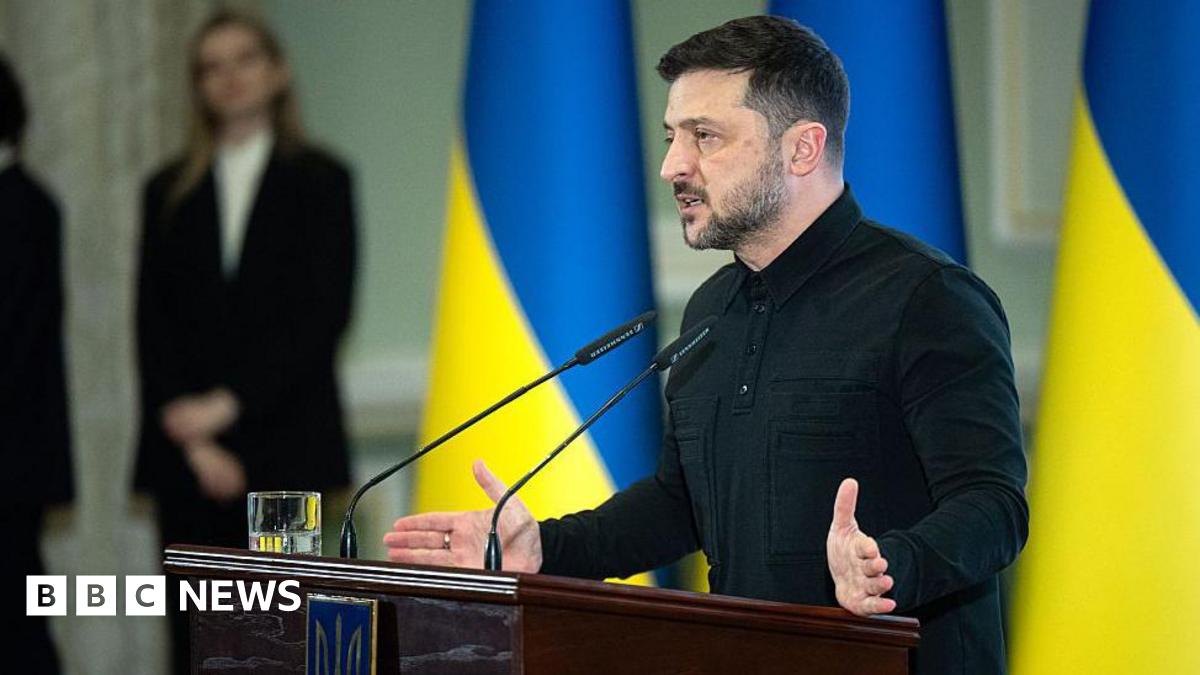
Zelensky made clear that if a free economic zone were established in Donetsk it would have to be under Ukrainian administration and police – “definitely not the so-called Russian police”. The current front line would then become the boundary of the economic zone with international forces on the ground along the contact line to ensure no Russian infiltration.
Russia has so far rejected a European proposal to police any peace deal through a Coalition of the Willing as a “brazen threat”.
A referendum would need to be held on the whole peace plan, Zelensky said, and only a referendum could decide on the idea of a potential free economic zone in Donbas.