

Listen to this article
Estimated 5 minutes
The audio version of this article is generated by AI-based technology. Mispronunciations can occur. We are working with our partners to continually review and improve the results.
The Terrorism Confinement Centre, known by its Spanish acronym CECOT, is the Salvadoran mega-prison at the centre of a recent controversy at CBS’s news flagship 60 Minutes.
A segment about the prison that took a critical look at the Trump administration’s deportation policies was pulled hours before it was set to air, angering CBS employees and raising questions about U.S. government influence over the news division.
But the prison complex was controversial long before 60 Minutes got involved, and even before the U.S. had sent hundreds of mostly Venezuelan migrants there without trial.
What is CECOT? And why does a prison in El Salvador’s countryside frequently described as “notorious” have anything to do with the U.S.?
Here’s a closer look.
Centrepiece of a crackdown by the ‘coolest dictator’
Opened in February 2023 as the centrepiece of President Nayib Bukele’s crackdown on gangs, the prison is believed to be the largest in the Americas.
The 23-hectare complex is about 70 kilometres east of the capital, San Salvador, and can hold 40,000 inmates.
The facility, which cost $115 million US, is part of Bukele’s highly popular hardline security policy, which has resulted in a sharp drop in homicides.
Calling himself the world’s “coolest dictator,” Bukele, 44, declared a state of emergency in March 2022 that saw tens of thousands arrested, including alleged gang members.
What’s it like inside?
The complex includes eight large pavilions, each with cells that house up to 70 prisoners, the SAIS Review of International Affairs at Johns Hopkins University said in an analysis earlier this year.
It prioritizes security and isolation over rehabilitation.
Cells are windowless and bunks are bare and metal. Each cell has two sinks and two toilets with no privacy. Cameras and guards are everywhere.
A report from the Inter-American Commission on Human Rights in September last year expressed concerns about overcrowding in CECOT, citing a study that found inmates had an average 0.6 square metres of space, below international standards, which vary from three to six metres of space.
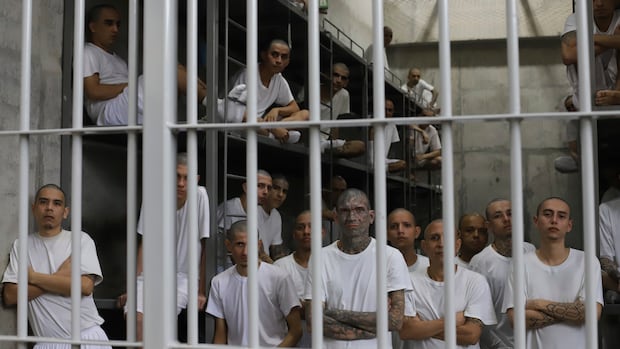
Images from the facility — often slickly produced photo and video — show prisoners packed tightly together with their heads shaved and wearing only shorts.
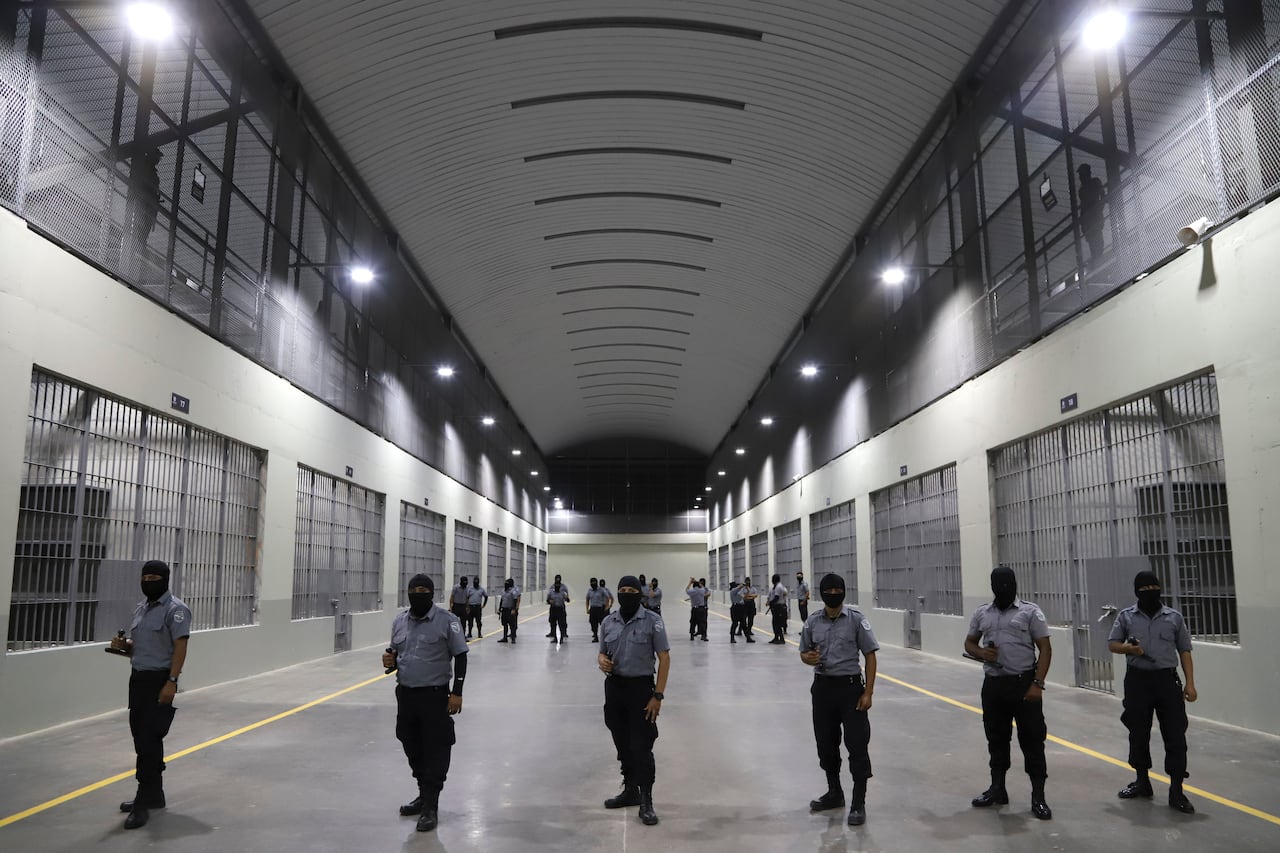 Prison guards stand outside holding cells during a media tour of the Terrorism Confinement Center, or CECOT, in Tecoluca, El Salvador, in February 2023. (Salvador Melendez/The Associated Press)
The prison has no outdoor recreational space and no family visits are allowed. The dining halls, break rooms, gym and board games are for the guards.
In the 60 Minutes segment, which was briefly available in Canada, two men who were deported to CECOT reported torture, beatings and abuse. One Venezuelan said he was punished with sexual abuse and solitary confinement.
Another was a college student who said guards beat him and knocked out a tooth upon arrival.
“When you get there, you already know you’re in hell. You don’t need anyone to tell you,” he said.
Why is the U.S. involved?
Bukele invited them.
During a visit from U.S. Secretary of State Marco Rubio in February, the Salvadoran president offered to incarcerate criminals deported from the U.S. in the mega-prison.
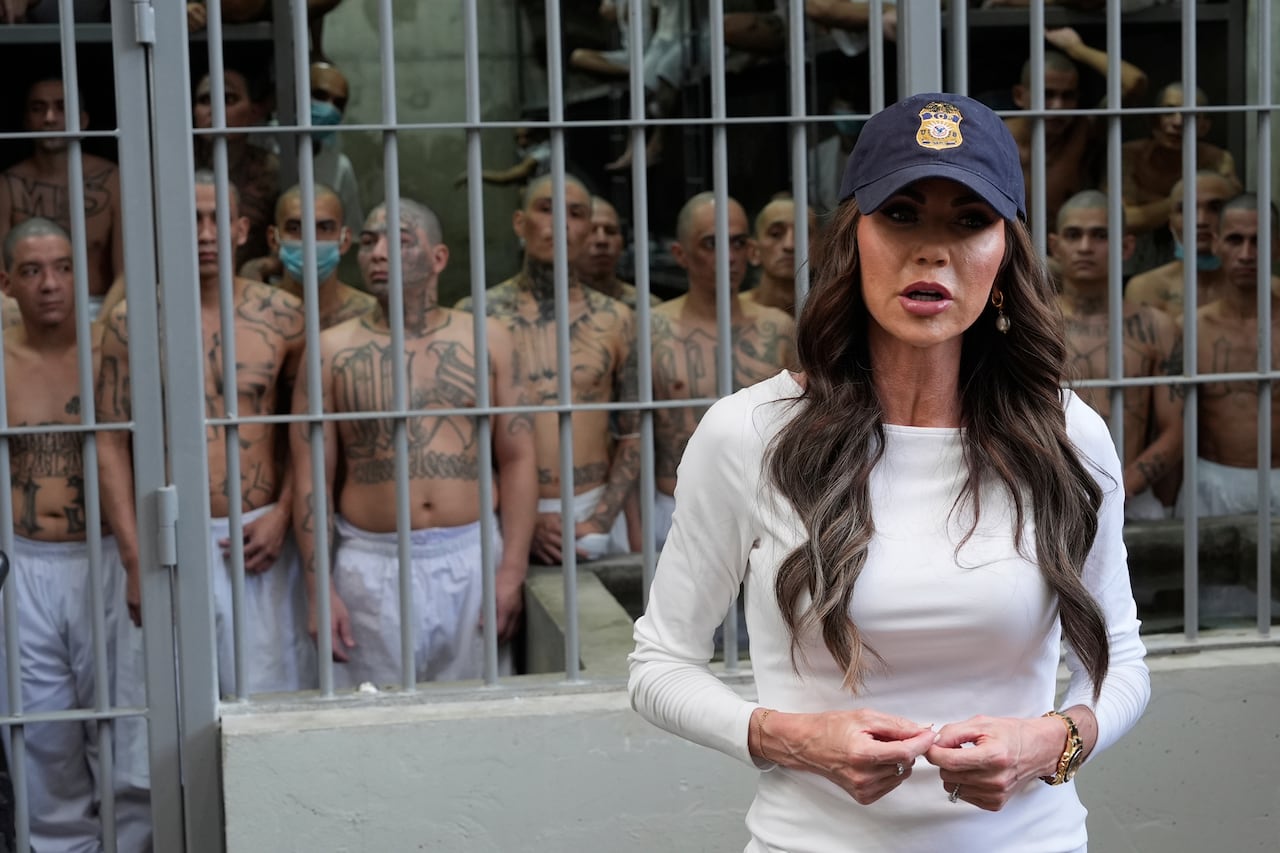 U.S. Department of Homeland Security Secretary Kristi Noem speaks during a tour of CECOT on March 26. (Getty Images)
The Trump administration took him up on it in March, invoking an 18th-century wartime law to send mainly Venezuelan migrants accused of being gang members to CECOT.
The SAIS review says the deal between the two countries helps Trump’s aggressive immigration crackdown while burnishing Bukele’s strongman image and providing financial incentives.
The U.S. government paid El Salvador about $6 million US to receive the deportees, the White House said.
Why is the prison controversial?
Even before the U.S. was involved, many human rights organizations criticized El Salvador’s prisons and especially CECOT. Groups have reported human rights violations including torture, mass trials and hundreds of inmate deaths.
At the same time, the prison has attracted praise from hardline law-and-order politicians and from many Salvadorans, who have welcomed the reduction in homicides during Bukele’s crackdown on gangs.
WATCH | How Trump used the Alien Enemies Act to deport people: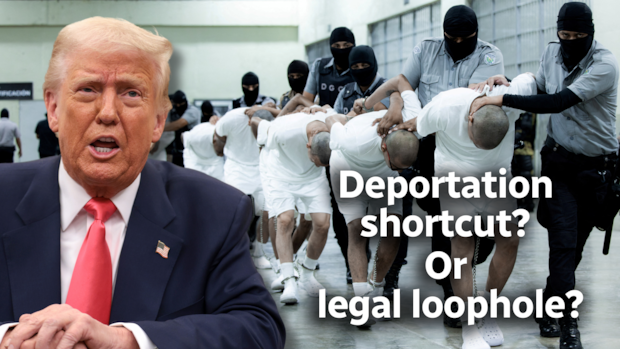
How can Trump use a wartime law to deport people when there’s no war? | About That
The Trump administration deported more than 200 immigrants by invoking the Alien Enemies Act — a wartime measure — alleging they were members of Tren de Aragua, a Venezuelan gang. Andrew Chang explains how Trump is interpreting the language of the 1798 law in order to avoid the standard immigration court system, and why experts say it’s a slippery slope.
As for the U.S. deportations, lawyers for and relatives of the migrants sent to El Salvador say they are not gang members and that they had no opportunity to contest the U.S. government’s assertion that they were.
Judges also questioned the vague claims and thin evidence from the U.S.
Human Rights Watch and the Central American human rights organization Cristosal found that “252 Venezuelans were subjected to what amounts to arbitrary detention and enforced disappearance under international human rights law.”
In a report last month, the two groups said interviews with almost 200 people had revealed inhumane conditions at CECOT including a lack of food, hygiene, sanitation and health care.
The groups called on government and human rights bodies, including at the UN, to step up scrutiny of human rights violations by the U.S. and El Salvador.