
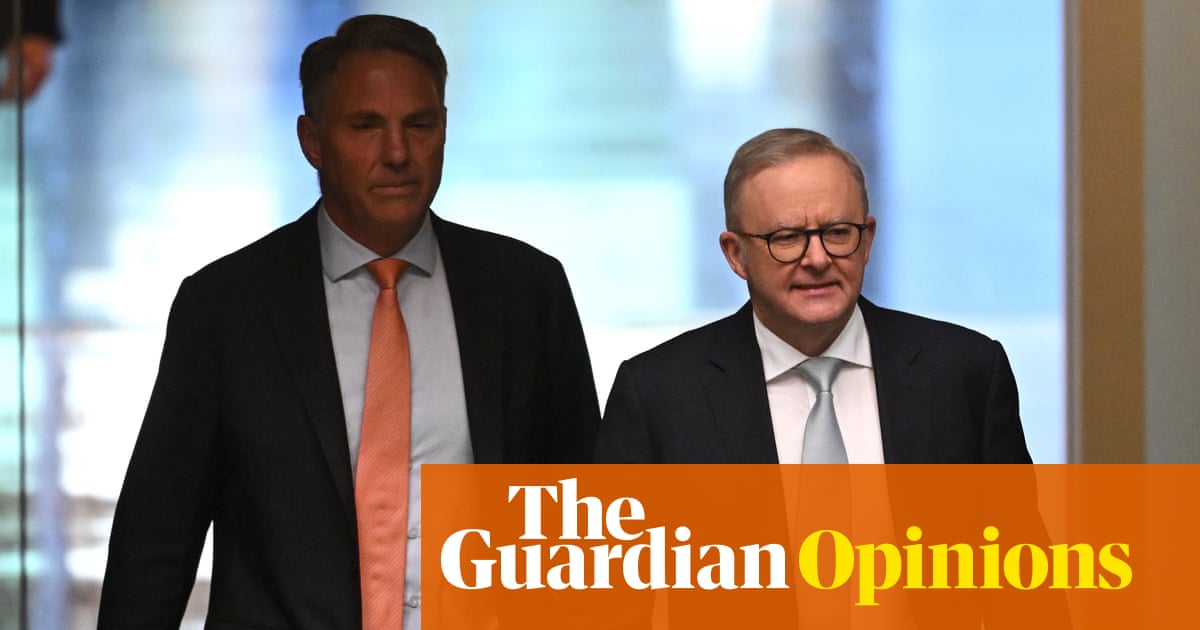
Richard Marles was the guest of honour at the American embassy in Canberra on Tuesday night, braving the cold for a belated Independence Day celebration.
After a striking speech about enduring ties between Australia and the US by Washington’s chargé d’affaires, Erika Olson, the defence minister showed off his credentials as an American history buff, describing the Declaration of Independence as the foundation of modern democracy.
Speaking without notes, he listed the 249-year-old document’s self-evident truths: that all men are created equal, and that they are endowed with certain unalienable rights, including “life, liberty and the pursuit of happiness”.
“That to secure these rights,” Marles recalled word-perfectly, “governments are instituted among men, deriving their just powers from the consent of the governed.”
But the speech, and the whole celebration – complete with a dress code of cowboy boots and denim – took place against a backdrop of an increasingly uncertain alliance and a dramatically unstable global landscape.
Sign up: AU Breaking News email
Following months of tension over Donald Trump’s aggressive trade tariffs and lingering doubt about the future of the Aukus submarine deal, the Labor party, and Anthony Albanese, appear to be preparing for their biggest foreign policy break with the US president: recognition of Palestinian statehood.
After the French president, Emmanuel Macron, said his country would recognise Palestine in September, Albanese signalled plans for Australia to move to the same destination.
He started the week saying appropriate guarantees were required about the viability of such a state, including the exclusion of the terrorist group Hamas, which is responsible for the 7 October attacks on Israel. Albanese said a Palestinian state must operate in a way that does not threaten the existence of Israel and that any two-state solution would need to include provisions for the rebuilding of Gaza and the West Bank, and a resolution to the issue of Israeli settlements.
Any decision would not be “a gesture”, Albanese told David Speers on ABC on Sunday.
Events moved quickly through the week. Albanese spoke with British prime minister Keir Starmer after the UK announced plans to recognise Palestine by September, unless Israel agreed to a lasting ceasefire in the bloody war. Trump later warned on social media such a move would reward Hamas.
Despite months of unfathomable suffering, images of children starving due to Israel’s blockade of humanitarian aid found renewed cut-through, and leading international voices objected to Benjamin Netanyahu’s government blocking journalists’ access to document the reality on the ground in Gaza.
Then Canada’s prime minister, Mark Carney, said his government would recognise Palestine next month, if democratic reforms were achieved, including the Palestinian Authority committing to holding elections within a year, with Hamas shut out of the process.
Labor MPs spoke up in Canberra too. The former minister Ed Husic showed determined clarity in a press gallery doorstop, describing a wave of “moral momentum” around the world and urging action here. Husic sought to debunk a key argument against recognition, saying statehood would deprive Hamas of its power over Gaza.
“Hamas is built largely on grievance,” Husic said.
In the Senate, Labor’s Michelle Ananda-Rajah decried the humanitarian catastrophe and starvation. A medical doctor, Ananda-Rajah said it was unconscionable that anaesthesia, painkillers and antibiotics had run out in Gaza, while a few kilometres across the border, supermarkets were “groaning with food”.
The treasurer, Jim Chalmers, confirmed it was a matter of “when, not if” Australia would join the recognition push, coming as the foreign minister, Penny Wong, continued close international engagement on next steps.
skip past newsletter promotion
Sign up to Breaking News Australia
Get the most important news as it breaks
Privacy Notice: Newsletters may contain info about charities, online ads, and content funded by outside parties. For more information see our Privacy Policy. We use Google reCaptcha to protect our website and the Google Privacy Policy and Terms of Service apply.
after newsletter promotion
Opposition to a change in Australia’s position is coming from the Coalition and from Jewish community leaders.
While Trump acknowledged for the first time this week that there is “real starvation” in Gaza, the opposition leader, Sussan Ley, was unable to acknowledge the deprivation on Tuesday. Asked directly if the people of Gaza were facing starvation, Ley repeatedly said only that it was a “complex situation”. She called for Hamas to surrender and release the remaining hostages. Frontbenchers Michaelia Cash and Dan Tehan spent the week clinging to scant talking points, tone deaf performances which even prompted internal criticism that the Coalition shouldn’t be the last defending Israel’s actions on aid at all costs.
Mark Leibler, the chair of the Australia/Israel & Jewish Affairs Council, warned the government recognising Palestine would delay the release of Israeli hostages and extend the carnage in Gaza.
But the biggest problem facing Albanese could be retribution from Trump. So far the pair haven’t met face-to-face and the goodwill that exists in their relationship appears to stem only from Trump being flattered by public praise from the prime minister.
After Carney’s statement, the president threatened Canada with economic retaliation, saying a trade deal would be very hard. On Friday, Canada was slugged with a 35% tariff rate, a decision the White House blamed on fentanyl and other illicit drugs coming across the border into the US.
Albanese said the US position would not be an effective veto over Australia, a recognition of Trump’s close political relationship with Netanyahu and the particular sensitivities of Middle East issues in the American political context, including the Israel lobby’s power within the Republican party.
Some opposition is likely within Labor as well, including from within the Victorian Right faction, controlled by Marles. One MP told Australian Financial Review on Friday that right members were going “soft” and should not be weakening in their hardline support for Israel.
Australia will be right to act with Macron, Starmer and Carney, leaders Albanese has described as friends, and the informal coalition prepared to stand up to Trump. Institutions and alliances – which will be required well after Trump’s term ends – need defending, and it’s the responsibility of the international community to speak up against suffering, violence and human rights abuses.
As the conflict in Gaza drags on, Australia adding weight to the cause of Palestinian statehood can help extend the unalienable rights Marles spoke about at the American embassy to one of the places where they are needed most.