
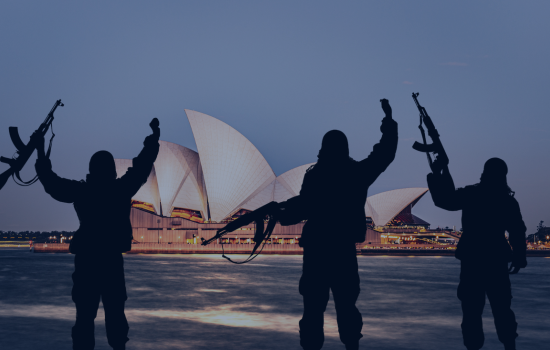
The Chanukah massacre of Sydney’s Jewish community. Australian authorities had good reasons to be more…
The Chanukah massacre of Sydney’s Jewish community. Australian authorities had good reasons to be more alert about the potential jihadist threat
Introduction
On December 14, 2025, a terrorist mass shooting occurred at Bondi Beach in Sydney, Australia. Two gunmen targeted a “Chanukah by the Sea” Jewish community celebration, attended by approximately 1,000 people at Archer Park. Fifteen people were killed, including a 10-year-old girl and an 87-year-old Holocaust survivor. Over 40 others were injured, including two police officers.
It is the deadliest terrorist attack on Australian soil and the second-deadliest mass shooting in the country’s modern history, after the 1996 Port Arthur Massacre. It is the most serious event that has affected New South Wales for decades.1
The Sydney Chanukah terrorist attack is the worst anti-Jewish community massacre since the July 18, 1994, terrorist attack by Iran and Hezbollah that destroyed the seven-story building in Buenos Aires that housed the Asociación Mutual Israelita Argentina (AMIA) and the Delegación de Asociaciones Israelitas Argentinas (DAIA), the umbrella organizations for Argentina’s Jewish community. Commonly referred to as the AMIA bombing, with 85 people killed and over 300 injured, it remains the deadliest terrorist attack in Argentine history.
Previously, in September 1986, two terrorists of the Palestinian Abu Nidal Organization entered the Neve Shalom Synagogue in Istanbul during Shabbat morning services and opened fire with automatic weapons and threw grenades, murdering 22 Jewish worshipers. On November 15, 2003, two suicide bombers linked to al-Qaeda, driving separate trucks, detonated explosives outside the Neve Shalom and Bet Israel synagogues in Istanbul, killing 23 people and injuring an estimated 300 others. Most of the victims were Turkish citizens, both Muslims and members of the Jewish community, with two security guards among the dead.
The Bondi Beach terrorist attack
A week after the attack, more information regarding the perpetrators was released, but it is yet not known whether a larger cell, a local group or an international terrorist organization were behind the operation.
However, the Australian general political and social background are quite obvious, as well as the Australian government’s approach to the terrorist threat in this context, which will be addressed later in this article.
The perpetrators and their operational behavior
The perpetrators of the terrorist attack were a father and son identified as Sajid Akram (50) and Naveed Akram (24). It should be noted that there are few known cases of father-son terrorist teams.2
The father, Sajid Akram–killed during the attack–was an Indian national from Tolichowki, Hyderabad, who emigrated to Australia in 1998 on a student visa, after completing a business degree in Hyderabad and marrying a woman in Australia. Telangana Police reported that the father had no “adverse record” prior to his emigration, and that his family in India appeared to be unaware of his “radical mindset or activities”. Indian authorities say there was no evidence he was radicalized before arriving in Australia.
The son, Naveed Akram–seriously wounded during the attack–is an Australian-born citizen. As a teenager, he followed radical Islamic preacher Wissam Haddad, who was found to have violated Australia’s racial hatred laws in 2025. He regularly worshipped at Haddad’s Bankstown prayer space, the Al Madina Dawah Centre. Videos from 2019 show him proselytizing and distributing pamphlets for the Street Dawah Movement. Police arrested several associates of the movement, including Isaac El Matari, a friend of the son. El Matari was jailed in 2021 and is serving a seven-year sentence for plotting an insurgency and attempting to acquire firearms. Despite these connections, authorities concluded the son was not a high-risk member of this network.
A senior official of Australia’s Joint Counter Terrorism Team (JCTT) said that Naveed was “closely connected” to Isaac El Matari.3 Matari had declared himself the IS commander in Australia. In a lengthy statement on messaging app Telegram on December 19, Haddad denied claims that Akram was one of his followers. “This claim is undefined and misleading,” he wrote.4 “No evidence has been produced showing any personal, organizational, or instructional link between Naveed Akram and Wissam Haddad.” Haddad did not explicitly say that he did not know Akram, only that there was no evidence for it. And he denied reports that he was a “spiritual leader of ISIS in Australia,” arguing, “there is no evidence to support this allegation.” There is no suggestion that Haddad had any knowledge or involvement in the attack.
Naveed and Sajid Akram lived in the south-west Sydney suburb of Bonnyrigg, about an hour’s drive inland from Bondi. A few weeks before the shooting, the two men moved into an Airbnb in the suburb of Campsie, a 15- to 20-minute drive from the beach.
The father had a firearms license, was a member of a shooting club, and had six registered guns. The son had trained at the same shooting club as his father. Three firearms were used during the attack, and a fourth was located at the scene. The firearms used during the attack are believed to be a Beretta BRX1 straight-pull rifle and two 12-gauge Stoeger M3000 M3K shotguns. Police later found 3D printed parts for a shotgun component at the Campsie house, bomb making equipment, and copies of the Quran.
A video recorded in late October 2025 depicts Naveed and his father conducting firearms training in a countryside location, suspected to be in New South Wales (NSW). “The accused and his father are seen throughout the video firing shotguns and moving in a tactical manner.”5
Police found a video that was taken in October 2025 on the accused’s mobile phone. It showed both gunmen in black T-shirts sitting in front of an image of an IS flag. Resting on a wall behind them were four long-arm firearms with visible rounds attached to their frames. The accused appears to recite a passage from the Quran in Arabic. Afterwards, both make statements in English about their motivation for the Bondi attack and condemn the acts of Zionists.6 The pair had allegedly planned the attack for several months and visited the Bondi beachside park for reconnaissance two days prior.
Immediately after the shooting, it was reported that two rudimentary improvised explosive devices were in the suspects’ vehicle, and a third device was later located at the scene. They were safely removed by the police bomb squad. According to information released by the magistrate, the pair threw four improvised explosive devices (three aluminum pipe bombs and a tennis ball bomb containing an explosive, black powder, and steel ball bearings) into the crowd, moments before opening fire.7 While none of the devices detonated, police say they were all viable. Two ISIS flags were found in the men’s car at Bondi.
The father and son trip to the Philippines
This is the most interesting information concerning the behavior of the perpetrators close to the date of the attack. Their travel to the southern Philippines has since emerged as a focal point for investigators seeking to determine whether the trip had any operational relevance to the attack. Although more than a week has passed since the attack, very limited information regarding the gunmen’s trip has emerged.
The Philippine immigration bureau informed that they were in the country from November 1 to November 28, almost two weeks before the attack. Their destination was the southern city of Davao.
According to local police and staff, they spent their entire 28-day stay in Davao City, rarely leaving their hotel room and then for only an hour or so at a time, and received no visitors. Per hotel staff, they had initially booked a 7-day stay but repeatedly extended it.8 They did not leave behind papers or documents. They did not have their own vehicle. The Philippine national security adviser, Eduardo Año, said the father and son were believed to have remained in the city. “No evidence that they went outside Davao. Our investigation is still ongoing,” Año said.
The pair’s movements outside the GV hotel, where they holed up throughout their time in the country, have become the center of the investigation. The father visited a firearms shop, local police have revealed.9 Likewise, they did not visit any firing range in Davao. One line of investigation is why the pair repeatedly extended their stay and whether they may have been waiting for something or someone to arrive.
Abubakar Camid, who leads a mosque near the hotel in Davao, said there was no indication the two visited the community near the mosque.10 They reviewed CCTV cameras as soon as they heard about the link to Davao, and did not see them there.
According to veteran Philippine journalist Carmela Fonbuena, who has covered Mindanao security for years, the Bondi case illustrates how quickly older threat narratives resurface after major attacks.11 “Everybody jumped into the fact that they made a trip to the Philippines,” she said, but what happened in Bondi did not require military style training, and she called for caution against such assumptions. She also warned that ISIS today operates less as a centrally directed organization and more as a loose brand, complicating efforts to distinguish between directed, inspired, or opportunistically claimed attacks.
A spokesperson for the president, Ferdinand Marcos Jr, rejected what he called a “misleading characterization of the Philippines as an ISIS training hotspot” following a report that the attackers underwent “military-style” training in the country.12 The Philippine military said the number of IS-linked militants was down to about 50, distributed in provinces in Mindanao. There has been no record of foreign terrorist activities in recent years.
Cities like Davao, where the Bondi Beach terrorists traveled to, have been used by jihadist terrorists as meeting points and logistical hubs, allowing extremists to plan, finance, and coordinate operations while blending into civilian life.
The ISIS track
For the moment, the most plausible scenario for the Sydney attack seems to be inspired by ISIS, or perhaps even coordinated with ISIS, if it is proven that the Philippines trip materialized in a meeting with some member of its South Asian branch. This scenario is based on the following elements: Naveed Akram’s connection to Isaac El Matari, self-declared IS commander in Australia, or other members of an ISIS cell; the video taken in October 2025 (before the visit to the Philippines), in preparation of the attack (the information does not specify if the father and son mention their intention to attack the Jewish community or other target); the ISIS flag on their car; and the trip to the Philippines, a hotbed of ISIS activity.
The devastating attack on a Balinese nightclub on October 12, 2002, in which some 202 people (mainly Australian tourists) were killed, Al-Qaeda’s second most deadly attack after the September 11, 2001, was a wake-up call to governments in the region.
Australia has a long history of Sunni jihadist activity on its soil. Sam Mullins noted that ‘homegrown’ Islamist terrorism has developed in Australia in a comparable pattern to other Western countries, in his 2011 article “Australian Jihad: Radicalization and Counter-Terrorism”; Shandon Harris-Hogana and Andrew Zammit analyzed the Jemaah Islamiyah (JI) activities in Australia in their 2014 article “Mantiqi IV: Al-Qaeda’s Failed Co-Optation of a Jemaah Islamiyah Support Network”13; Jenni Ryall wrote “Why the Threat of ISIS Suddenly Feels Very Real in Australia,” in September 2014.14
Ely Karmon has described Australia in the eye of the Jihadist storm in his comprehensive 2015 article, “Terror Australis,” published by the Australia/Israel Review.15 The trigger for the writing of that article had been the 15-16 December 2014 hostage crisis staged by Man Haron Monis in Sydney, which shook the Australian people and was followed live across the world. Haron Monis took 18 people hostage at the Lindt chocolate café in downtown Sydney, practically paralyzing the center of the metropolis. The televised saga ended after a 16-hour siege in which two people were killed. Monis was also killed in the police assault. Monis, a troubled 50-year-old man of Iranian origin on the fringes of the city’s Muslim community, presented himself as a Shi’ite cleric converted to Sunnism and a peace activist, raising the question of whether he indeed acted in the name of ISIS.
Paradoxically, or rather ironically, in the aftermath of the Monis affair, Australian Foreign Minister Julie Bishop declared during a visit to Iran in 2014 that Australia and Iran have agreed to share intelligence about Australians fighting in Iraq to help both countries “in their efforts in the war against ISIS.”16 The Foreign Minister said that the agreement with Iran would be of assistance in the war on terror because she believes that Iran has the information that the Australians are looking for and is willing to share it with them.
Thus, the Australian government and its intelligence agencies, like its academic experts, were well aware of the jihadist threat, despite the defeat of al-Qaeda in Europe and Afghanistan and ISIS in Syria and Iraq in 2019.
In a new editorial dedicated to the Sydney attack, the ISIS weekly “Al-Naba” publication clarifies that measuring the nature of the organization only through the prism of attacks against Jews is incorrect, since circumstances have not yet allowed for a direct confrontation with Jews, and yet, its efforts to try to plan attacks against the Jewish community anywhere in the world have not stopped.17
The Islamic State praises the terrorist attack in Australia, criticizes all the detractors who claim that ISIS refrains from attacks against Jews, mocks the failed efforts of Western security services to deal with terrorist attacks against Jews and Christians in the West, and calls for more jihad attacks in the West. ISIS calls on its operatives and supporters to adhere to jihad against the enemy despite the surrounding condemnations and emphasizes that, despite the technological superiority of Western intelligence means, its efforts to defeat it are doomed to failure.
ISIS notes that for a long time its propaganda materials focused on the need to harm Jews and Christians and their places of worship, and that it is not eager to take responsibility for any such attacks, since these are Muslims who saw fit to adhere to the path of the Prophet Muhammad.
It claims that the Sydney attack revealed that all expressions of solidarity by Australians with Gaza were fake, due to the condemnation of the Sydney attack.
The ISIS statement contains no hint that they knew anything about the attack. Nor does it praise the perpetrators by name.
The Iran/Hezbollah track
In the first hours after the attack, the evaluation was that possibly Iran was involved in the organization of the massacre.
Indeed, in August 2025, Australia accused Iran of involvement in two antisemitic arson attacks and ordered its ambassador to leave the country within seven days. Australian Prime Minister Anthony Albanese said intelligence gathered by the Australian Security Intelligence Organization showed Iran had directed attacks on a kosher restaurant in Sydney and a synagogue in Melbourne last year.
The Israeli Mossad announced at the end of October 2025 that it had uncovered the mechanisms behind several Iranian-led terrorist plots thwarted in Australia, Greece, and Germany between 2024 and 2025.18 Israeli intelligence said multiple terror cells linked to these operations have been dismantled and their members arrested. According to the agency, the Iranian regime has intensified efforts to target Israelis and Jewish communities worldwide in the aftermath of the October 7th attacks.
According to a senior Israeli intelligence official, Israel’s foreign intelligence service provided Australian authorities with concrete warnings about what the official described as Iranian-directed terror activity operating inside Australia.19 The warning, the official said, was not about the Bondi Beach attack specifically, but about broader efforts to build terror networks with the intent of harming Jewish targets. “We stopped a few ticking bombs,” the official said. “The target was on people’s heads.”20
Iran’s foreign ministry issued a formal denunciation of the shooting at the Hanukkah gathering at Sydney’s Bondi Beach. Foreign Ministry spokesman Esmail Baqaei had said in a post on X that “terror violence and mass killing shall be condemned, wherever they’re committed, as unlawful and criminal.”21
In a statement responding to his Iranian counterpart, Israeli foreign ministry spokesperson Oren Marmorstein declared that “the world record in deception belongs to Iran’s Foreign Ministry spokesman.”22 Iranian media outlets, meanwhile, veered between depicting the attack as a false flag operation and celebrating the slaughter. A headline in the state-run Mehr News Agency falsely claimed that the “primary suspect in the attack on Jews in Australia is the Zionist regime,” while Tasnim News, which is affiliated with the IRGC, ran the triumphant headline, “At Least 10 Zionists Slain in Hanukkah Festival in Australia.”23
There is no evidence in recent reporting (2024-2025) of specific, active plots by Hezbollah to target Western or Israeli interests in Australia. In the early 2000s and prior, however, Hezbollah’s global network had considered or attempted to use Southeast Asia, including the Philippines and Australia, for operational logistics.
In March 1994, a suicide truck attack against the Israeli embassy in Bangkok was foiled. Five years later, after the arrest in the Philippines of Pandu Yudhawinata, a man of Indonesian descent, it was discovered that this was a Hezbollah attack. Pandu’s involvement with Iranian intelligence and then with Hezbollah can be traced back to as early as 1981. Pandu admitted to authorities that he acquired forged passports in the Philippines for a group of Indonesian recruits Hezbollah planned to have infiltrate Israel by travelling through Australia. Another plan included sending operatives to Australia where, it was believed, they could acquire legitimate Australian passports in the hopes they would appear less suspicious travelling on documents from a Western country friendly to Israel. It also considered sending three Indonesian members to Australia for a notional attack (never acted upon) on American and Jewish targets during the 2000 Olympics.24
Criticism of the Australian government
Tanveer Ahmed, a Bangladeshi Muslim, born Australian, psychiatrist, journalist and television presenter, has probably best exposed the effect of antisemitism in Australia, and its government’s lack of efficient action, on the terror attack in Sydney. I take therefore the liberty to widely cite from his article.25 “The attacks should not come as a surprise. Within days of the 7 October massacres 2023, pro-Palestine protesters marched by the Sydney Opera House, shouting slogans like ‘fuck the Jews.’ Multiple bystanders have alleged that there were chants of ‘gas the Jews,’ too. This occurred well before Israel had begun any kind of response to the Hamas atrocity.”
A report by the Executive Council of Australian Jewry found that recorded antisemitic acts in Australia increased by 316 percent from 1 October 2023 to 30 September 2024, with a total of 2,062 incidents. From graffiti to the torching of synagogues and the firebombing of Jewish buildings, there has been a crescendo of attacks, some of which were likely orchestrated by Iran. “The government has paid lip service to the need to combat antisemitism,” argues Tanveer Ahmed, “producing reports, holding meetings, and appointing an antisemitism envoy.” Meanwhile, it has recognised Palestine as a state and been fiercely critical of Israel’s actions. “Whether or not these criticisms were justified, they have only heightened the sense of insecurity among local Jews.”
Discussions about antisemitism have increasingly focused on the rise of radical right-wing groups with neo-Nazi connotations. On 8 November, a group of around sixty men clad in head-to-toe black rallied outside the New South Wales Parliament in Sydney, displaying a banner that read “Abolish the Jewish lobby” and chanting a slogan associated with the Hitlerjugend: “Blood and Honour.”
In fact, claims Tanveer Ahmed, the focus on right-wing neo-Nazi groups has allowed left-wing academics, activists, and progressive media to “deny the fact that antisemitism is especially rampant and vicious among Australia’s Muslim communities. In addition, the modern Left’s obsession with identity has made it easier for them to hold all Jews responsible for the actions of Israel. The line between anti-Zionist activism and outright antisemitism has become increasingly blurred. The need to appease the Muslim communities that have rapidly grown in numbers and influence throughout the West has led governments to sideline Jewish concerns.”
The Jewish community has criticised Prime Minister Anthony Albanese for not taking enough action on antisemitism–he defended himself against those accusations, telling ABC NewsRadio he had taken a series of measures including appointing the country’s first antisemitism envoy, toughening hate speech laws and increasing funding for social cohesion projects and Jewish institutions.
Allegra Spender, independent member of the Australian House of Representatives for Wentworth, which includes Bondi, declared that members of the Jewish community are frustrated by the federal government’s slow response to the long-awaited plan to combat antisemitism. Spender said the delayed response to the recommendations in the report by Jillian Segal, the government’s special envoy to combat antisemitism, was “simply not good enough” and explained a “level of anger” being directed towards Labor in the aftermath of the Bondi massacre.26
Jeremy Leibler, president of the Zionist Federation of Australia, told The Times of Israel the shooting could have lasting consequences for Australia’s Jewish community. “I’m trying to process what impact this is going to have on the Jewish community of Australia,” he said, calling it one of the deadliest attacks on Jews globally in recent years. He added that concerns about antisemitism were already prompting some members of the community to consider leaving Australia.27
New South Wales Premier Chris Minns has been decisive in his response to the Bondi Beach massacre. He backs calls for royal commission into Bondi Beach terror attack, saying the inquiry was necessary to help prevent further incidents. Minns announced he would recall parliament to fast-track urgent firearm and hate-speech reforms as part of the state government’s response to the shooting. He wants parliament to grant his government “extraordinary powers” to effectively ban protests for three months, specifically ban the chant alongside terrorist symbols and hate speech, claiming the “implications” of pro-Palestine rallies could be seen in the Bondi terror attack that killed 15 people.28
The Prime Minister Anthony Albanese has apologised to Australia’s Jewish community, saying he feels “the weight of responsibility” after the terror attack on Bondi Beach, as Labor begins to push back against Coalition criticism. The day after he was booed at a Sunday night vigil in Bondi, the prime minister told a Canberra press conference that he understood the community’s anger towards him.29
When Prime Minister Anthony Albanese was asked if he would also support a royal commission into the attack, he said he would back “whatever actions the New South Wales government take.” “Over recent days, we’ve announced new measures to eliminate the scourge of antisemitism, to stop the hate preachers, to get guns off our streets and to ensure that law enforcement agencies have the resources that they need to prevent future attacks,” he said. “If London police are taking action to arrest people for hateful rhetoric in the UK, then we need to be doing it here too.”30
However, on December 22, more than 100 pro-Palestine protesters gathered at Sydney’s Town Hall to rally against the NSW Labor government’s proposed protest crackdowns. They held a minute of silence for the victims of the Bondi attack, before moving into criticisms of the state of Israel and the NSW government, chanting “From Gadigal to Gaza, globalise the intifada.” NSW Premier Minns has flagged his intentions to ban the phrase, which he has described as “hateful, violent rhetoric.”31 Palestinian activists argue the intifada chant is not antisemitic, rather an Arabic word meaning to shake off.
Conclusion
For the moment, the most plausible explanation for the Bondi Beach murderous attack is a project of a father and a son, radicalized in the framework of a known pro-ISIS group or cell active in Sydney, and incentivized by the antisemitic and anti-Israeli atmosphere in Australia, due to huge manifestations involving Arab, Muslims, radical leftist, and possibly rightist groups and elements, protesting the war in Gaza. The lenient policy of the Australian authorities and their neglect of the known jihadist threat on its territory have probably facilitated the disaster.
The attack was planned over a long period of time and rehearsed days before its completion. Although the son Naveed was suspected of connections and propaganda activities inside the local pro-ISIS infrastructure, it should be further investigated if the real spirit behind the attack was Sajid the father, owner of the weapons’ arsenal and trainer for its execution. By killing in cold blood the Jewish couple who courageously tried to stop him when he arrived with his car at the scene of the massacre, and through his behavior after being disarmed by the Muslim hero Ahmed al-Ahmed, he showed his determination to carry his mission to the end.
The failure of the explosive devices, which fortunately reduced the lethality of the attack, proves they were incompetent in this expert field. And here enters the big question: what was the goal of the duo’s trip to the Philippines?
Were the perpetrators looking for some sophisticated explosive devices or weapons to use in the attack? Did they meet a manipulator who was involved in the planning of the attack and perhaps decided on the timing and the target of the attack?
However, as long as the Philippines episode is not deciphered, the possibility that this was a false-flag Iranian operation must be kept in mind. Senior figures, including de facto al-Qaeda leader Sayf al-Adl, lived in Iran under “house arrest” that allowed them to conduct terrorist operations. There are reports of ongoing relations between Iran and the al-Qaeda-affiliated al-Shabaab in Somalia, as supporters of the proxy Houthi movement in Yemen.
The Atlantic magazine staff writer Graeme Wood, who reported extensively on ISIS during its heyday, commented on the Sydney attack: “In the coming days, I wanna hear what the travel of these two people looks like in the Philippines: Was there help from the outside? Was there help from the Islamic State in the Philippines? There’s speculation that there was help from Iran. And this becomes a very different situation if it turns out that there’s outside help, and it’s a directed attack rather than what they sometimes call an ‘inspired’ one.”32
The Australian government and the security and intelligence establishment will have to quickly address the failure of control and insight in the Sunni jihadist arena and the repercussions of the political and social upheavals provoked by antisemitism and radical reactions to the war in Gaza.
Nevertheless, it seems that the Israeli intelligence agencies, which focused their attention on the Iranian international terror menace–albeit very successfully–also neglected the growing threat from al-Qaeda and ISIS, which has been openly expressed in their publications since the beginning of the war in Gaza.
The Australian Jewish community, which has the largest population of Holocaust survivors per capita outside of Israel, feels that “the country has changed” and has “let them down.” “The day everything changed for Jewish Australians,” titled Tammy Reznik’s op-ed in the Jerusalem Post.33 The terrible shock is similar to that felt by the Argentinian Jewish Community after the July 1994, AMIA bombing, which continues to affect the country’s leadership and political class. Jews around the world, as well as the international community and political and social leaders, will have to consider how to address the growing threat of antisemitism, the precursor of violent global upheavals.
*Dr. Ely Karmon is Senior Researcher at the International Institute for Counter-Terrorism (ICT) and lecturer at Reichman University, Herzliya, Israel, and former advisor to the Anti-Semitism Monitoring Forum of the Israeli Government.
**The views expressed are those of the author and do not reflect the official position of the International Institute for Counter-Terrorism.