
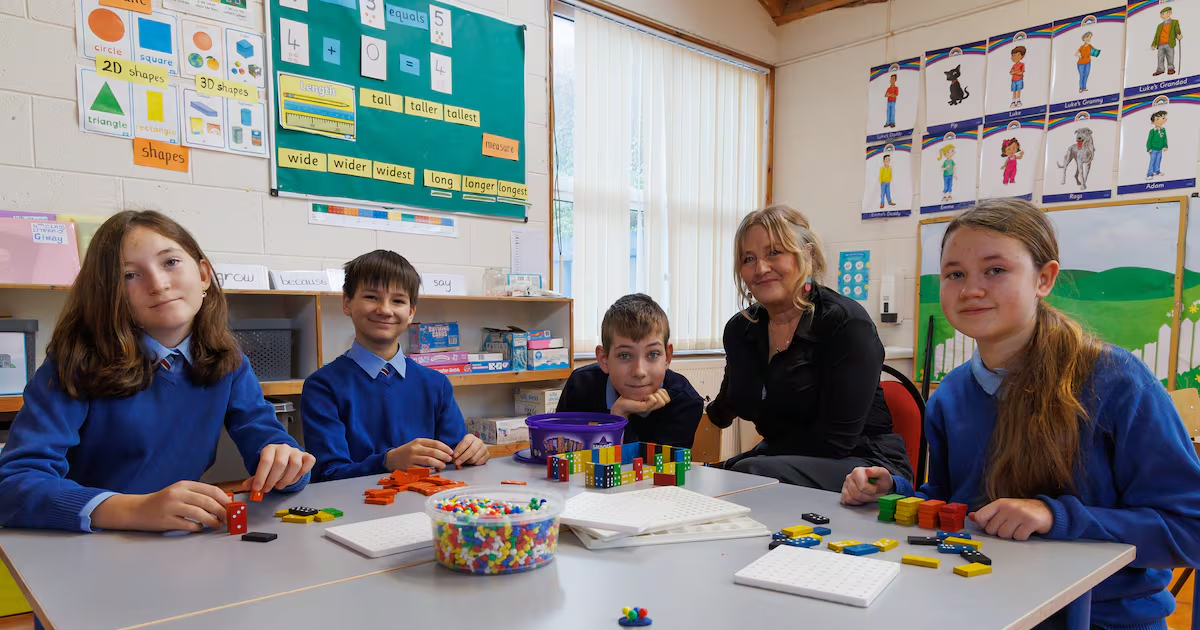
“When I was little, I thought Ukraine was the only country,” says Kateryna Reshetnikova to her friend Sofia Laptenko.
“I didn’t even know Ireland existed before I came here,” replies Sofia, as the two pals chat before rehearsals for their Christmas school play.
Both girls are 11 years old and fifth class pupils at Scoil Saidhbhín Cahersiveen in south Kerry. They play the part of Santa’s Letters in the school’s production of Charles Dickens’s Christmas Carol, a story that highlights the redemptive powers of empathy, compassion and generosity.
But, unlike Scrooge, Cahersiveen has long recognised the value of compassion and kindness, showing it from the off when it came to helping those fleeing Russia’s invasion of Ukraine since February 2022.
A report last month from the Central Statistics Office (CSO) showed 119,043 personal public service (PPS) numbers have been issued to Ukrainians since they started arriving in Ireland after the Russian invasion. At the end of August, 83,594 Ukrainians remained in the State.
The CSO report showed that Kenmare Municipal District in Co Kerry, an area that stretches from Kenmare around the Ring of Kerry up to Killorglin, had both the highest number of arrivals of Ukrainians (1,873) and the highest proportion of Ukrainians for every 100 people of the population.
Within the Kenmare Municipal District, the largest concentration of Ukrainians is in Cahersiveen. About 200 mainly women and children came to the town in March 2022. Their arrival in local hotels posed immediate challenges for the town’s schools.
Teresa Ní Chróinín, principal of Scoil Saidhbhín, explains the challenge the school faced when they learned on a Friday that 200 refugees were coming to stay in the Sceilg Star Hotel. Among the group were 40 to 50 children looking for places in a school with 101 pupils.
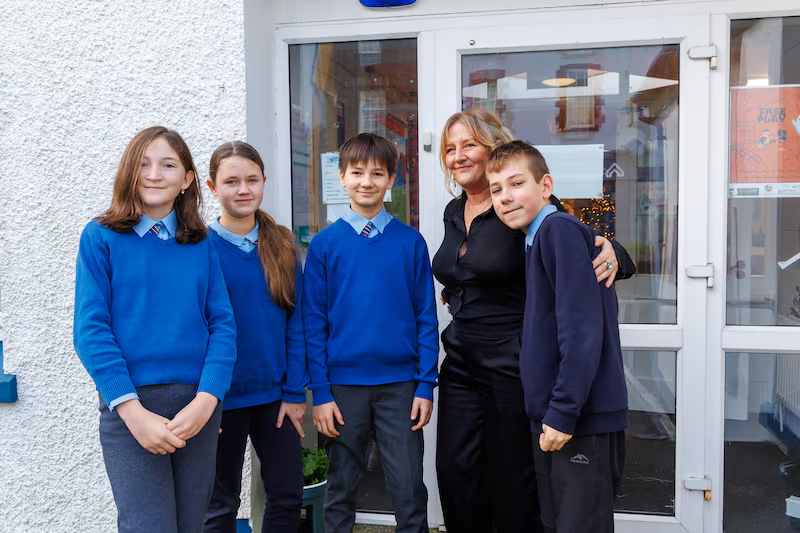 Scoil Saidhbhín principal Teresa Ní Chróinín with Kateryna Reshetnikova, Sofia Laptenko, Mark Fedan and George Zborovskyi. Photograph: Alan Landers
“I remember looking out the front door the first morning to see 200 children and adults standing at the gate in silence,” she says.
“Our plan was to start with getting the youngest children settled first, get them to file in neatly and nicely, so I went out to welcome them and give them my instructions.”
Ní Chróinín says she was met “blank faces”.
“I suddenly realised nobody had a clue what I was talking about, but luckily one girl put her hand up and said: ‘I speak English.’ She came to the rescue.”
Her “brilliant” staff came “under serious pressure”, she says, coping with the pupil number rising from 101 to 154 and one class increasing from 14 to 32.
“But the children too were incredible; they just instinctively took a back seat and just welcomed everyone.”
English classes were organised, and with support from the Department of Education staff numbers went from seven to 10.
Today, the new arrivals speak not only English but have begun learning Irish and can sing the Cahersiveen anthem, Sigerson Clifford’s Boys of Barr na Sráide.
In the run-up to the festive season, the focus in Scoil Saidhbhín is on preparing for the Christmas play.
As they prepare for their parts, Sofia and Kateryna chat with their friend Mark Fedan, a rapper Ghost of Christmas Future who delivers his lines in perfect English with just a hint of a Kerry accent.
Sofia is from Kherson in southern Ukraine and came to Cahersiveen with her mother, Tatyena Gavrelova. Kateryna is from Khymelnytski in western Ukraine and arrived in the Co Kerry town with her mother Iryna Yuzkova and grandfather Viktor Yuzkov.
Mark, who was living in Lviv when the war broke out, came to Cahersiveen with his mother, Marjana, who works with the South West Kerry Family Resource Centre in the town. They are full of praise for the way the people of Cahersiveen have made them feel at home.
[ ‘We realised we don’t know English, not the way it’s spoken in Ireland’Opens in new window ]
“We have a very great principal,” he says, with an impish smile as he looks at Ms Ní Chróinín.
Marjana, who has been back to Ukraine twice this year for family funerals, echoes her son’s views.
“It was difficult when we came first; we were living in a hotel, but here people give a lot of love and understanding to Ukrainian people, organising English classes and all.”
Another Ukrainian arrival similarly impressed by the support is Oleksii Zborovskyi from Odesa on the Black Sea in southern Ukraine. His son George is autistic but has received one-to-one tuition and support in Scoil Saidhbhín.
“The school is amazing,” says Oleksii, who works as a chef with Irish Ferries. “George has a one-to-one teacher and the staff here are so well qualified and professional, and there is better support for him here than in Ukraine and we have seen him make good progress.”
Maurice Fitzgerald, principal of the town’s secondary school Coláiste na Sceilge, and his staff of 60 also saw their pupil numbers soar with an influx of Ukrainians. At one point the school added 85 students to the 500 already on its books before student numbers settled down now to 550.
Availing of Department of Education support through the English as an Additional Language (EAL) scheme, Fitzgerald and his staff set up special classes in English for the new arrivals, keeping them within the existing class schedule so no student had to stay back after hours to learn the language.
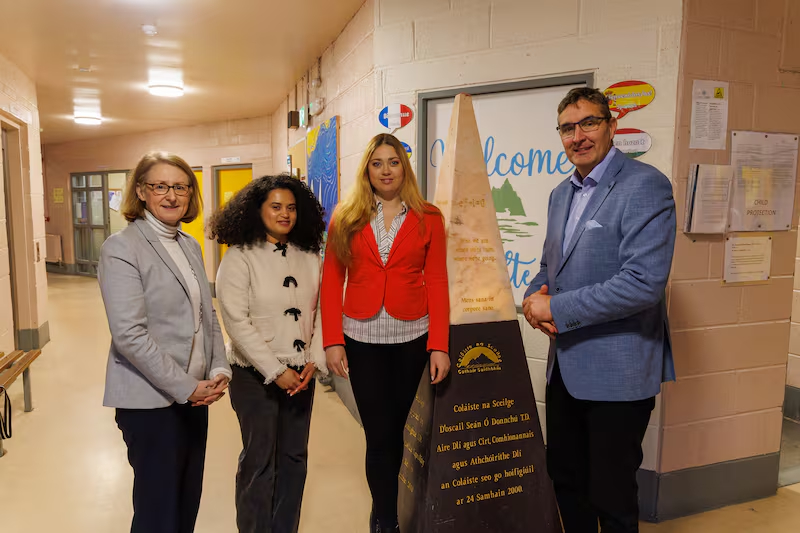 Maurice Fitzgerald, principal at Coláiste na Sceilge in Cahersiveen, Co Kerry, with deputy principal Ann Marie Killen (left) and Ukrainian support staff Lolita Egberipou and Nataliia Lebedieva. Photograph: Alan Landers
Assisted by some Ukrainian women with teaching backgrounds, the classes helped the Ukrainian students to improve their language skills. The school also held them back an extra year in second year and fourth year to give them more time to prepare for State exams.
“There was a period where we probably had to get used to each other’s culture, but after a period of time there was a great trust built up between the two nationalities, and we built up very strong relationships with the parents too,” says Fitzgerald, a former Kerry footballer.
He described the early period as “extremely difficult” as news of the war in Ukraine filtered back from their homes and regions.
“It was difficult for us to have a concept of what that must feel like for them,” he says.
“We just tried to normalise things as much as possible for them, surround them with as much support as was humanly possible, while still trying to maintain the integrity of a system where you are trying to achieve high standards, so it was a question of keeping that balance.”
Midway between Scoil Saidhbhín and Coláiste na Sceilge lies the Kerry South Development Partnership, a community-led local development company. Many of Cahersiveen’s Ukrainian community have taken their first steps towards employment through the partnership. Several have set up their own businesses. The partnership’s rural development manager, Joseph McCrohan, says the agency continued to help Ukrainians find work, with the new arrivals accounting for 120 of the 145 on its scheme for the long-term unemployed.
“Language is very important, so we do a lot of English classes and then we give them work in the community – everything from tidying up graveyards to maintaining mountain walks and GAA pitches, and they build up confidence and then they transfer into the private sector,” he says.
The employment is good for Ukrainians as it gives them a basic wage, but he says it is also of benefit to the area.
“We are short of population here in south Kerry – we have lost thousands to emigration – but these people get work in local shops and in the hospitality sector, so it’s a bonus for the community too,” he says.
Sports clubs have also benefited from Ukrainian arrivals. Iveragh United FC’s chairperson Gerry Kennedy says many Ukrainian youngsters now play soccer for the Cahersiveen club, while Padraig O’Shea of Sive Rowing says the adults have found rowing a great way to meet people.
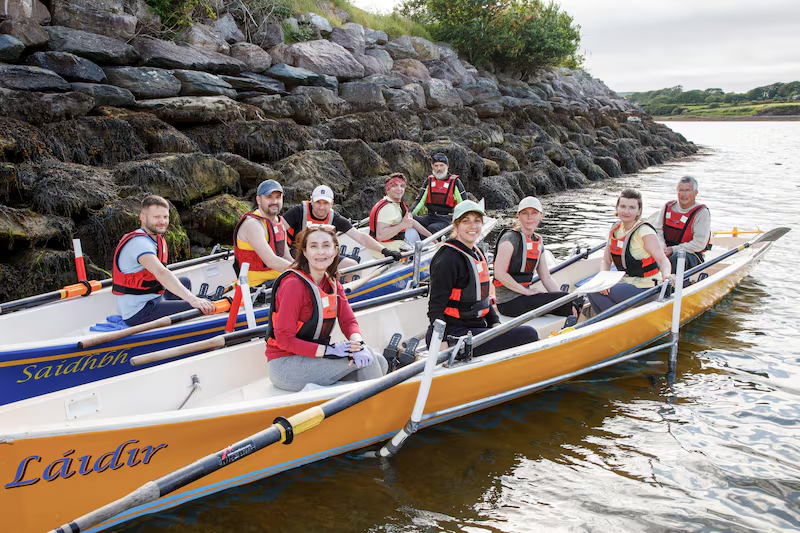 Taking to the water with Sive Rowing Club in Cahersiveen, Co Kerry, Ukrainian rowers (front) Alla Binieieva, Nataliia Sulatska, Zhanna Stetsyk, Hanna Melnikova and cox Mikey Murphy; (back) Andrii Shtoda, Oleh Mekeda, Pavlo Melnikov, Alex Filipashko and cox Padraig O’Shea. Photograph: Alan Landers
 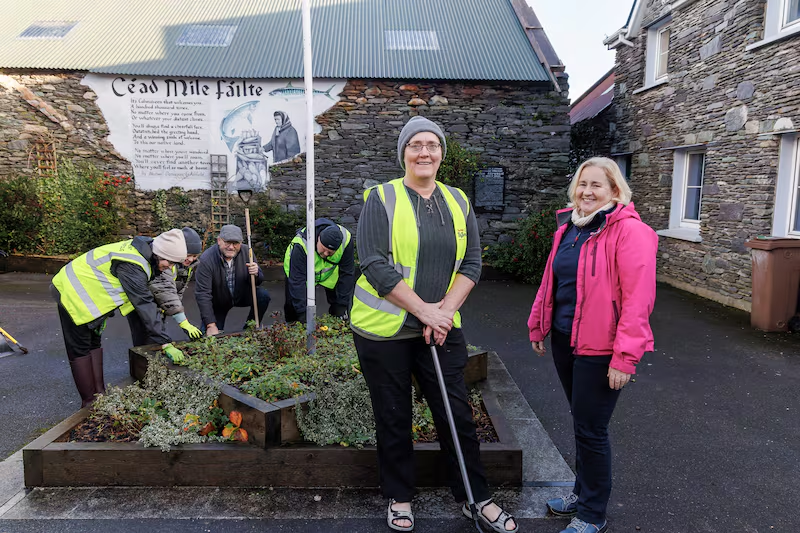 Pictured at the Garden of Remembrance in Cahersiveen, Co Kerry, Joan O’Donoghue (centre) of Cahersiveen Tidy Towns with Cllr Norma Moriarty (right), and helpers Anife Nimetullaiera, Svitlana Radova, Ad de Vroome and Yurii Lrebediev. Photograph: Alan Landers
 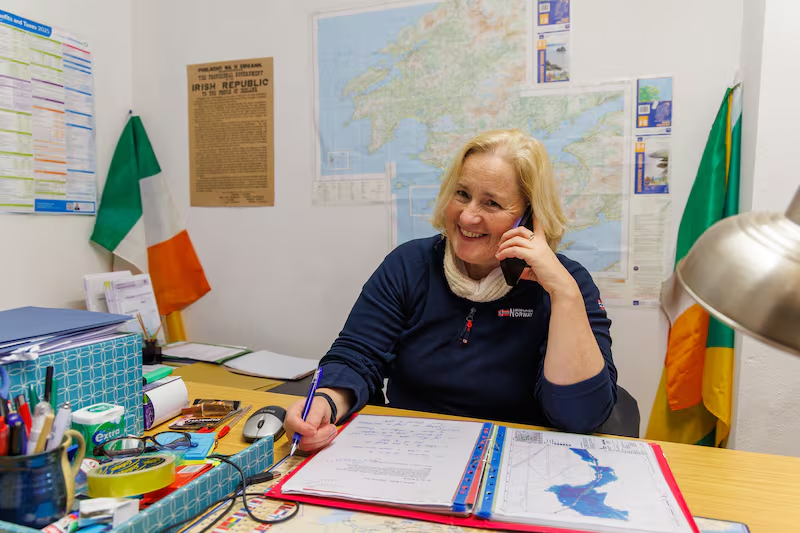 Fianna Fáil councillor Norma Moriarty says the arrival of Ukrainians helped reverse a fall in Cahersiveen’s population. Photograph: Alan Landers
Joan O’Donoghue of Cahersiveen Tidy Towns says Ukrainian volunteers have helped out on special clean-ups around the town, while a number regularly work with the group on street tidying and projects such as the Fairy Trail at Carhan Bridge near the town.
Local Fianna Fáil councillor Norma Moriarty points to another benefit from the arrival of the Ukrainians in March 2022: they helped reverse a fall in Cahersiveen’s population, which rose from 1,041 in 2016 to 1,297 in 2022.
She says most Ukrainians now live in private rented houses under the Accommodation Recognition Payment scheme, where hosts receive a monthly tax-free payment of €600 for hosting them.
Moriarty says there is still a need to strike a balance between providing beds typically used by tourists to refugees, and keeping enough free for tourism so Cahersiveen can benefit from visitors using the newly opened South Kerry Greenway, which will run to the town from Glenbeigh.
Overall, she feels the town has coped well with the influx of newcomers and the Ukrainians have been “well received”.
“In terms of a response to a crisis, you couldn’t but say that south Kerry responded really well – and that is something to be proud of,” she says.