
Fans streamed into the old Orange Bowl from every enclave of Miami-Dade County. A man and his little boy from Coral Gables. A family of four from Hialeah. A married couple from Liberty City.
Pounding a beat in Little Havana, Miami police officer Warren Barnes would often make small talk with the fans, asking where they lived and how far they had traveled to see the Miami Hurricanes football team in action.
“It was like seeing a microcosm of the entire community,” Barnes recalled of the makeup of people who attended Hurricane home football games at the venerable Orange Bowl during the 1980s and ’90s, when the team racked up victories and national championships at a breakneck pace.
“The spectators in the stands were diverse, from all walks of life,” Barnes said. “And the officers and I who would sometimes work the games saw camaraderie among them, people you never thought would come together high-fiving each other, wearing the orange and green, and saying things like, ‘See you at the next game.’ It was uplifting.”
Young men in shoulder pads and helmets, many of them baby-faced and no older than 19 or 20, did something politicians and pundits couldn’t—unite a community.
Now, as the current Miami Hurricanes continue their historic run in the College Football Playoff, Barnes, now retired from the Miami Police Department, sees the same solidarity among fans of the current Canes. “In my neighborhood, in the grocery store, and just from talking with friends,” he said. “It’s harmony and unity, man, when it comes to pulling for the Hurricanes.”
That comes as no surprise to London Wood, assistant director of the Athletics Transfer Program at the University’s athletics department.
“Sports in general, and athletic teams in particular, have traditionally been non-controversial and apolitical when it comes to social identity,” Wood said. “Teams themselves are a form of social identity, one that often transcends race, ethnicity, religion, or gender. People develop deep affinity for a team based on shared geography, history, or lived experience. When people cheer for the same team, a genuine sense of connection and shared humanity can emerge among individuals who might otherwise have very little in common.”
College athletics, Wood explained, are especially powerful in this way. “There’s something uniquely compelling about the combination of elite competition and authentic youthful ambition,” he said. “It draws people in and creates a strong collective sense of belonging around a shared experience.”
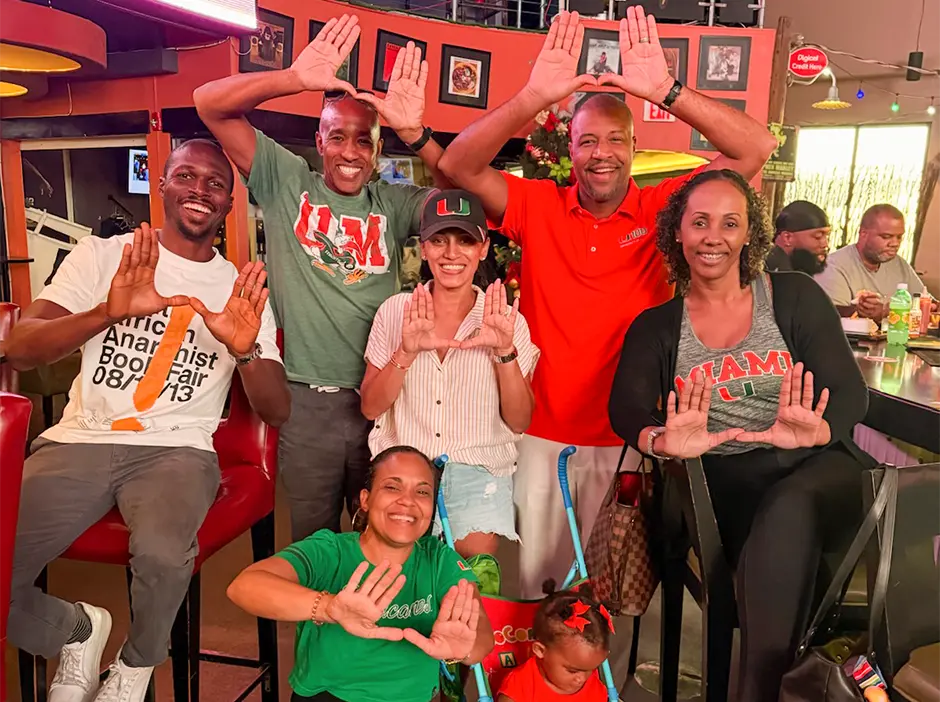
David Mullings, President-Elect of the University of Miami Alumni Association and family, at the first-ever watch party in Jamaica for the first College Football Playoff game against Texas A&M University. Photo: Courtesy of Darren Dupriest
Antonio Hester experienced that “sense of belonging” while growing up in Miami Gardens’ Carol City neighborhood. He and his closest friends would catch a municipal bus down to the Orange Bowl to attend Hurricanes home football games. “We, of course, were all aware of the Miami Dolphins,” Hester recalled. “But we knew the Dolphins as a professional team. For us, the University of Miami took precedence, and they inspired us. We admired their confidence, their excellence on the field.”
After watching University of Miami away games on television, Hester and his closest friends often gathered outside for a competitive game of street football, emulating their favorite Hurricanes players such as Randal Hill, Ray Lewis, and Warren Sapp.
Today, as a Miami-Dade bus operator, Hester hasn’t lost any of the passion he had for the Hurricanes in his youth. But instead of streetball, it’s game-day watch parties at his Carol City home—complete with Canes decorations hanging from the ceiling and walls—that are the order of the day.
He witnesses the same excitement he has for the U in the passengers he transports on his assigned bus route, which takes him past Hard Rock Stadium in Miami Gardens, where the Hurricanes now play. “You can feel the electricity in the air when fans of all kinds board the bus on their way to the games,” he said. “It’s a lot of hootin’ and hollerin’.”
The U’s community appeal isn’t just local, it’s worldwide, Wood pointed out. “When I took my family to Paris for my wife’s 50th birthday, we were at the very top of the Eiffel Tower when someone noticed the UM shirt I was wearing and threw up the U,” he recalled. “At the top of the Eiffel Tower! University of Miami sports isn’t just athletics—it’s identity, it’s unity.”
Evidence seems to support Wood’s claim. According to Jomills Henry Braddock, professor of sociology in the College of Arts and Sciences, studies have documented that winning college football—and basketball—teams are associated with a variety of beneficial outcomes, including expanding the undergraduate applicant pool at colleges and universities, stimulating donor interest, and enhancing pride in their local communities.
“On a personal level, I observed the collective impact of a winning college football team in the aftermath of Hurricane Andrew in 1992, when the Hurricanes football team went undefeated during the regular season,” Braddock said. “What I observed was memorable. In nearly every public encounter in supermarkets, hardware stores, pharmacies and the like, people—across race, class, and gender—were often engaged in conversations about the Hurricanes’ success in ways that appeared to both uplift their spirits and divert their attention away from the collective trauma that every local resident was emersed in.”
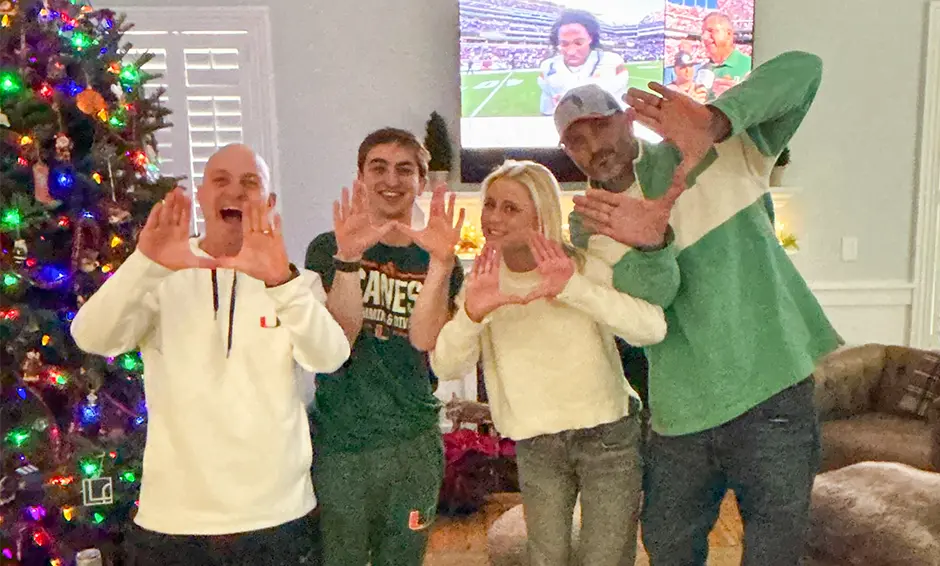
Josh Cohen, former vice president of the University of Miami Alumni Association and member of the current President’s Council, along with his son Charlie and friends, celebrating the first win of the College Football Playoff. Photo: Courtesy of Darren Dupriest
Hurricanes football is not only embedded in the community, but it also gives back, noted Dan Radakovich, vice president and director of athletics. “It’s a big focus within our program to give back. It’s something that has been instilled in our student-athletes through our student development area as well as our football program,” he said.
“And, what’s even more interesting and exciting is that so many of these young folks over the last few years, due to the changes in rules, now have created their own foundations and have done Christmas offerings for young kids and turkey giveaways,” Radakovich said. “They have really expanded what we would normally do for community involvement to the things that are special to them.”
The University’s student-athletes, noted Wood, have earned national recognition for their community service efforts. Most recently, Miami athletics won first place in the 2024 NCAA Team Works Community Service Competition, earning the Division I award, with 99 percent of its 400-plus student-athletes participating in at least one community service activity.
Wood also touted the academic success of the University’s football players, noting that the program consistently posts some of the highest NCAA Academic Progress Rate scores among Power Four schools.
“People naturally focus on wins and losses, but our wins also include the academic success of our student-athletes,” he said. “This is one of the most important ways our athletes impact the community—showing young people across South Florida that you don’t have to choose between academics and athletics. Both matter, and both are essential to long-term success.”