
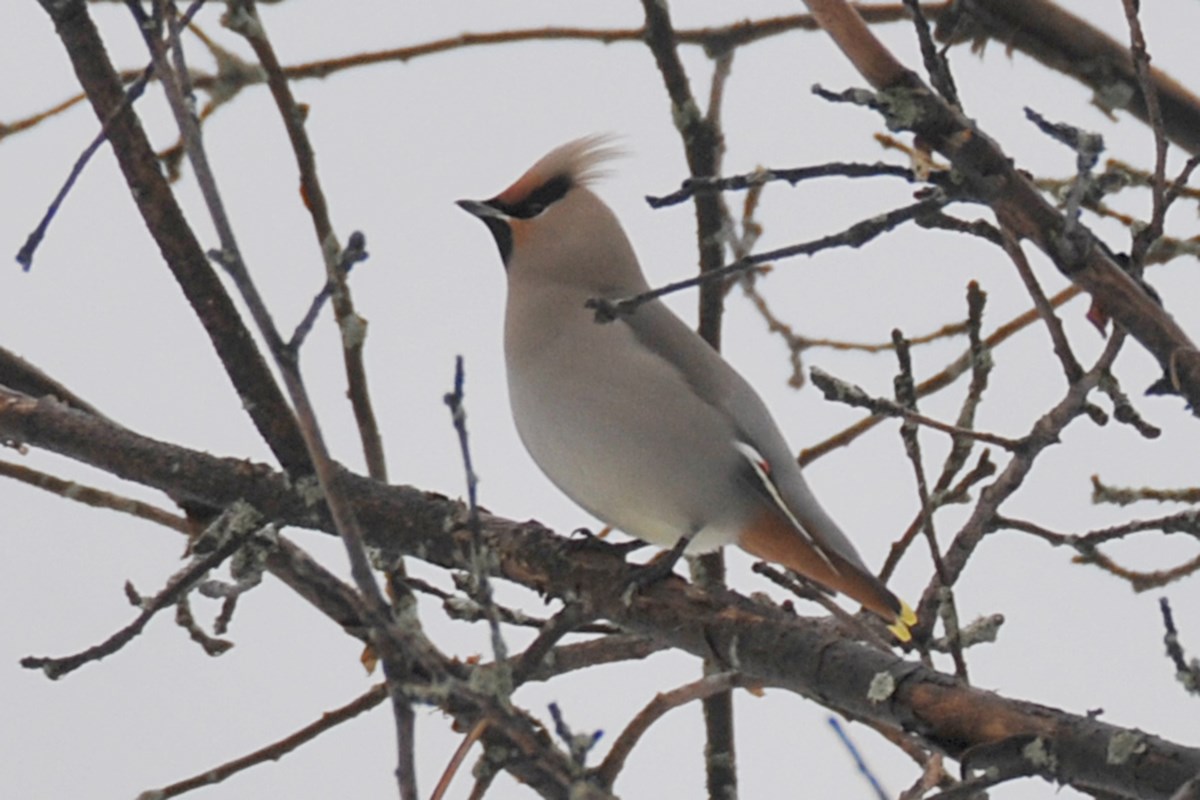
The Bohemian waxwing, known for its sleek plumage and berry-loving habits, is delighting local birdwatchers, says columnist
Do you know of someone who lives a Bohemian lifestyle? You know, showing up here and there, then disappearing, yet always looking good and standing out in a crowd.
There is a bird that does that, an irregular winter visitor, aptly named the Bohemian waxwing.
“Boheemie what-wings?” Bohemian waxwings, a dazzling winter visitor originating from British Columbia and Alberta. They travel as if they were a roaming troupe of musical gypsies, dropping in from the western reaches of Canada, staying here for just a while, then they are gone again
A jaunty crest sits atop its head while a black mask surrounds the face (reminiscent of those oh-so-cool wrap-around sunglasses). The body is a subtle yet well stated pastel brown, with noticeable chestnut-coloured undertail feathers (yes, that’s correct, a brown butt).
Along the wings are two slashes of contrasting colour: a white bar across the middle, and a longitudinal line of yellow accents at the tips of the secondary feathers. The small feathers which overlap the flight feathers sometimes have a bright red, waxy tip, although you have to be very close to see this, or have a very powerful telescope.
Don’t confuse these special visitors with their local cousins, the Cedar Waxwings, which are smaller and lack the two wing streaks. Sometimes those guys are here all year round, although they, too, tend to roam around the countryside a bit.
Bohemian waxwings usually breed in the northern parts of British Columbia and migrate for the winter down to Victoria or into Washington State. But every five to seven years, they decide to migrate in a south-easterly direction, going the long haul across the prairies, and ending up here just in time to buoy up the critically sagging spirits of Ontario wintertime birdwatchers.
Their very name suggests to us that they are a bit of a free spirit when it comes to following the rules. Originally, someone who came from Bohemia (later a part of Czechoslovakia) was called a Bohemian. My handy-dandy Canadian dictionary tells me that Bohemians were known for their free and easy lifestyle, like that of a gypsy. (Although I think that current knowledge would label them as deposed residents of that era.)
Now that we know about their common name, let’s look at their scientific name, a tongue-twister that goes like this: Bombycilla garrulus. “Bomby” is Greek for silk, pertaining to the soft colour and texture of the feathers; “cilla” is Latin for tail. “Garrulus” comes from the Latin language, and means chattering.
If you put this information all together, you should come up with a silky-tailed chatterbox which comes and goes as it pleases.
And this winter they seem to be arriving once again. Julie observed a flock of 30 or so in downtown Orillia last week, hanging around a cluster of shrubs just across the road from the post office.
Any shrub that produces berries is a potential dining area for these waxwings, as fruit is the biggest part of their diet (so don’t expect to see them on the feeder fighting the blue jays for some dry seeds.) Mountain ash, sumac, and small flowering crab apple trees are their favourites. They try to strip the entire tree of any fruit in a single visit.
Their appetite for fruit demands they eat a lot of it. As fruit is mainly water, the meal is digested within thirty minutes, and the bird is hungry again. Studies have found that the waxwings eat two to three times their body weight in fruit each day.
If you happen upon a flock of these dapper-looking birds, take the time to enjoy them, as they will be returning to the wild and rugged western lands in just a few weeks.
David J. Hawke is a freelance writer and naturalist who lives in rural North Simcoe County. He has been continuously creating weekly nature stories since 1989… and thinks that there are still many more topics to cover!