
Unlock the White House Watch newsletter for free
Your guide to what Trump’s second term means for Washington, business and the world
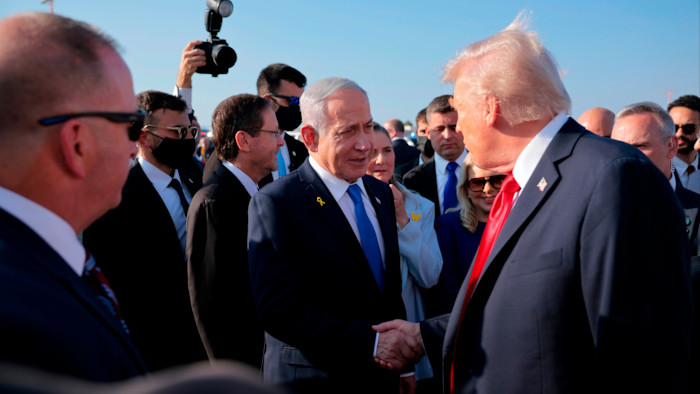
Benjamin Netanyahu is to hold crunch talks with Donald Trump on Monday at the US president’s Mar-a-Lago estate, with key differences emerging over Gaza and other regional security issues.
The US visit will be the Israeli prime minister’s sixth summit with Trump in the past year — more than any other world leader — and comes at a critical juncture in the Gaza ceasefire deal concluded in October between Israel and Hamas.
The truce that halted two years of war has largely held, despite near-daily clashes between the two sides, who have regularly accused each other of violating the agreement.
US officials insist that a move to “phase two” of the ceasefire will begin in January. This would include the unveiling of the “board of peace” and an executive committee to oversee the strip, a Palestinian technocratic committee on the ground to handle daily governance, as well as the deployment of a multinational peacekeeping force.
According to the terms of the US-brokered ceasefire, Israeli troops — which at present still hold half of Gaza — would gradually withdraw as the multinational force enters the strip to monitor Hamas’s disarmament and the transition to postwar reconstruction.
Yet serious questions remain over the make-up and mandate of the mission, called the International Stabilization Force. No country has yet committed to sending troops and none has expressed willingness to disarm the Palestinian militant group by force.
 An Israeli tank along the border fence between Israel and the Gaza Strip in October © Jack Guez/AFP/Getty Images
Israeli officials are concerned that Trump, in his bid to emphasise progress on the ceasefire, will press Netanyahu on several key points, including potential further military withdrawals, and sidestep the thorny issue of Hamas’s disarmament.
“The fear is that Trump will pull the carpet from under them,” said one person familiar with the Israeli government’s thinking.
“The Americans are naive to think they can move forward with anything without Hamas laying down its arms . . . [and so far] there is no real plan to take care of Hamas’s weapons,” the person added.
Recommended

Another potential point of friction between Netanyahu and Trump is any future role in postwar Gaza for Turkey and Qatar, two states deemed close to the current US administration, as well as the western-backed Palestinian Authority that exercises limited self-rule in the occupied West Bank.
The Israeli prime minister has consistently rejected any role for the three actors in the shattered enclave.
Separately, Netanyahu is expected to stress what Israel sees as the renewed threat from Iran, just six months after the 12-day June war between the two states. Israeli officials allege that the Islamic Republic is rapidly working to rebuild its ballistic missile arsenal.
“He’s going to tell him ‘we can’t let them develop [their arsenal] again’,” said the person familiar with Israeli government thinking.
Divergences between US and Israeli positions may also arise with regard to the fragile US-brokered ceasefire in Lebanon, signed in November 2024 between Israel and Hizbollah which brought a halt to a year of open warfare on that front.
The Iran-backed militant group has yet to fully disarm, as called for in the deal, with Israeli officials alleging that the Lebanese government has been slow to press the group to fulfil all of its obligations. Israel, for its part, has continued to regularly strike Hizbollah personnel and military installations throughout Lebanon despite the truce.
US officials had previously indicated that the end of the year would act as a deadline for Hizbollah to comply, although that date is now expected to lapse.