
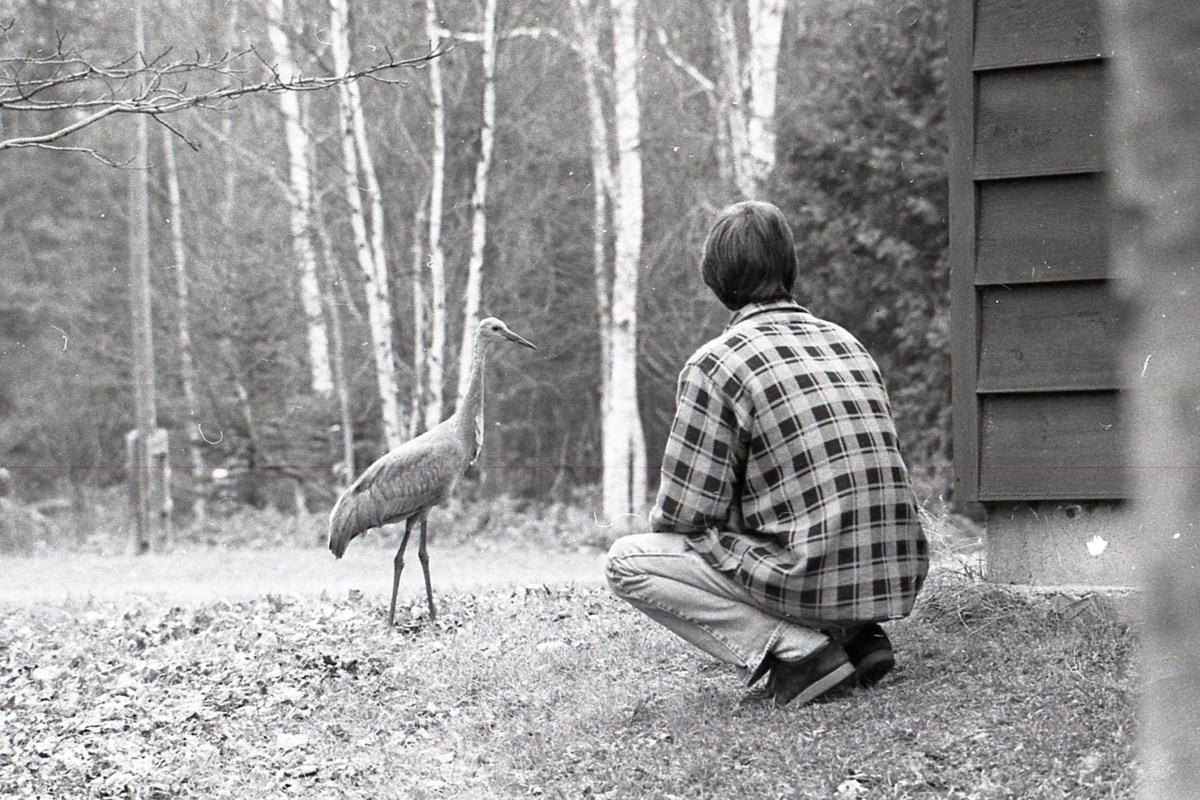
Remember this? A juvenile sandhill crane nicknamed ‘Sandy Baby’ became an unexpected local celebrity in the early-1980s after choosing crabapples over migration
From the archives of the Sault Ste. Marie Public Library:
Sandhill cranes: in Algoma, they are a sign of the changing seasons when they arrive to breed in the spring and leave for warmer climates in the late fall. While their populations were decimated by hunting in years past, they have been declared a protected bird, and their numbers have boomed. Standing at over a metre tall, with a wingspan of two meters and a distinctive red patch on their head, they are easy to identify by sight – and their unique trumpeting sound helps, too.
Sandhill cranes as a species are beloved by birdwatchers – and, sometimes, cursed by farmers who find them in their fields, eating all their grain. But at least one individual crane captured the hearts of locals in 1981.
On November 4th, 1981, the Sault Star shared a photo of a sandhill crane, noting that the bird probably should have been heading south for the winter but may have been tempted to stay by the fruit remaining on a nearby crabapple tree.
The crane in question was a juvenile of about eight or nine months, the youngest of a small group in the area of Walls Side Road. While it was too early to tell the sex of the bird – sandhill cranes are not visually distinct the way that many birds are, and the Sault Star noted that it could take two years before their sex could be determined – locals quickly gave the bird fond nicknames. The bird became known as George, Sandy, Baby, and, as referred to in the Sault Star, “Sandy Baby” (Sault Star, November 25, 1981).
As additional news stories discussed Sandy’s plight, it became apparent just how much the sandhill crane loved crabapples. People described Sandy as being “hooked on the fruit” and “locked into the apples,” to the point of ignoring the parental honking urging him to join the migration (Sault Star, November 25, 1981). All of the other sandhill cranes headed south. Sandy Baby stayed – after all, why leave behind such delicious food?
But it was late November, and the crabapple tree was looking more and more bare. Locals fed Sandy insects, worms, Cheerios, and cornflakes – but Sandy also proved to be a bit of a picky eater who refused bird seed or the wrong sort of apple (Sault Star, November 25, 1981).
Sandy had no fear of people or pet dogs and would follow walkers down the road and eat out of people’s hands; however, this boldness, and the bird’s insistence on remaining in Sault Ste. Marie weeks longer than expected caused some concern as well.
At least one local resident contacted the Ministry of Natural Resources and the Humane Society to try to get some help for the bird, concerned that Sandy Baby wouldn’t survive the cold in Sault Ste. Marie winter alone (Sault Star, November 11, 1981).
By late November, when Sandy Baby still hadn’t flown south, the Ministry of Natural Resources decided to take action and move the bird themselves. With the help of a sweater (to restrain the bird’s enormous wings) and a kennel, MNR officials were able to load the bird onto an airplane (Sault Star, November 25, 1981).
Sandy Baby finally made a flight south… courtesy of Air Canada. Sandy’s home over the winter would be in the Toronto Metro Zoo, in the company of another sandhill crane who had been relocated to the zoo from Hearst, Ontario.
The hope was that Sandy Baby could mate with the bird there – or, if that didn’t work out, be returned to Sault Ste. Marie in the spring to find a mate who might convince Sandy to migrate (Sault Star, November 25, 1981).
That same week, Sandy had more company. Another sandhill crane, this one from Goulais River, was flown to Toronto by Air Canada. The second bird had been injured by a pellet gun and was unable to fly more than a few dozen yards. Like Sandy Baby, the crane had no fear of humans, courtesy of being fed by a fisherman for weeks: “You can pat its head or touch its beak… Normally, they would attack you.” The fisherman also noted that the bird would eat alongside his pet cat (Sault Star, December 3, 1981).
That wasn’t the last that Algoma saw of either Sandy or the second crane. In June of 1988, all three sandhill cranes from the Toronto Zoo were released into the Sylvan Valley by the Ministry of Natural Resources – Sandy Baby, the bird from Goulais, and the bird from Hearst. They had stayed in the Zoo for years, but officials were hopeful they would readapt to the outside world: “They will have the summer to reorient themselves in the wild. Hopefully they will fly south with the sandhills” during the fall migration (Sault Star, June 21, 1988).
It’s not clear what happened to the three birds from the Toronto Zoo. However, sandhill cranes can live for 30 years in the wild. Hopefully, they enjoyed decades of successful migrations – and maybe some crabapples as a delicious, seasonal snack.
This article was written using information compiled from the Sault Star Archive Collection at the Sault Ste. Marie Public Library.
Each week, the Sault Ste. Marie Public Library and its Archives provide SooToday readers with a glimpse of the city’s past.
Find out more about what the Public Library has to offer at www.ssmpl.ca and look for more “Remember This?” columns here.