
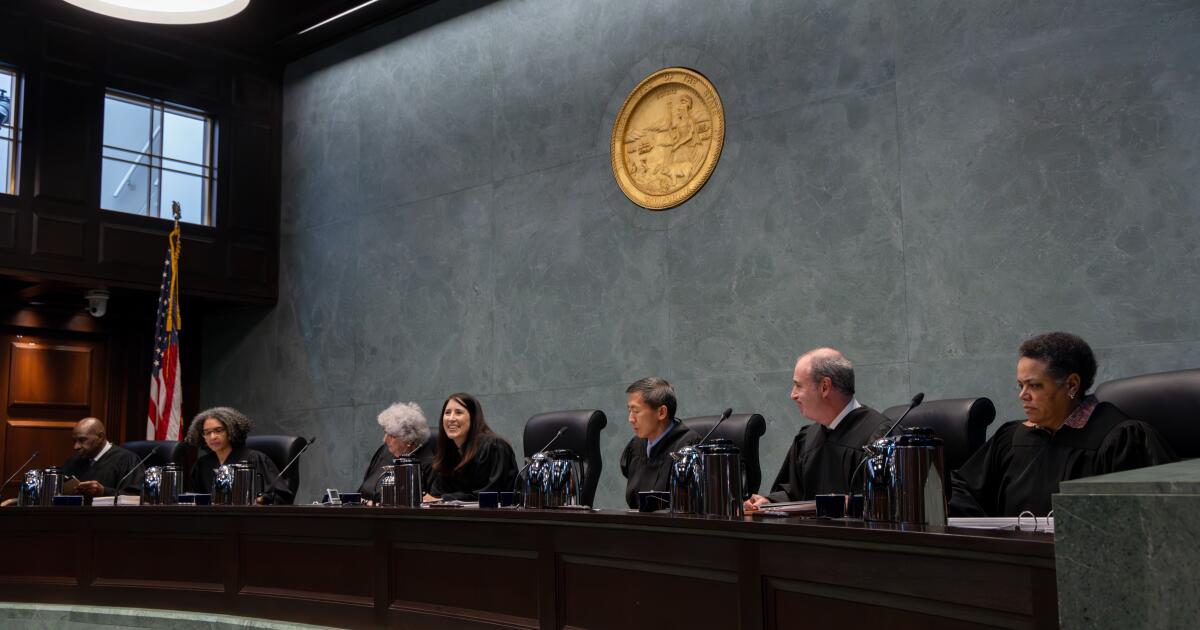
California civil liberties groups cheered a decision by the state Supreme Court that wipes out hundreds of dollars in fines for a reputed Mexican Mafia member — a move advocates say strengthens protections for indigent defendants in other cases.
“This holding is a meaningful step toward a justice system that does not punish people for poverty,” said Kathryn Eidmann of Public Counsel, whose landmark 2019 victory set the stage for Monday’s decision.
The ruling irons out recent judicial efforts to protect California convicts from what Associate Justice Goodwin H. Liu called “cascading consequences” of administrative debt.
“While a defendant’s poverty does not make him any less subject to punishment for violating the law, our justice system must not punish a defendant more harshly simply because he is poor,” Liu wrote in his concurrence.
The case is one of scores to emerge in the wake of People v. Dueñas, a 2019 ruling from the state’s appellate division that found imposing mandatory fines on indigent people ran afoul of the 8th Amendment, which prohibits excessive fines along with cruel and unusual punishment.
Velia Dueñas was homeless mother with cerebral palsy and two young children who ended up behind bars and drowning in debt because she continued to drive after her license was suspended over three unpaid citations she racked up as a teenager.
Jason Hernandez, whose victory Monday strengthens those protections, is described in court filings as a Varrio Fallbrook Locos gang boss and Mexican Mafia “shot caller.” Hernandez was convicted of brutalizing a woman he said owed him money — stabbing her in the head and neck and breaking several bones in her face — and then conspiring to kill a man who witnessed the beatdown.
In 2019 he was sentenced to 50 years to life in prison and ordered to pay a $10,000 restitution fine to the state’s victim compensation fund — money he told the court he didn’t have.
California officials argued being broke wasn’t enough to justify trimming Hernandez’s bill.
“He committed a vicious assault during which he personally inflicted great bodily injury,” the state argued in a 2020 brief. “To evade responsibility for that assault he conspired to kill one witness and attempted to dissuade another witness from testifying against him. He committed all these crimes to benefit a criminal gang and he had a long history of prior serious offenses.”
Hernandez also was assessed a raft of administrative fines and fees, including for lab testing, a drug program, booking fees for his arrest, operations assessments and facilities fees for the court where his case was heard.
The high court’s decision vacated hundreds of dollars of administrative fees that Hernandez faced and sent the $10,000 restitution fine to the lower court for reconsideration.
Such fees have come under intense scrutiny in recent years. Proponents say they help defray the costs of delivering justice. Critics say they bury convicts in debt and land them back behind bars simply for being poor.
Following the Dueñas decision, California lawmakers passed a bill that would have forced courts to determine whether defendants could pay before imposing many remaining fines — effectively codifying the ruling as state law.
Gov. Gavin Newsom vetoed the bill in 2019.
“We must tackle the issue of burdensome fines, fees and assessments that disproportionately drag low-income individuals deeper into debt and away from full participation in their communities,” Newsom wrote at the time. “However, I do not believe that requiring a hearing on defendants’ ability to pay is the best approach in every case.”
In response the legislature voted to eliminate some of the state’s most controversial fees and effectively nullify others. What emerged in the ensuing years is a patchwork of conflicting appellate court decisions, which the Supreme Court attempted to resolve Monday.
“While today’s ruling adopts a narrower constitutional framework than Dueñas, it affirms a core principle our work helped advance: Courts must consider a person’s inability to pay before imposing certain court assessments,” Eidmann said.
The decision does not go as far as the bill Newsom vetoed but does extend more latitude to poor convicts to avoid or challenge fees and fines imposed by the court.
“Although our holding resolves the orders in this particular case, we urge the Legislature to revisit issues surrounding court-ordered ancillary payments in criminal cases and address them in a more comprehensive manner,” Associate Justice Carol A. Corrigan wrote.