
The “main audience” for this week’s drills “really is the United States, Donald Trump and Japan more than the people of Taiwan,” Susan Shirk, former US Deputy Assistant Secretary of State, told the BBC’s Newsday programme.
“It’s an expression of resolve and anger” about the US arm sales, which now include not only defensive weapons but also offensive equipment that could strike the Chinese mainland, Ms Shirk added.
She also pointed out concerns in the US that President Trump “is less committed to America’s defence of Taiwan than previous presidents had been”.
“He’s engaged in a kind of transactional policy in which he might be willing to reduce some of America’s commitment to Taiwan, in exchange for other trade or economic benefits,” she said.
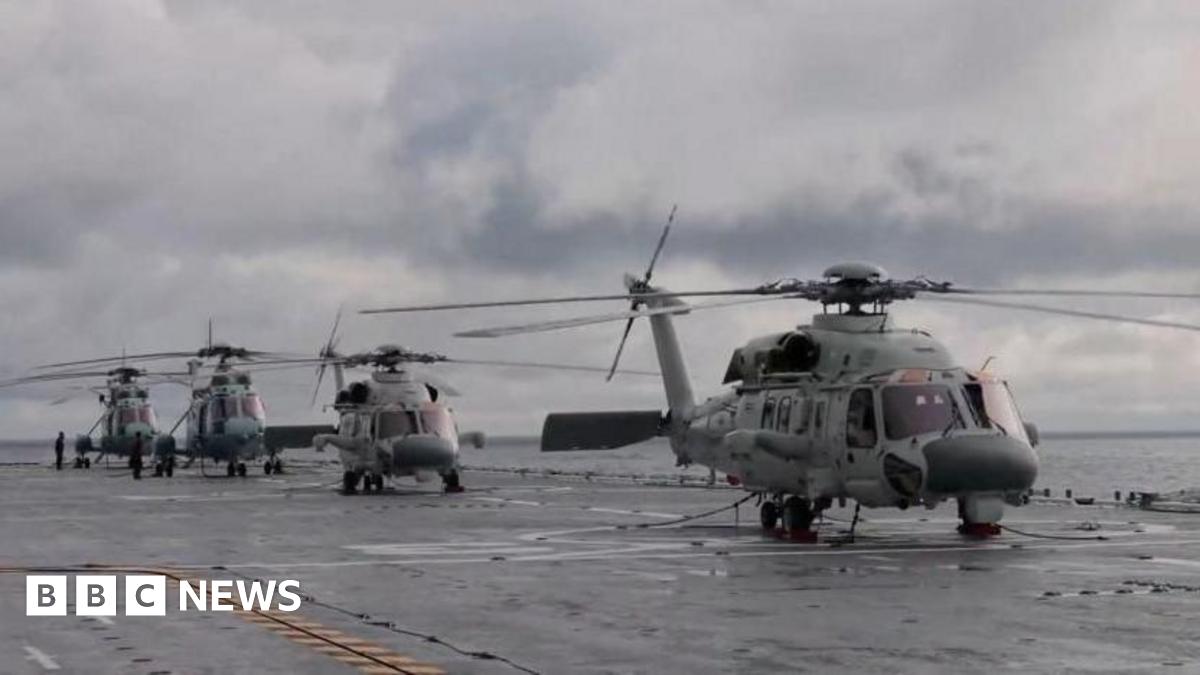
Alexander Neill, an adjunct fellow with the Pacific Forum, told the BBC that the ongoing exercise is “designed to demonstrate an operational capability by the People’s Liberation Army at sea and in the air”.
Trump is “not wrong” about China’s ramping of up such exercises over the past two decades, which is in line with the modernisation of its military, Mr Neill says.
But, he adds, “if [Trump] is suggesting that his rapport with Xi Jinping will have any bearing on Xi’s approach to the Taiwan Strait, I think he’s deluding himself.”
China has long vowed to “reunify” with Taiwan and has not ruled out the use of force to take it.
It has in recent years ramped up pressure over Taipei with military drills and regular incursions into its waters and airspace. Taiwan in turn has plans to boost defence spending to modernise its armed forces.
While Trump has downplayed Beijing’s ongoing drills, his administration had recently announced a $11bn (£8.2bn) weapons package to Taiwan, which includes advanced rocket launchers, self-propelled howitzers and a variety of missiles.
The US has formal ties with Beijing rather than Taiwan, and has walked a tight diplomatic rope for decades. But it remains a powerful ally of Taiwan and the island’s biggest arms supplier.
China hit back at the sale with sanctions on several US defence firms. Its foreign ministry also said that any attempt to “contain China by using Taiwan will absolutely not succeed”.
Chinese foreign minister Wang Yi said on Tuesday that China must “firmly counter” what he described as “continuous provocations from pro-independence forces in Taiwan” and the “large-scale arms sales” from the US.
He added that the “complete national reunification” of Taiwan was “a historical mission we must accomplish”.