
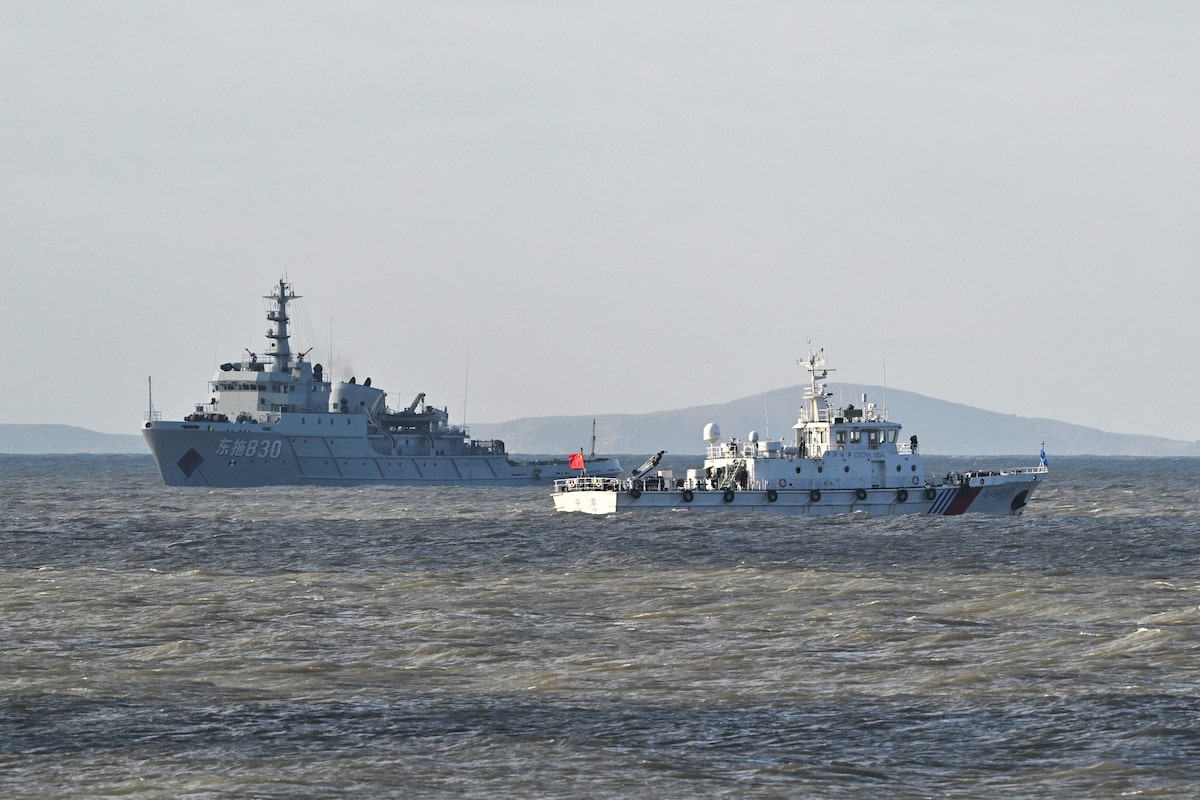
Chinese ships patrol as the People’s Liberation Army conduct military drills on Pingtan island, in eastern China’s Fujian province, the closest point to Taiwan, on Tuesday.ADEK BERRY/AFP/Getty Images
China threatened to trap Taiwan in a “chokehold” on Tuesday, as it continued large-scale war games aimed at demonstrating Beijing’s ability to cut the autonomous island off from outside assistance.
Videos released by the People’s Liberation Army and Chinese state media showed rockets and artillery firing into waters around Taiwan, as dozens of jets buzzed the island’s airspace and the Chinese coast guard threatened to block ships headed for Taiwanese ports.
Taiwan’s leader William Lai denounced China, saying Beijing “has continued to escalate military tension in the region, which is not the behaviour of a responsible world power.”
“Maintaining peace in the Taiwan Strait and the Indo-Pacific is an international consensus, and Taiwan, as a responsible regional partner, will continue to uphold this goal,” Mr. Lai said. “Taiwan will not provoke a confrontation, nor seek conflict with China.”
China’s military moved army, naval, air force and artillery units around Taiwan on Monday for its ‘Justice Mission 2025’ drills, as the island vowed to defend democracy and mobilized troops to rehearse repelling a potential Chinese attack.
Reuters
China announced the “Justice Mission 2025” war games, the largest in years, on Monday, as the PLA dispatched air, army, naval and rocket forces to the Taiwan Strait.
Senior Colonel Shi Yi, spokesperson for the PLA Eastern Theatre Command, said Beijing was sending a “stern warning against ‘Taiwan independence’ separatist forces,” adding that the drills were a “legitimate and necessary action to safeguard China’s sovereignty and national unity.”
Governed separately from China’s mainland since the end of the Chinese Civil War in 1949, and independent for much of its history, Taiwan is nevertheless claimed by Beijing as an integral part of its territory and China has threatened to annex it by force.
Under Chinese President Xi Jinping, as public opinion in Taiwan has moved decisively against any unification with China, Beijing has ramped up diplomatic and military pressure against Taipei. It has picked off Taiwan’s few official allies, excluded its government from international forums and staged aerial, naval and missile drills around the island.
This week’s blockade-focused exercises come after Japan suggested earlier this year it may intervene if China invades the island, and the United States approved a massive new arms sale to Taipei.
A graphic released by the PLA on Monday showed two large shields surrounding Taiwan, warning “any external interference that touches the shield will lead to destruction,” while a similar poster published Tuesday depicted coast guard vessels blocking Taiwanese cargo ships that appeared to be carrying weapons.
The poster featured the slogan “Chokehold,” with the Chinese characters encircled in a pair of handcuffs.
The PLA’s Eastern Theatre Command said one of the exercises being practised this week was a blockade of Taiwan’s vital deepwater Port of Keelung, to the island’s north, and the southern port city of Kaohsiung.
A Taiwan air force fighter jet takes off at Hsinchu Air Base on Monday.CHENG YU-CHEN/AFP/Getty Images
Many analysts doubt China’s ability to invade and occupy Taiwan, which would involve the largest amphibious operation in history and could face fierce resistance and drag in the U.S. and among other regional powers, including Japan and Australia.
A blockade is seen as a potential alternative to an invasion – though one that could quickly escalate into all-out conflict. Were Beijing to move swiftly enough, China could make it difficult for the U.S. or Japan to reinforce Taiwan, testing the resolve of Washington and Tokyo to escalate further.
Any such action would have ramifications far beyond Taiwan, which sits on key shipping and aviation routes, with some US$2.45-trillion in trade passing through the Taiwan Strait each year. Taiwanese chip manufacturers are also a major driver of the current artificial intelligence boom, and a blockade could cut major tech firms off from key suppliers.
Speaking in Washington on Monday, U.S. President Donald Trump said he was “not worried” by the Chinese war games, adding that China has been “doing naval exercises for 20 years in that area.”
Mr. Trump, who in November met with Mr. Xi amid efforts to tamp down a trade war between the U.S. and China, has previously claimed the Chinese leader promised not to invade Taiwan while he is in office.
Taiwanese official warns Carney boosting ties with China will leave Canada vulnerable to coercion
“He told me, ‘I will never do it as long as you’re president.’ President Xi told me that, and I said, ‘Well, I appreciate that,’ but he also said, ‘But I am very patient, and China is very patient,’” Mr. Trump said in August.
Washington’s vacillating support for Ukraine since Mr. Trump’s return to office has shaken many in Taiwan, who fear the U.S. may not follow through on promises to defend the island if an invasion occurs in the next three years.
“China has become increasingly clear about its objectives, which include enacting a de facto blockade of Taiwan maintained by the Chinese Coast Guard and backed by military force to prevent U.S. or allied forces from reaching the island,” Jack Burnham, a senior China analyst at the Washington-based Foundation for Defense of Democracies, wrote on Monday.
“The United States and its allies and partners must be equally clear in their determination to deter such a campaign, including establishing regional stockpiles of key resources such as energy, planning convoy operations, and hardening the island’s resilience.”