
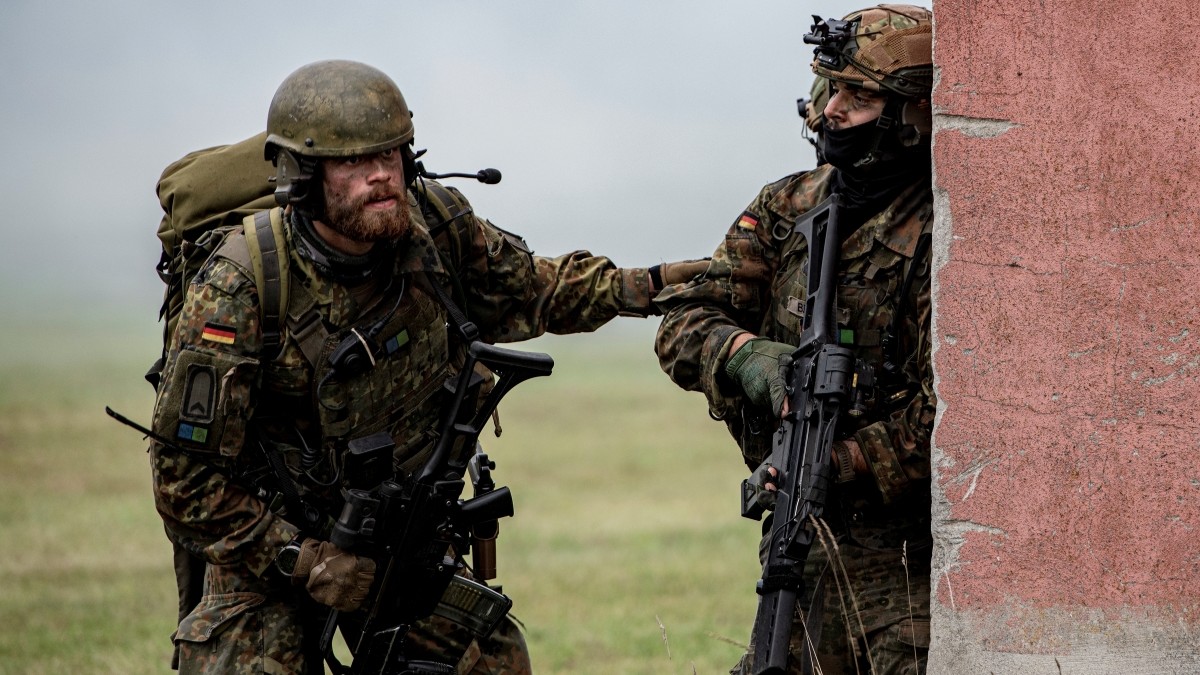
On Dec. 5, 2025, German Chancellor Friedrich Merz reached a significant milestone in his bid to build “Europe’s strongest conventional army”: Germany’s parliament passed a controversial bill requiring all German men to register for potential military service, which could become the first step toward reinstating a draft if volunteer numbers fall short. The breakthrough followed weeks of tense negotiations within Merz’s governing coalition, during which leading members accused one another of “torpedoing” the plan. In the end, Merz held his coalition together, and the law was approved by a margin of 323 to 272.
The hard-won vote contrasted sharply with the momentum Merz enjoyed just three months earlier. In August, he convened his full cabinet at the defense ministry — the first such meeting in nearly 20 years. Standing beside U.S. Gen. Alexus Grynkewich, NATO’s Supreme Allied Commander Europe, Merz signaled that Germany was ready to take on a more active leadership role in European security. The cabinet approved a draft of the military service bill and created a new National Security Council, building on a recent constitutional amendment that enabled major defense investments. For a moment, Merz seemed poised to deliver on the Zeitenwende, the epochal “turning point” declared after Russia’s full-scale invasion of Ukraine.
The fight over reviving conscription has been a reality check. Public willingness to defend Germany in wartime is increasing, but remains comparatively low, and questions persist about whether the Bundeswehr can meet the government’s ambitions after decades of underinvestment. Yet the government’s progress on service reform suggests that political will for change is stronger than in the past and that incremental steps can still add up to meaningful reform.
Merz’s challenge reflects the forces that have shaped German security policy since 1945. Rising threats and allied expectations have pushed Germany toward a more active defense posture, even as a deeply rooted culture of restraint continues to shape public attitudes. These complex and sometimes contradictory dynamics explain why the Zeitenwende has advanced haltingly, with progress often followed by setbacks.
The United States and Germany’s European allies should calibrate their expectations accordingly. The Zeitenwende is a gradual transformation, not a sudden pivot. For Merz, the real test lies not in passing a military service law or meeting a spending target, but in reshaping Germany’s strategic culture — the enduring patterns of thought that guide how countries conceive of and use force. One should not expect such a transformation to occur overnight, but time will inevitably be of the essence if Germany wants to avoid being sidelined by a rapidly shifting geopolitical environment. If successful, Germany may complete its long journey from a country that associates power with guilt to one that understands power as responsibility.
Germany’s Postwar Paradox
Emerging from the ashes of World War II, West Germany faced a delicate balancing act. As the Soviet Union loomed as a threat, its leaders came under growing pressure to rebuild a military capable of deterring a potential Soviet invasion of Western Europe. At the same time, they had to reassure their neighbors that the country would not once again endanger peace in Europe.
As NATO’s first secretary general, Lord Hastings Lionel Ismay, famously put it, the alliance’s original purpose was to “keep the Soviet Union out, the Americans in, and the Germans down.” West Germany’s accession to NATO and the creation of the Bundeswehr in 1955 embodied this compromise: The country would rearm, but only under allied supervision. It would not develop its own nuclear weapons, but would host U.S. nuclear weapons as part of NATO’s nuclear-sharing arrangements.
German leaders’ caution toward military power stemmed not only from allied constraints but also from the postwar reckoning with Nazi crimes. Over time, this evolved into what became known as a culture of restraint (Kultur der Zurückhaltung): a national identity rooted in repentance and the belief that self-limitation — especially in the use of military force — was essential. As scholars such as Colin Gray, Elizabeth Kier, and John Duffield have argued, strategic culture reflects a nation’s historically conditioned ways of thinking about security and the using force.
For Germany, this meant that restraint became an enduring mindset shaping how both elites and the public understood the country’s role in the world. Yet political elites also increasingly invoked it as a convenient rationale — allowing successive governments to reject allied demands, defer costly military investments, and manage coalition politics, even as Berlin remained at the center of European economic integration. Germany’s strategic culture is thus something that is certainly historically rooted, but that has also on occasion been invoked by leaders who found restraint politically useful.
During the Cold War, the result was a stable yet uneasy equilibrium. West Germany built one of NATO’s most capable armies, with over 500,000 active troops at its peak, and devoted between 2.5 and 3 percent of GDP to defense through the 1980s, according to World Bank data. Yet it did not deploy forces abroad. Military power was tolerated as a necessity, not embraced as a tool of statecraft — a tension that would continue to define German security policy long after the Berlin Wall fell.
From “Civilian Power” to Complacency
The end of the Cold War removed the external pressures that had long balanced Germany’s culture of military restraint. With the Soviet threat gone and NATO obligations receding, Germany’s defense spending fell to about 1.3 percent of GDP by 2001 and remained near that level until 2022. This became known as the Friedensdividende, the peace dividend of the post-Cold War order.
Germany settled into the role of a “civilian power,” seeking to project influence through trade, diplomacy, and multilateral cooperation rather than military force. It deployed troops to the Balkans in the 1990s and to Afghanistan after 2001, but framed these missions as humanitarian or alliance obligations — extensions of, rather than departures from, its civilian identity.
This self-image also defined the era of Chancellor Angela Merkel in 2005–2021. She pursued a strategy of engagement aimed at moderating Russia and China through economic interdependence — an approach that has faced growing criticism since her departure for prioritizing short-term commercial interests over long-term security concerns. In 2011, her government suspended conscription after a reform commission concluded that “with the disappearance of an immediate, massive military threat,” it could no longer be justified. Germany became heavily reliant on cheap Russian gas, assuming that, despite Russia’s 2014 annexation of Crimea, large-scale war in Europe had become unthinkable.

Scholz’s Zeitenwende
That illusion was shattered by Russia’s full-scale invasion of Ukraine in February 2022. Within days, Chancellor Olaf Scholz declared the Zeitenwende and pledged to make Germany once again a capable ally within NATO. His government launched a 100 billion euro (approximately $110 billion at the time) special fund to modernize the Bundeswehr and committed Germany to meeting NATO’s spending targets.
Scholz’s approach marked a clear break from the era of engagement to one of deterrence and de-risking — efforts to secure and diversify supply chains, making Germany less vulnerable to the risk of other countries “weaponizing” its dependence on energy and export markets. He rapidly reduced Germany’s dependence on Russian gas and oversaw the adoption of the country’s first National Security Strategy and China Strategy in summer 2023. Both documents emphasized the need to protect Germany from coercion by authoritarian powers while preserving cooperation where possible.
The defense budget reached two percent of GDP in 2024 for the first time in over three decades, and Germany became the second largest military donor to Ukraine after the United States. While Russia’s invasion led to a reassessment of security perceptions, the culture of restraint proved resilient within both Scholz’s own party and German society. The tempo of reform slowed, recruitment stalled, and readiness goals slipped. Scholz had initiated change, but sustaining political and societal support proved difficult, and his coalition collapsed in late 2024.
Merz: New Ambitions, Old Obstacles
When Merz took office in May 2025, Germany was in mid-transformation. The Bundeswehr remained only partially operational even as Berlin faced strong U.S. pressure to increase defense spending and alarm over an emboldened Russia. Merz vowed to restore readiness and build Europe’s strongest conventional force.
Before assuming power, Merz narrowly secured a parliamentary majority to suspend the constitutional “debt brake,” exempting defense spending above 1 percent of GDP and creating a 500 billion euro ($585 billion) defense and infrastructure fund. Together, these measures are expected to mobilize one trillion euro in military and industrial investment over the next decade. He also pledged to meet NATO’s new 5 percent of GDP benchmark by 2035: 3.5 percent for military capabilities and 1.5 percent for infrastructure, industry, and resilience.
Expanding the armed forces, as well as improving their combat readiness, has proved far more difficult. Persistent shortages in critical capabilities, especially air defense and digital communications, continue to constrain overall readiness. The Bundeswehr currently fields just over 180,000 active personnel. Meeting NATO’s new requirements would mean approximately 260,000 active troops and 200,000 reservists by 2035 — a combined force of 460,000. Yet Berlin has authorized an increase of only 1,750 active soldiers for 2026, a pace that would push NATO’s targets decades into the future.
The new bill seeks to close this gap through a selective service framework: All 18-year-old men will complete a questionnaire and medical screening to assess willingness and suitability for service, while women may volunteer. The registration process will begin on Jan. 1, 2026 for men born in 2008 or later. The law also establishes better pay and benefits for volunteers, and incentives for extended service. Although initially focused on voluntary enlistment, the law leaves open the option of reintroducing mandatory service if volunteer numbers fall short. Whether the voluntary scheme can generate sufficient numbers remains deeply contested.
Beyond various legal and logistical hurdles lies a deeper cultural one. Although a majority of Germans acknowledge the threat posed by Russia, their willingness to take up arms remains limited. In a recent poll, only 16 percent said they would “definitely” fight to defend the country, and 22 percent said they “probably” would, a total of 38 percent. A large survey by the Bundeswehr Centre of Military History and Social Sciences paints a similar overall picture, though with important nuances: Among Germans aged 16 to 49, 54 percent of men and 21 percent of women — again, an average of about 38 percent — said they would be willing to take up arms in the event of an attack, with lower levels of willingness among young men. The military service reform has triggered student protests, and successfully reintroducing conscription will require persuading the generation most directly affected by it.
Despite unprecedented financial commitments, Germany’s ability to field the forces envisioned for the 2030s remains uncertain. A reluctant public is not the only brake on reform. Resistance also originates within political elites and the defense bureaucracy, which, when under pressure, sometimes find it convenient to cast society as the obstacle — an interpretation that deflects attention from institutions slow to modernize. Meanwhile, the biggest progress may be coming from the private sector. Rheinmetall, for example, has ramped up munitions production at record speed. Other firms are rapidly scaling missile and radar production, while high-valued AI defense startups have emerged — evidence that industrial capacity can surge even when cultural change lags behind.
The Way Ahead
Across eight decades, external constraints and internal restraint have defined German foreign policy. During the Cold War, the Soviet threat and NATO demands were tempered by a reluctance to use military power. After 1990, as the sense of threat receded, restraint became orthodoxy. Since Russia’s assault on Ukraine in 2022, external pressure has pushed Germany toward greater assertiveness, even as its strategic culture continues to shape the pace and character of change. The Zeitenwende therefore resembles evolution more than revolution.
The conscription debate illustrates this dynamic: a government under mounting pressure to assume a larger security role, yet still constrained by a strategic culture that sees military force as a risk to stability rather than a means of preserving it. To navigate this tension, the government should explain more clearly to the public how military capabilities contribute to European security and why younger generations have a stake in national defense. The draft debate reflects a broader pattern of political shifts once thought unimaginable, and even incremental reforms could meaningfully alter Germany’s role in Europe’s security architecture.
Yet gradualism carries risks. Germany’s defense transformation is unfolding in a strategic environment no longer centered on Berlin, and its measured pace offers limited reassurance to NATO’s eastern flank, which assesses readiness in months rather than decades. As Germany debates reform, Poland and other eastern allies are emerging as Europe’s new center of gravity. Germany thus has a narrow window to close its capability gaps if it hopes to remain a central pillar of European security and reduce its reliance on the United States.
For the United States, the key question is not whether Germany is changing but what it can deliver — and when. The recent suggestion by U.S. Ambassador to NATO Matt Whitaker that Germany might one day assume the Supreme Allied Commander Europe position — a post held by an American since Gen. Dwight D. Eisenhower in 1950 — underscores how significantly expectations are shifting.
Washington should continue encouraging Berlin to assume greater responsibility while remaining cautious about expectations of rapid force expansion and clear-eyed about the possibility that a more capable Germany may act more independently. Germany’s most consequential near-term contribution will likely come from its defense-industrial base, whose growth is outpacing the evolution of its strategic culture. Deepening U.S.-German cooperation on defense industrial issues — illustrated by the 2025 collaborations on drones, maritime and air defense systems — will be essential to sustaining momentum. Whether Germany can complete its journey from restraint to readiness before the strategic clock runs out remains the defining question of its transformation.
Michael F. Harsch, Ph.D., is an associate professor at the National Defense University’s Eisenhower School, specializing in international security. He holds a doctorate in political science from the Free University of Berlin and has been a visiting scholar at Harvard and Stanford University.
Image: Michele Wiencek via DVIDS