
Unlock the Editor’s Digest for free
Roula Khalaf, Editor of the FT, selects her favourite stories in this weekly newsletter.
Crucial Israeli allies have condemned the country’s “unacceptable” plan to suspend three dozen international aid groups from working in Gaza, saying a new government registration scheme could affect life-saving supplies.
Israel on Tuesday announced it would bar 37 non-profits, including Oxfam, Médecins Sans Frontières and the Norwegian Refugee Council, which it said had failed to meet a new government requirement to provide authorities with lists of all their employees.
NGOs said the demands, set to take effect in the new year, would breach EU data protection laws and put their staff at risk. The groups are in danger of losing their ability to operate in both war-shattered Gaza and the occupied West Bank in the coming two months.
EU equality commissioner Hadja Lahbib wrote on social media on Wednesday that Israel’s “NGO registration law cannot be implemented in its current form. All barriers to humanitarian access must be lifted.”
A group of 10 foreign ministers from the UK, France, Canada, Japan and elsewhere said the new law “would have a severe impact on access to essential services including healthcare”, with one in three Gazan health facilities at risk of closing.
“Any attempt to stem their ability to operate is unacceptable. Without them, it will be impossible to meet all urgent needs at the scale required,” they said in a joint statement on Tuesday.
Israeli officials say the new rules are meant to stop Hamas and other militant factions from diverting international aid groups’ supplies or embedding their fighters in non-governmental organisations as humanitarian workers — claims the organisations largely reject.
Many NGOs said earlier this year, when the new registration scheme was first raised, that providing a list of their local staff could put those employees at risk of Israeli military action.
The Israeli military body responsible for civilian affairs in Gaza, Cogat, described the outcry by international aid groups as a “false campaign”, saying their refusal “raises genuine concern regarding the nature of their activities”.
Cogat also claimed the three dozen NGOs in question played a minuscule role in aid provision to Gaza, and that MSF operated only five clinics and medical points out of more than 200 across the territory.
MSF on Wednesday said the shutdown would “deprive hundreds of thousands of people from accessing medical care”.
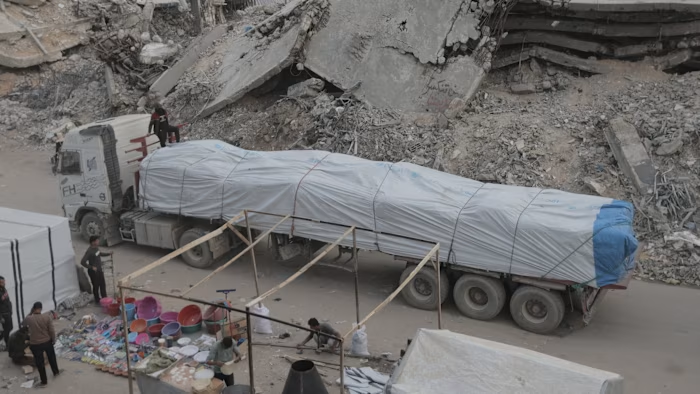
A US-brokered ceasefire between Israel and Hamas came into effect in October, halting two years of devastating war in Gaza triggered by the militant group’s October 7 2023 attacks. The truce has held overall despite near-daily clashes, with both sides accusing the other of violations. As part of the accord, humanitarian supplies have increased, with more than 4,000 trucks entering the strip every week.
Yet the humanitarian situation in Gaza “remains catastrophic”, the joint foreign ministers’ statement said, with inadequate shelter during recent torrential rain, heavily damaged infrastructure, a partially functioning medical system and food insecurity.
The ministers said critical aid and reconstruction supplies were being held up by Israeli bureaucratic restrictions, including on potential items of “dual” military use.
“The target of 4,200 trucks per week . . . should be a floor not a ceiling,” the statement said. “These restrictions limit the capacity for aid to be delivered at the scale needed, in accordance with international humanitarian law.”