
Unlock the Editor’s Digest for free
Roula Khalaf, Editor of the FT, selects her favourite stories in this weekly newsletter.
The writer is a senior associate fellow at the Royal United Services Institute and the Center for American Progress
The UK’s recent announcement that it will follow France and recognise Palestinian statehood, and Canada’s declaration that it intends to do the same, adds new urgency to a long-standing question.
Recognition affirms the Palestinian people’s entitlement to self-determination under international law, which the vast majority of the world’s nations already uphold. But if this recognition is not tied to real measures to end the war on Gaza and dismantle the occupation, it risks becoming a substitute for action.
UK Prime Minister Keir Starmer has made recognition of Palestinian statehood conditional on a set of steps by Israel, including ending the crisis in Gaza, forswearing annexation in the West Bank and recommitting to a peace process aimed at a two-state solution. While framed as a balanced approach, the formulation in effect formalises an Israeli veto over recognition — despite Starmer’s stated view that no party should wield such a veto.
A more coherent position would be grounded in international law and the UK’s long-standing recognition of the legal status of the territories: Israel is the occupying power, and the Palestinians are an occupied people. Recognition of their right to self-determination is not a concession to be negotiated, but a legal obligation whose urgency has only deepened in light of the evolving situation on the ground.
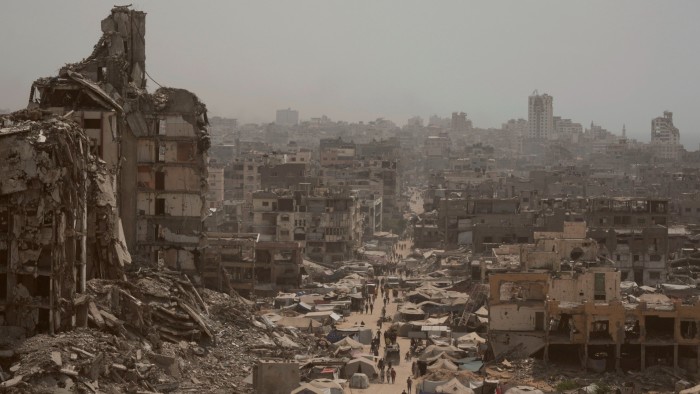
The war on Gaza has taken a staggering toll, to the point where leading Israeli and international human rights organisations have called it genocide, as well as nations such as Spain and Ireland. Eminent scholars such as Omer Bartov, one of the world’s most noted experts on genocide, and Israel’s own former attorney-general, Michael Ben-Yair, have concluded the same. Senior UK officials across Whitehall privately acknowledge that such conclusions are no longer fringe, and the level of frustration with Israel has reached unprecedented levels across Europe.
Against this backdrop, the International Court of Justice’s provisional measures ordering Israel to prevent genocidal acts take on profound significance — not just for Israel, but for third-party states, including those in Europe, which must now ensure they are not complicit. Yet the UK and European states find themselves failing not only to enforce these norms but, in some cases, actively undermining them.
In its recent report, the UK parliament’s foreign affairs committee warned that Israel’s conduct may constitute serious breaches of international humanitarian law, and that British inaction risks legal complicity. The report laid out clear recommendations: suspend arms exports, put conditions on or suspend trade agreements, ban imports from illegal settlements in the West Bank and impose sanctions on officials responsible for violations. Europe as a whole should adopt this framework.
There have been some steps forward, but they have been insufficient. For instance, in September the UK suspended more than 30 arms export licences to Israel — but this partial ban explicitly exempted components for the F-35 fighter jet programme.
Furthermore, in light of mounting evidence that the Israeli military may be involved in widespread serious violations of international law, it is appropriate and necessary for European and British co-operation with Israeli military officials on all levels to be reassessed.
But the measures must go further than this. The EU came close to suspending part of the EU-Israel association agreement, but then took Israel’s word that it would alleviate the starvation in Gaza, despite months of continued violations of humanitarian access and deteriorating conditions in the West Bank. More recently, the EU announced it would partially suspend Israel’s participation in educational research activities — and then failed to gather enough consensus in the EU to take even this paltry step.
The EU and UK have also imposed limited sanctions on a handful of violent settlers and, in the case of the UK, the Netherlands and Slovenia, on two of Israel’s most extreme ministers. But the settlement enterprise is not a rogue fringe; it is a state-directed policy apparatus that may be extended from the West Bank to Gaza. Therefore, targeted measures must extend to all Israeli ministers, military officials and lawmakers who facilitate or incite violations of international law, including in settlements in the West Bank and East Jerusalem.
European leaders have shown they are willing to apply sanctions on officials from Russia, Iran and Syria. Refusing to do so in Israel’s case has undermined both the law and the credibility of European foreign policy worldwide. Without measures such as these, the recognition of Palestine risks becoming a legal fiction rather than a catalyst for change. It may allow European states to signal support for Palestinian rights while avoiding the harder work of enforcing them.
The UK and Europe must decide: will they continue to issue statements while Gaza starves and the occupation deepens? Or will they take action and impose a price on those who flout the law so flagrantly?
Recognition of Palestine is not the end of the story. It must only be the beginning.