
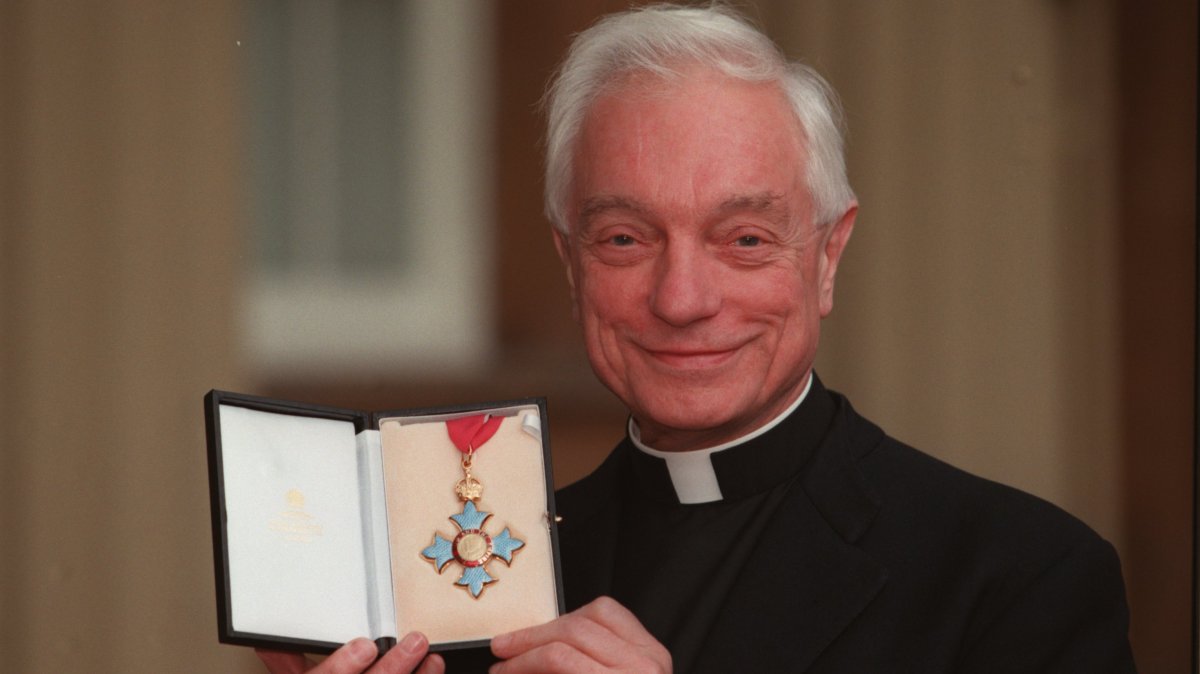
The solemnity of the Speaker’s procession, heralding another day of business in the House of Commons, was perennially interrupted by a squeak. Mice had long been a problem in the Palace of Westminster, but the furry critters had not decided to join the forthcoming debates.
In fact the noise was emanating from the shoes of the Rev Canon Donald Gray, the chaplain to the Speaker of the House of Commons and otherwise known by MPs as “Squeaky”. Resplendent in black silk cassock with white gloves, and in keeping with a tradition that dated back to the Restoration in 1660, Gray would lead prayers for five minutes before the rough and tumble began in earnest.
A genial man with an earthy Lancastrian wit, he took in good part his nickname; squeaking aside, he went about his pastoral business quietly having been appointed by the Speaker Bernard Weatherill in 1987 and serving under Betty Boothroyd until 1998.
Occasionally, he came to the fore such as when he led prayers for the repose of the soul of the Labour leader, John Smith, who died of a heart attack in 1994. “You could have cut the atmosphere out in lumps,” Gray recalled. “Everyone here had such a great admiration for him.”
His predecessor, the Very Rev Trevor Beeson, had expanded the role from being largely ceremonial, to an energetic pastoral ministry to government ministers, MPs and civil servants and even the tea ladies. Gray continued in that vein, hosting dinners with MPs of all stripes to discuss the interplay of faith, ethics and politics, and conducting marriages and baptisms for MPs and their families in the 13th-century undercroft of St Stephen’s Chapel, which adjoins Westminster Hall. “MPs come under enormous strains and often like to talk,” he told The Sunday Telegraph in 1995. “They are in the public eye and they live a goldfish-bowl existence. It is particularly daunting for newly elected MPs.” Notwithstanding the few “who fall below the exacting standards”, Gray had a high opinion of them in general.
Though Gray had to withstand occasional motions — such as one tabled by Donald Gorrie, the Liberal Democrat MP for Edinburgh West, to make the Commons prayers multi-denominational with the Speaker’s chaplain replaced by a roster of rabbis, Buddhist monks, imams, Roman Catholic priests and perhaps even the odd humanist — MPs largely returned the admiration.
Yet Gray had many enemies in the Church of England because of his pivotal role in what was perceived as a usurping of the 1662 Book of Common Prayer, which ironically he used for saying prayers in the House. Serving on the Church of England’s Liturgical Commission from 1968, Gray had tried to persuade stubbornly resistant factions of the church that the Book of Common Prayer was no longer appropriate for modern parishes with “livelier forms of worship”. Gray even argued that he wanted to return to patterns of worship that had been common among early Christians in the first centuries AD. As a scholar of liturgical history par excellence, he backed his arguments eloquently.
After years of unseemly bickering, the Alternative Service Book was published in 1980, pointedly named because it was never intended as a replacement for the original. The archaic language of the Book of Common Prayer, and its various successors, was banished. No longer would godparents at a baptism be required to renounce the Devil or “the vain pomp and glory of the world” and “the carnal desires of the flesh” but would instead turn to Christ, repent of sin and renounce evil. At marriage ceremonies the line suggesting that men might be like “brute beasts with no understanding” was removed.
The book was republished several times to meet demand; the Prayer Book Society began to complain that it was becoming hard to find a church that used the old prayer book. One church packed with congregants who most certainly did want to use the Book of Common Prayer was St Margaret’s, Westminster, where, as the chaplain to the Speaker, Gray also served as rector. Nothing if not thick-skinned, Gray introduced the ASB at St Margaret’s anyway.
He further outraged traditionalists in 1996 by suggesting that the much-loved hymn Jerusalem, set to a poem by William Blake, should not be sung at a memorial service being organised by peers for the children’s campaigner Baroness Faithfull. He believed that the line about England’s “green and pleasant land” smacked of privilege. He also interpreted the reference to “dark satanic mills” as a shameful metaphor for the church’s historical neglect of inner cities, where poverty and sickness was rife and Christ was needed most.
“The object of too much of our economic and social policy has been to derive as much wealth as we can out of the industrial and commercial areas, so that we can enjoy the delights of the country,” Gray said. “We must build a new Jerusalem, not just in the fields and pastures but in the cities and towns, where, always remember, the majority of God’s children live.”
Gray’s views generated an outraged response, with some suggesting that rather than criticise a treasure of British culture sung in public schools, Women’s Institute meetings and in more recent years before the start of each day’s play at cricket Test matches in England, Gray would be better taking more practical action to tackle urban deprivation. With justification, he could claim that that was exactly what he had done during two decades of ministry in Manchester and Liverpool. Ironically, Gray remained a great cricket lover into his retirement.
Donald Clifford Gray was born in Manchester in 1930 to Henry Hackett Gray and his wife Constance (née Bullock). He was educated at Newton Heath Technical High School in the city, where he first felt the calling to holy orders.
Gray was ordained in 1957 after training for the priesthood at King’s College London and St Boniface Missionary College in Warminster. He served as a curate at St Mary’s Church, Leigh, in the diocese of Manchester, and was appointed vicar of St Peter’s Church, Westleigh, in 1960 and from 1967 vicar of All Saints Church, Elton, Bury.
Preferment came his way in 1974 with his appointment as rector of Liverpool and the incumbency of the Church of Our Lady and Saint Nicholas. He became rural dean of Liverpool in 1975 and honorary canon of Liverpool Cathedral from 1982.
Gray’s influence spread in varied ministries: chaplain to Huyton College Chapel, a private girl’s school, and chaplain to the Territorial Army; he renewed friendships made in the services at the Army and Navy Club in later years. Most prestigiously, he was a chaplain to Queen Elizabeth for 16 years from 1982.
Between 1992 and 2001 Gray was chairman of the Christian Evidence Society that had been resurrected by the Bishop of Oxford, Richard Harries. In this role he was involved in the launch of Premier Christian Radio in 1994 and as the new millennium approached he commissioned booklets, including Whose Birthday is it Anyway?, Why God?, Why Suffering? and Finding God in Bereavement (as well as Illness and Marriage Breakdown) aimed at non-Christians. Tens of thousands of copies were distributed through cathedrals and churches.
In retirement Gray retained his interest in liturgical reform, writing Liturgical Renewal as a Way to Christian Unity in 2005 and The Oxford Handbook of English Literature & Theology in 2007. He had married Joyce Jackson, in 1955. She died in 2010. They had three children: Clare, Timothy and Alison.
Gray had loved his years in the Commons. He usually had a riposte when subjected to banter in the House, apart from one occasion when he was leaving the chamber and the veteran leftwinger Dennis Skinner, otherwise known as the “Beast of Bolsover”, was leaving it. Some Tories shouted, “You’re late for prayers, Dennis.” “He stopped in his tracks, looked me up and down and said, ‘When I’m Speaker I’m going to have David Icke as my chaplain’.” There was no answer to that.
The Rev Canon Donald Gray CBE, chaplain to the Speaker of the House of Commons, was born on July 21, 1930. He died on July 4, 2025, aged 94