
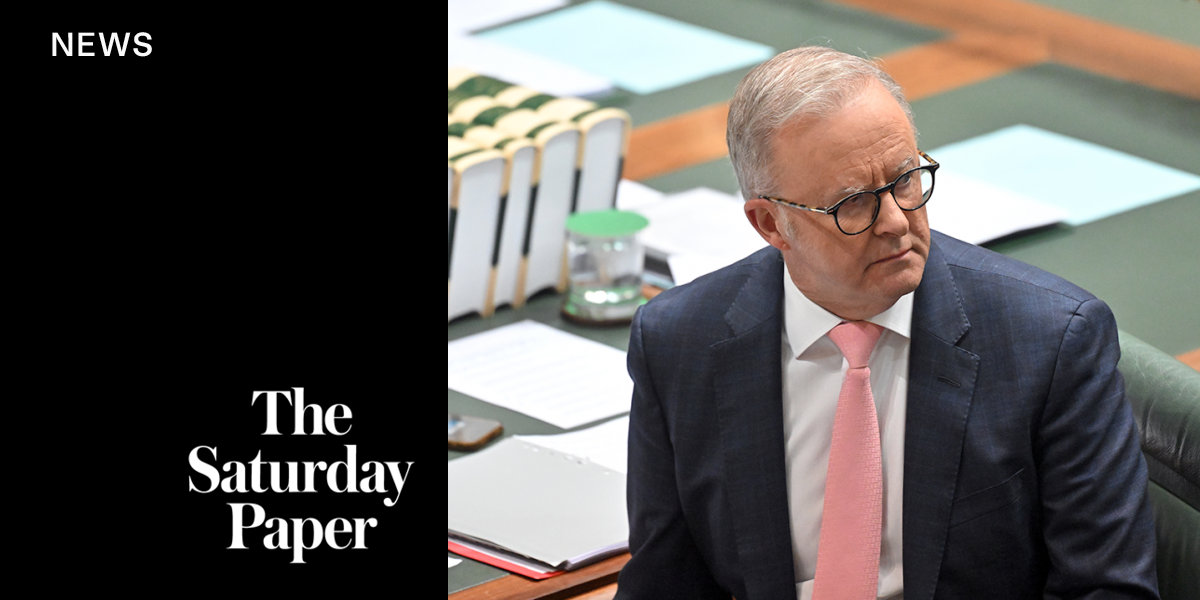
Anthony Albanese is preparing for Australia to recognise Palestinian statehood. Once achieved on the world stage, says Labor MP Ed Husic, such statehood would be the final “hammer blow” to the terrorist group Hamas.
Amid images of emaciated Gazans and famine alerts from the United Nations, Albanese has hardened his language and admonished Israel’s Prime Minister Benjamin Netanyahu. At the same time, he says several preconditions for Palestinian statehood must be met, including that Hamas would have no ongoing role in the region.
“I’ve said for a long time, my entire political life, I said I support two states: the right of Israel to exist within secure borders, and the right of Palestinians to have their legitimate aspirations for their own state realised,” the prime minister said on Wednesday.
“That’s my objective, not making a statement, not winning a political point, but achieving that. That’s very much my focus.”
Australia took part in a joint “New York call” of 15 foreign affairs ministers this week, in which there was “unwavering commitment to the vision” of a two-state solution and a call for all nations that have not yet recognised a Palestinian state to do so. Among the 15 were France, Canada, Ireland, New Zealand and Spain, countries that either recognised or had expressed “the willingness or the positive consideration of their countries” to do so.
It’s understood that Albanese has told colleagues the current situation in Gaza is not sustainable and Australian recognition will “obviously” come. The Saturday Paper understands he has told them it is a matter of when, pointing to the adage that sometimes out of a crisis comes a change.
This sentiment was echoed by Treasurer Jim Chalmers on Thursday, who said Australian recognition of a state of Palestine was a “matter of when, not if”.
Albanese is also stressing to pro-Palestinian advocates that a Palestinian state and justice can only come from simultaneously getting increased security for Israel.
The Executive Council of Australian Jewry met with the prime minister on Wednesday and came out of the meeting saying Palestinian statehood is “on the government’s agenda, but it is not imminent”.
Husic says there is no time to waste.
“I just think the moment has changed and our approach has to reflect that,” the former cabinet minister tells The Saturday Paper. “We also have to contend with this suggestion that we’re rewarding Hamas with the recognition of the state, and the fulfilment of the conditions we expect will be the hammer blow to Hamas.
“The reason I say that is because Hamas’s biggest source of fuel is grievance. If we recognise the state, we demilitarise Hamas, we improve the operations of the Palestinian Authority, and we encourage greater democracy in Palestine – that undercuts, fundamentally, Hamas.
“So, my argument is this actually does counter what the critics suggest.”
Albanese said the world was horrified by the terrorist atrocities committed by Hamas on October 7, 2023, but it is now watching what is happening in Gaza and sees that it is “unjustified”, a “tragedy” and it is “producing a response”.
Israel imposed a total aid blockade at the start of March. Extreme hunger has gripped a widely displaced civilian population. It also resumed its military offensive against Hamas, shattering a two-month ceasefire and taking control of swathes of a widely flattened territory.
The images of a sick and malnourished 18-month-old child, Mohammed al-Matouq, moved the prime minister to admonish Israel over what he says is a “breach of international law” and a “breach of decent humanity”. He said the control of food deliveries was “completely indefensible”.
“As I have said to the Israeli President Herzog in May, that Israel increasingly is seeing people express their opposition to those actions,” Albanese told reporters in his Parliament House courtyard.
“People who are friends of Israel have to be able to say, ‘what you are doing is losing support’, and that is what is happening.”
When challenged by Netanyahu and the Embassy of Israel in Canberra, who said there was no starvation or policy of starvation in Gaza and that Hamas was using “false pictures” of sick children to present a distorted view, Albanese said the denial was “beyond comprehension”.
Albanese’s position was echoed by United States President Donald Trump, who, while not criticising Netanyahu directly, stated that “real starvation stuff” is happening in Gaza and “you can’t fake that”.
French President Emmanuel Macron took a big step forward this week, announcing that in September France would become the first G7 nation to recognise Palestine statehood.
“I’m concerned that we may be overly committed to a process when the moment demands almost a moral response. I think the country would, as one, welcome an adjusted move that provides recognition now but an expectation that our stated preconditions must be met.”
The United Kingdom government under Labour’s Keir Starmer followed days later, offering a conditional pledge to recognise statehood as a “pathway to peace”, insisting it would act before the UN General Assembly on September 9 if the Israeli government did not take “substantive steps”, including agreeing to a ceasefire. Albanese has spoken to Starmer twice this week.
The change in UK policy was blasted by Netanyahu, with the Israeli leader posting on X that Starmer “rewards Hamas’s monstrous terrorism and punishes its victims”.
The UK announcement was also slammed by some of the families of Israeli hostages. One former hostage, Emily Damari, said the decision “risks rewarding terrorism” and sends the message that “violence earns legitimacy”.
Canada joined the UK a day later, promising recognition at the UN General Assembly after receiving assurances from Palestinian Authority leader Mahmoud Abbas of a raft of changes, including the dismantling of Hamas, the return of Israeli hostages and the holding of elections next year, after not holding one for 20 years.
Foreign Affairs Minister Penny Wong told the UN General Assembly last year that Australia no longer sees Palestinian recognition as the destination of a peace process but rather as a contribution of momentum towards peace.
Albanese, who will be attending the UN General Assembly in September, expressed the same sentiment to parliament this week, while saying discussions with other nations were under way.
“The timing of a decision to recognise the state of Palestine will be determined by whether that decision advances the realisation of that objective,” he said.
“It must be more than a gesture. It must be something that’s a part of a moving forward.”
The bipartisan view is that a peace agreement, the return of hostages and the dismantling of Hamas are prerequisites for considering the two-state solution.
The Coalition is opposed to premature recognition.
“My view is that Palestinian statehood should come about, but it needs to come about in such a way that it guarantees a better future for the Palestinian people but also a secure future for Israel. And it’s been the traditional position in Australia,” Liberal senator and former Australian ambassador to Israel Dave Sharma tells The Saturday Paper.
“We support a two-state solution, but recognition would come as a result of the negotiated two-state solution.
“Other countries seem to be saying we’re going to address Palestinian statehood or give Palestinian statehood as a way to alleviate the humanitarian situation in Gaza. It won’t. It’s not going to make any difference. In fact, it sort of risks complicating the whole picture and making it less likely.”
Husic says pressure works.
“I’m worried that an iron-fisted determination to just fulfil the game plan that we have outlined, no matter what, will leave us when there’s all this movement … with clay feet,” he tells The Saturday Paper.
“I’m concerned that we may be overly committed to a process when the moment demands almost a moral response.
“I think the country would, as one, welcome an adjusted move that provides recognition now but an expectation that our stated preconditions must be met.”
More than 100 international aid organisations and human rights groups have warned of mass starvation in Gaza, while a group of UN-backed global food security experts issued an alert warning declaring that the “worst-case scenario of famine” is currently playing out in the territory.
While Labor has moved quickly in response, there has been more caution from the federal opposition under Sussan Ley. She was asked repeatedly in a Parliament House press conference if she accepted there was evidence of starvation in Gaza.
“It’s a complex situation on the ground. Like everyone, I’m very distressed by the images I’ve seen,” she told reporters.
“I’m pleased to see that aid is flowing further and better into Gaza. And I really encourage everyone who sees this situation for the reality it is, to remind others that Hamas, in control of the hostages, could end the war tomorrow.”
Liberal frontbencher James Paterson acknowledges the “very genuine suffering of the people of Gaza” but urges against early recognition of a Palestinian state as he says it would recognise a state that is “in part governed by a terrorist organisation”.
He says reports of widespread starvation are credible.
“As a supporter of Israel, I support their campaign to remove Hamas and to free the 50 hostages who remain in captivity,” he told the ABC’s RN Breakfast. “But I also expect that, as the military power in control of the region, they do everything they can to make sure that innocent civilians in Gaza are fed.”
Husic said that among Coalition responses he hugely respected “the much more nuanced approach of people like Senator Paterson”.
Sharma says the Coalition is united on the view that there is a humanitarian situation in Gaza based on high-level food insecurity.
“We recognise that there’s enough experts out there, well-qualified credentialled experts. There is also some misinformation, propaganda out there, but there seems to be enough credible experts out there that acknowledge this is the case,” he says. “And look, President Trump, who you would say is one of Israel’s staunchest defenders, has certainly publicly accepted that as well.”
MPs’ offices are seeing growing contact over the crisis and the prime minister has indicated his Sydney electorate office has again been shut down due to protest activity.
Late on Wednesday, the Zionist Federation of Australia, one of the nation’s leading pro-Israel groups, insisted it stood “shoulder to shoulder with the State of Israel” but called for action “without delay”.
“Our humanity also compels us to recognise the pain and suffering of innocent civilians in Gaza,” Zionist Federation president Jeremy Leibler said in a statement that also stressed that the “ultimate responsibility for this humanitarian situation lies with Hamas”.
“We are deeply troubled by the reports of hunger in parts of Gaza. We call upon Israel, the United Nations and their counterparts to do everything within their power to ensure that sufficient humanitarian aid flows to Palestinian civilians without delay. That is their collective moral obligation.”
Dean Sherr, a former adviser to Albanese and former national president of the Australasian Union of Jewish Students, welcomed the statement.
“The starvation has clearly galvanised a lot of horror in the world, even in the Jewish world,” Sherr tells The Saturday Paper.
“Clearly, the question of how Israel gets out and ends this is open. And the ceasefires that have existed have been the most effective way to get hostages home. And I think Israelis know that.
“I think the majority of Israelis know that, and they’re just looking for an end to this as well.”
The Greens, now holding the sole balance of power in the Senate, want all levers pulled when it comes to Israel and want to expand individual sanctions applied to more Israeli figures, beyond the current dozen that includes right-wing cabinet ministers Itamar Ben-Gvir and Bezalel Smotrich.
This proposition has supporters in Husic and international law experts such as Donald Rothwell, but it was not embraced by the prime minister. He slammed the Greens for trying to “secure some domestic political advantage and damage social cohesion in this country”.
Later on Wednesday, the government and the Greens teamed up to pass an urgency motion calling Israel’s aid blockade a “breach of international law” that risks “mass death from starvation”. It also commits Labor to “diplomatic and further action” to pressure the Israeli government.
Husic, the first Muslim to be elected to federal parliament, does not want Australia to miss the moment.
“I don’t envy Penny Wong’s job,” he tells The Saturday Paper. “The multiplicity of sometimes competing, complex foreign policy considerations is like threading a needle in a gale-force breeze. I do not doubt for one minute how hard it is, but the moment is requiring the injection of agility to be able to respond to this humanitarian crisis of phenomenal proportion.
“The other thing I just want to emphasise is that recognition, of itself, will not end this crisis. There are a lot of things that have to happen for that to occur, but it is an important step.”
This article was first published in the print edition of The Saturday Paper on
August 2, 2025 as “Inside Albanese’s firming position on Gaza and Palestinian statehood”.
For almost a decade, The Saturday Paper has published Australia’s leading writers and thinkers.
We have pursued stories that are ignored elsewhere, covering them with sensitivity and depth.
We have done this on refugee policy, on government integrity, on robo-debt, on aged care,
on climate change, on the pandemic.
All our journalism is fiercely independent. It relies on the support of readers.
By subscribing to The Saturday Paper, you are ensuring that we can continue to produce essential,
issue-defining coverage, to dig out stories that take time, to doggedly hold to account
politicians and the political class.
There are very few titles that have the freedom and the space to produce journalism like this.
In a country with a concentration of media ownership unlike anything else in the world,
it is vitally important. Your subscription helps make it possible.
Send this article to a friend for free.
Share this subscriber exclusive article with a friend or family member using share credits.

Used 1 of … credits
use share credits to share this article with friend or family.
You’ve shared all of your credits for this month. They will refresh on September 1. If you would like to share more, you can buy a gift subscription for a friend.
SHARE WITH A FRIEND
? CREDITS REMAIN
SHARE WITH A SUBSCRIBER
UNLIMITED
Loading…
Comment
Albanese steps up pressure on Israel