Toplines
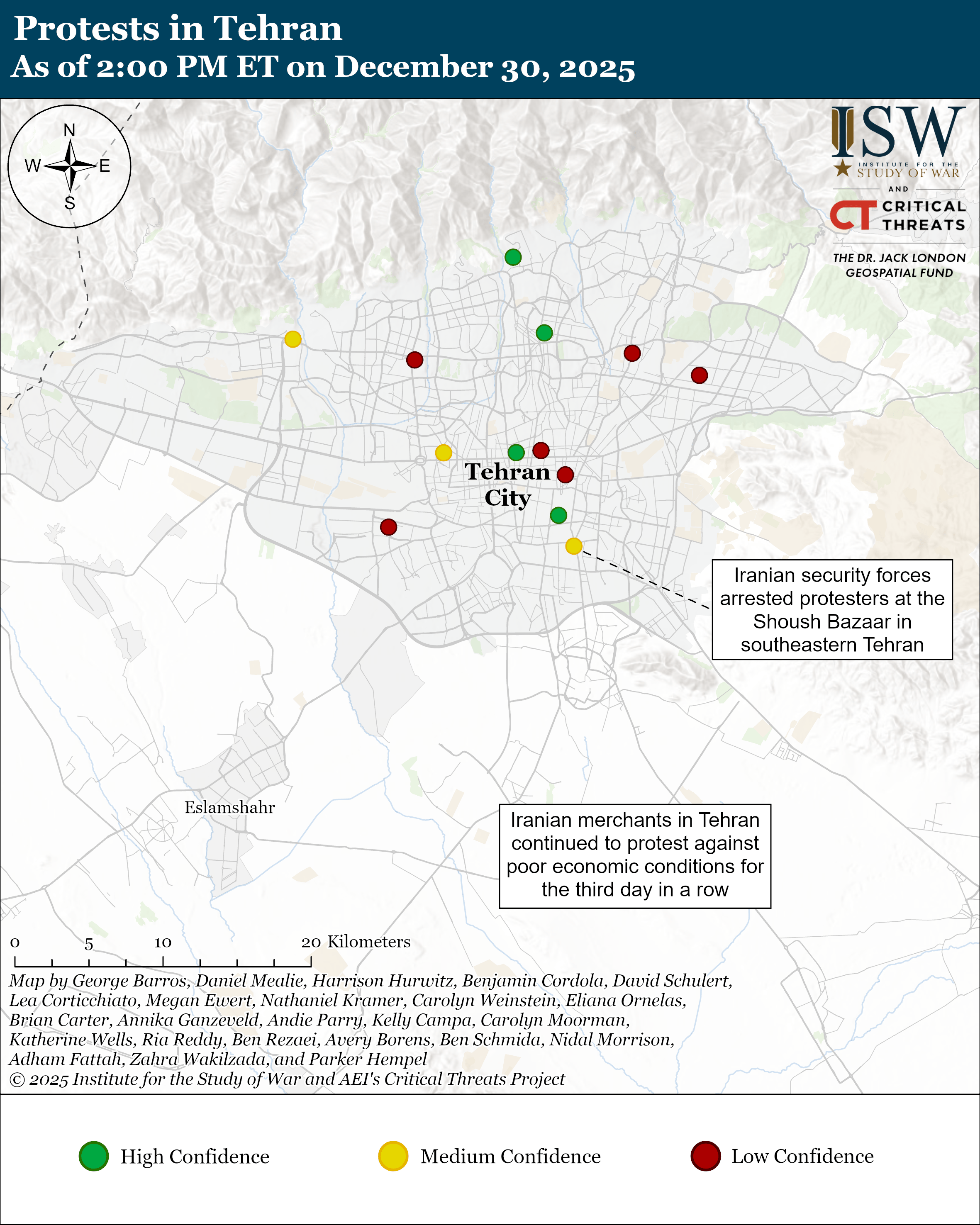
Protests in Iran have expanded geographically and demographically since December 28. Small protests broke out in Tehran on December 28 in response to worsening economic conditions. These protests were primarily concentrated near markets and shopping centers in Tehran.[1] The protests have since spread to other locations across Iran. Protesters demonstrated in at least nine provinces on December 30, including in Tehran, Alborz, Kermanshah, Markazi, Hamedan, and Esfahan provinces.[2] Students also participated in protests on December 30 at multiple universities across Iran, including at universities in Tehran, Yazd, and Zanjan.[3] Merchants went on strike in Shiraz, Fars Province, Ahvaz, Khuzestan Province, and Tehran Province.[4] The Iranian Truck Drivers Union declared support for striking shopkeepers and protesters on December 29.[5] Iranian truck drivers previously went on strike in May 2025.[6] CTP-ISW has recorded a total of 24 protests across Iran, including 13 protests in Tehran Province, since its last data cutoff on December 29.
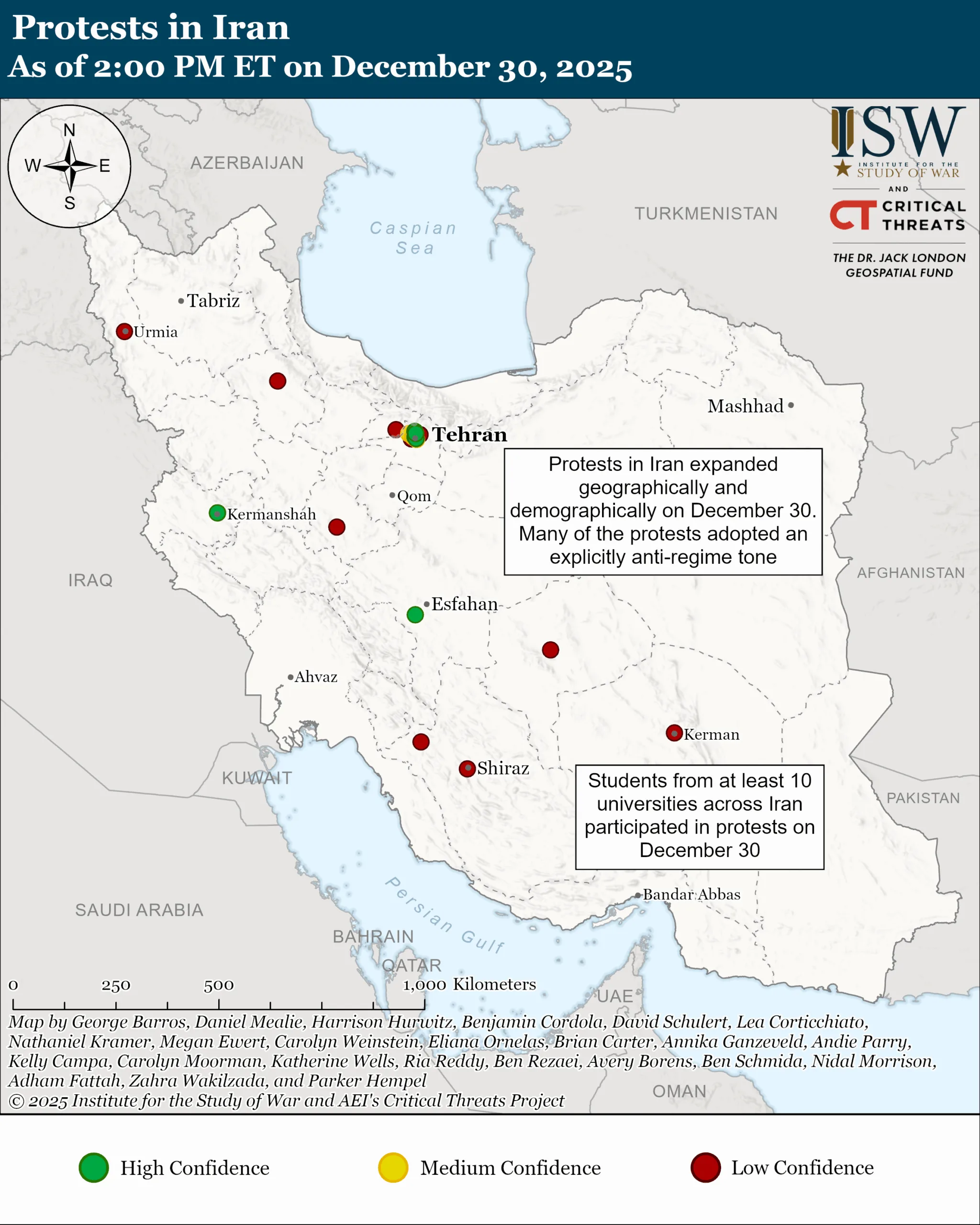
Many of the recent protests adopted an explicitly anti-regime tone. Protesters and students chanted anti-regime slogans, such as “Death to the dictator” and “No Gaza, No Lebanon, I will sacrifice my life for Iran,” as well as slogans that praised the Pahlavi dynasty.[7] The anti-regime tone of many of the protests comes as the regime is trying to frame the protests as driven solely by economic grievances. Economic-related protests and strikes have the potential to transform into explicitly anti-regime protests. Demonstrations against an increase in gasoline prices morphed into anti-regime protests in Iran in 2019, for example.[8]
Iranian government officials and some Iranian media outlets have likely adopted a relatively soft tone toward the protests thus far to prevent the protests from expanding and becoming more overtly anti-regime in nature. Iranian government officials have acknowledged Iranians’ economic hardships and emphasized the need for dialogue with protesters during the first three days of the protests. Iranian President Masoud Pezeshkian stated on December 29 that the livelihoods of Iranians are his daily concern and that his administration will pursue monetary and banking reforms to preserve purchasing power.[9] Pezeshkian added that he tasked Interior Minister Eskandar Momeni to “hear protesters’ legitimate demands” through dialogue with the protesters’ representatives.[10] It is unclear what representatives Pezeshkian was referring to. Iranian Government Spokesperson Fatemeh Mohajerani separately stated on December 30 that the government recognizes public protests, supports peaceful gatherings, and listens to “harsh and critical voices.”[11] Parliament Speaker Mohammad Bagher Ghalibaf stated on December 30 that officials must respond fully and responsibly to public concerns over livelihood problems and that executive authorities must prioritize dialogue, especially with representatives of merchants.[12] Government officials’ relatively soft tone toward the protests is not completely unusual, given that the Iranian regime has historically been slightly more tolerant of economic-driven protests as compared to protests driven by sociocultural grievances, such as the 2022-2023 Mahsa Amini protest movement.
There are several other factors that could also explain the Iranian government’s relatively soft tone toward the protests thus far. The Pezeshkian administration includes more moderate figures than the administration of Pezeshkian’s hardline predecessor, Ebrahim Raisi, who was serving as president during the Mahsa Amini movement. The Iranian regime is also concerned about a potential new conflict with Israel and may seek to avoid worsening its internal security situation so that it does not have to confront external and internal threats simultaneously. An adviser to former IRGC Commander Mohsen Rezaei claimed on December 29 that Israel could exploit Iran’s weakened position to attack Iran. The adviser called on the Iranian regime to address external perceptions of internal unrest in Iran.[13]
Some elements of the Iranian security apparatus have adopted a more hardline tone toward the protests, however. The Armed Forces General Staff published a statement on December 29 in which it called on the government to address economic problems but also warned that Iran’s adversaries “will receive blows that are much stronger, more crushing, and more damaging” if they “make another mistake.”[14]
Iranian security forces have responded in a relatively restrained manner to the protests thus far. CTP-ISW has observed limited reports of engagements between security forces and protesters thus far. Social media users circulated a video from December 29 that showed security forces firing tear gas at a small crowd in Hamedan Province.[15] Security forces also arrested protesters in Tehran Province on December 30.[16] The Amir Kabir University newsletter reported clashes between security forces and student protesters at Shahid Beheshti University in Tehran on December 30.[17]
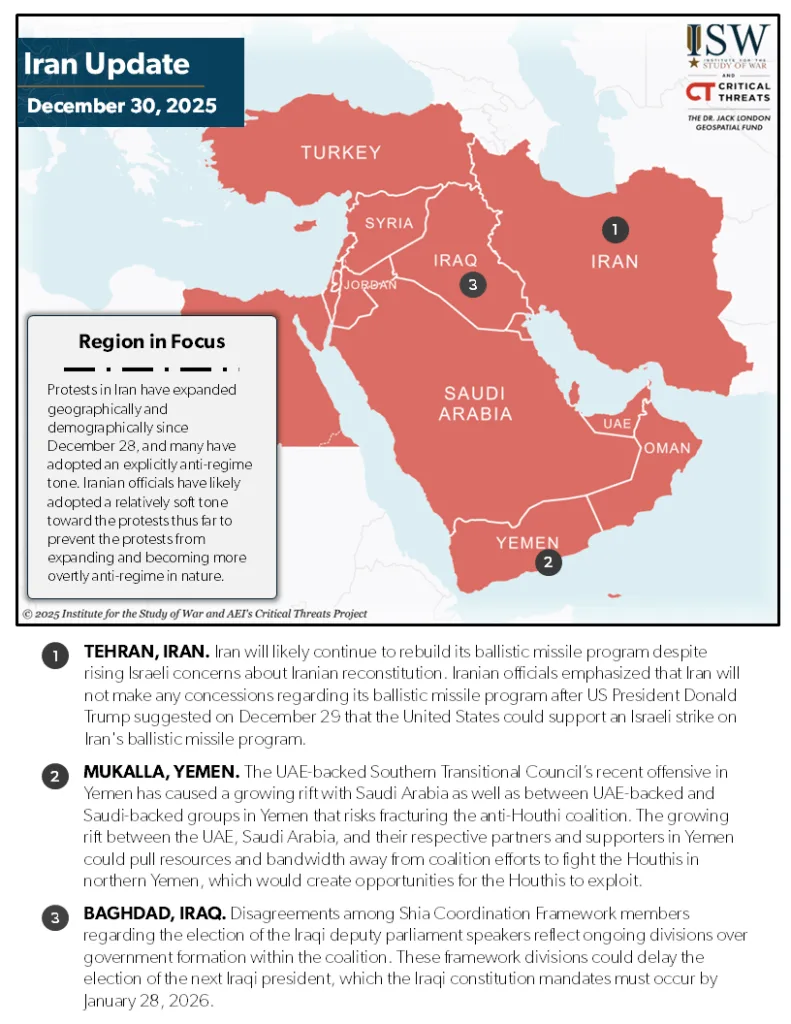
Iran will likely continue to rebuild its ballistic missile program despite rising Israeli concerns about Iranian reconstitution. Iranian officials emphasized that Iran will not make any concessions regarding its ballistic missile program after US President Donald Trump suggested after his meeting with Israeli Prime Minister Benjamin Netanyahu on December 29 that the United States could support an Israeli strike on Iran’s ballistic missile program.[18] Israeli officials have become increasingly concerned about recent Iranian efforts to rebuild its ballistic missile production facilities.[19] One of Supreme Leader Ali Khamenei’s representatives to the Defense Council, Ali Shamkhani, stated on December 29 that Iran’s missile capabilities are not “permission-based” and warned that Iran would respond to any threats before they materialize.[20] An Iranian analyst close to former IRGC Commander Mohsen Rezaei separately claimed that any path to negotiations with the United States would be based on Iran strengthening its “hard power, military capability, and…deterrence levers.”[21] Missiles, in addition to Iran’s Axis of Resistance, have long acted as the central pillar of Iran’s regional defense strategy, and Iranian officials have long considered the regime’s ballistic missile program to be a crucial deterrent to Israel and the United States.[22]
UK-based Amwaj Media reported on December 29 that Iran and Israel have recently exchanged secret messages through Russia to deescalate tensions, citing informed regional and political sources.[23] One unspecified regional source claimed that Netanyahu asked Russia to convey to Iran that Israel does not seek further confrontation with Iran.[24] A separate unspecified source in Tehran claimed that Iran and Israel told a Russian intermediary—believed to be President Vladimir Putin—on an unspecified date that they do not intend to conduct new strikes on the other country.[25] The source reported that Supreme National Security Council Secretary Ali Larijani engaged with the unspecified Russian intermediary, rather than the Iranian Foreign Affairs Ministry.[26] This report contrasts recent reports that Netanyahu was planning to brief Trump on options for the United States to “join or assist” an Israeli military operation against Iran’s ballistic missile program during his December 29 meeting with Trump.[27]
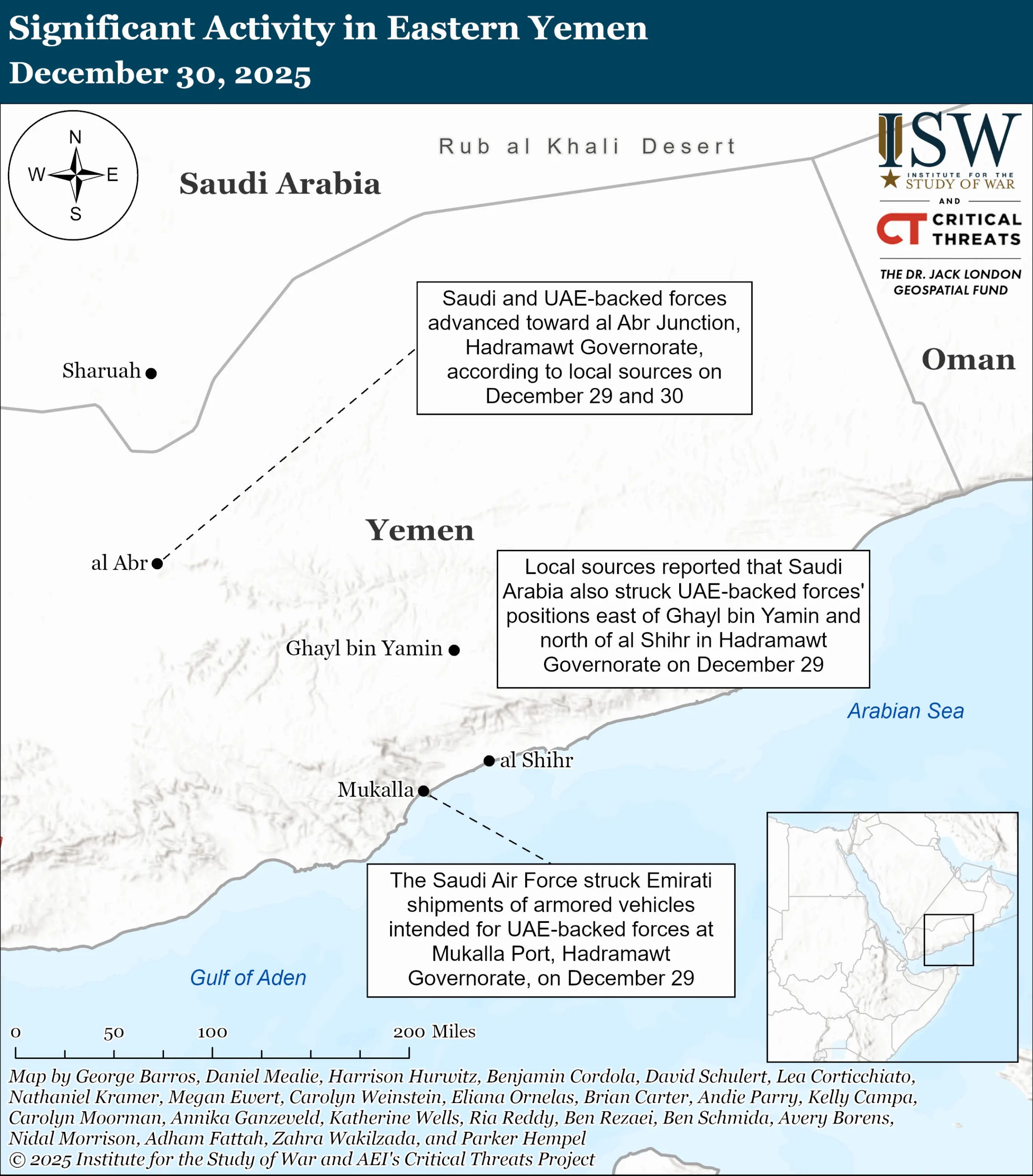
The United Arab Emirates (UAE)-backed Southern Transitional Council’s (STC) recent offensive in Yemen has caused a growing rift between the UAE and Saudi Arabia as well as between UAE-backed and Saudi-backed groups in Yemen that risks fracturing the anti-Houthi coalition. The STC seized key areas of Hadramawt and Mahra governorates in eastern Yemen in early December.[28] The UAE and Saudi Arabia have cooperated since 2015 to fight the Iranian-backed Houthi movement as part of the Saudi-led Arab Coalition but competing Saudi and Emirati interests in southern Yemen are causing a growing rift between the two countries.[29] Saudi Arabia, which opposes the STC‘s recent offensive, struck Emirati targets in Yemen on December 29, including an Emirati shipment of armored vehicles and weapons intended for STC forces at Mukalla Port, after the STC refused to withdraw from positions it recently seized.[30] Saudi Arabia condemned the UAE’s support for the STC as “extremely dangerous” in a statement following the strikes on December 30.[31] The Riyadh-based, Saudi-supported Yemeni President and Presidential Leadership Council (PLC) President, Rashid al Alimi, declared a 72-hour state of emergency across all Republic of Yemen Government (ROYG)-controlled territory following the airstrikes. Alimi also annulled a Yemen-UAE defense agreement, announced a temporary blockade of ROYG-controlled territory, and ordered Emirati forces to leave Yemen.[32]
The UAE and UAE-backed actors in Yemen have also refused to back down from their support for the STC’s takeover of parts of Hadramawt and Mahra governorates. Four UAE-backed PLC members rejected Alimi’s measures in a joint statement on December 30.[33] These PLC members include STC President Aidarous al Zubaidi, STC Vice President and Southern Giant Forces Commander Abu Zaraa al Muharrami, STC Vice President and former Second Military Region (southern Hadramawt and Mahra governorates) Commander Faraj al Bahsani, and the commander of the National Resistance Forces on the West Coast, Tariq Saleh.[34] Saleh, although UAE-backed, only recently aligned with the STC, whereas the other three men have long supported the STC’s objective to establish an independent southern Yemeni state.[35] The UAE announced on December 30 that it would withdraw Emirati counterterrorism personnel from Yemen in response to Alimi’s annulment of the Yemen-UAE defense agreement. Emirati counterterrorism forces have been operating under the anti-Houthi coalition since Emirati forces left Yemen in 2019.[36] The UAE notably did not state that it would halt Emirati support for UAE-backed groups in Yemen, namely the STC, however.[37] UAE-backed forces and Saudi-backed forces continued deploying to contact lines in Wadi Hadramawt on December 29 and 30.[38]
The growing rift between the UAE, Saudi Arabia, and their respective local partners and supporters in eastern Yemen could pull resources and bandwidth away from coalition efforts to fight the Houthis in northern Yemen, which would create opportunities for the Houthis to exploit. It is difficult to ascertain how many STC units have left frontline positions facing the Houthis to consolidate their gains in eastern Yemen, though at least one brigade from the STC’s Southern Giant Forces participated in the STC’s seizure of Saudi-backed groups’ positions in Mahra Governorate on December 10.[39] The Southern Giant Forces, commanded by STC Vice President and PLC Vice President Abu Zaraa al Muharrami, is primarily based in southwestern Yemen and has played a significant role in fighting the Houthis in Shabwa and Marib governorates in central Yemen.[40] The Southern Giant Forces operates alongside Tariq Saleh‘s UAE-backed National Resistance Forces under the Joint Forces on the West Coast.[41] The Joint Forces on the West Coast hold key positions along Houthi frontlines in Hudaydah, Taiz, and Lahj governorates in southwestern Yemen.[42] CTP-ISW has not observed other STC units leaving positions along Houthi frontlines to consolidate their gains in eastern Yemen, but the growing Saudi-Emirati tensions over eastern Yemen increase the risk that either party would need to pull resources from efforts to counter the Houthis to address the ongoing territorial disputes. CTP-ISW has also not observed any Houthi mobilization or large Houthi deployments on either its southwestern or eastern frontlines at the time of this writing. The risk of the Houthis exploiting the conflict between UAE- and Saudi-backed forces for their own territorial gain remains, however.
Disagreements among Shia Coordination Framework members regarding the election of the Iraqi deputy parliament speakers reflect ongoing divisions over government formation within the coalition. The Shia Coordination Framework is a loose coalition of Shia political parties, some of which Iran backs. The Iraqi parliament elected Sadiqoun parliamentarian and former Babil Province Governor Adnan Fayhan as the first deputy speaker on December 29.[43] Sadiqoun is the political wing of Iranian-backed Iraqi militia Asaib Ahl al Haq.[44] A parliamentarian from Prime Minister Mohammad Shia al Sudani’s Reconstruction and Development Coalition told Iraqi media on December 30 that Sudani supported Fayhan whereas State of Law Coalition head Nouri al Maliki backed Iraqi Foundation Coalition head and former First Deputy Speaker Mohsen al Mandalawi.[45] The Iraqi Parliament also elected Kurdistan Democratic Party (KDP) parliamentarian Farhad Amin al Atroushi as second deputy speaker on December 30.[46] The KDP’s original candidate for the position, Shakhwan Abdullah, and a candidate from a smaller Kurdish political party failed to win enough votes in parliament to win the position on December 29.[47] Kurdish media reported on December 30 that Iranian-backed Badr Organization head Hadi al Ameri oversaw efforts to resolve disputes within the framework over the second deputy speaker position.[48] A Kurdish social media observer noted that Ameri, Maliki, and Popular Mobilization Commission head and Reconstruction and Development Coalition member Faleh al Fayyadh supported Abdullah.[49] Asaib Ahl al Haq head Qais al Khazali reportedly backed a different candidate.[50] The Kurdish account described a sequence of events that led to a consensus on the second deputy speaker, which highlights the informal negotiations that Iraqi politicians engage in during the government formation process.[51] KDP leader Masoud Barzani reportedly called Iranian-backed Supreme Judicial Council head Faiq Zaidan to rally support for Abdullah and eventually likely agreed to accept Altroushi as a compromise candidate after Maliki intervened, according to the account.[52] The account added that Barzani likely promised not to obstruct the presidential election process if Altroushi was elected as second deputy speaker.[53] The KDP and its rival, the Patriotic Union of Kurdistan (PUK), continue to negotiate which party will fill the presidency.[54] Conflict between the KDP and the PUK over the presidency led, in part, to Iraq’s nine-month-long delay in electing a president following the parliament speaker’s election in 2022.[55]
The debate over Iraqi deputy speakers is an extension of the framework’s current divisions over a variety of issues, including the selection of the next prime minister. The framework has yet to name its preferred candidate for prime minister. The framework’s candidate will have the opportunity to attempt to form a government after a new president is elected, as the framework is currently the largest bloc in parliament.[56] Multiple framework actors, including Maliki and Ameri, oppose Sudani serving a second term in office due, in part, to some actions Sudani has taken in office against Iranian-backed interests in Iraq.[57]
These framework divisions could delay the election of the next Iraqi president, which the Iraqi constitution mandates must occur by January 28, 2026. The Iraqi Parliament must elect a president by a simple majority with a two-thirds quorum within 30 days of the first parliament session, which corresponds to January 28.[58] The Iraqi Parliament failed to elect a president for more than nine months after the election of a parliament speaker following the 2021 elections due, in part, to divisions between the framework and Shia nationalist cleric Muqtada al Sadr’s coalition.[59] The two-thirds quorum requirement to elect a president has historically enabled parliamentarians to paralyze the government formation process by boycotting parliament sessions.[60] Any disagreements between framework members could therefore cause parliamentarians to boycott parliament sessions and delay the election of the president. Framework parliamentarians could also threaten to boycott parliament sessions in order to extract concessions from other parties regarding ministry appointments and other positions within the Iraqi government.
Foreign-directed and -organized Alawite insurgent networks remain active on the Syrian coast, but these networks are likely smaller, less capable, and less organized than recent Western media reports suggest. A New York Times report on December 24 highlighted the efforts that former Assad regime officials in Russia and Lebanon have taken to recruit, fund, and equip Assadist insurgents.[61] The former officials include former Tiger Forces Commander Suhail al Hassan, Military Intelligence Chief Kamal Hassan, and Fourth Division General Ghiath Dalla.[62] These commanders allegedly have access to hundreds of thousands of potential Alawite fighters across coastal Syria.[63] Dalla reportedly distributed roughly $300,000 per month to fighters and has sought to acquire drones and anti-tank systems to fight the government.[64] The New York Times report suggested that Alawite insurgent groups along the coast are sophisticated and well-financed by these foreign-based benefactors.[65]
Alawite insurgent groups’ recent activity suggests that these groups are smaller and have more limited resources than former Assad regime officials claim. The Coastal Shield Brigade and Men of Light (Saraya al Jawad) are two Alawite insurgent groups with Assadist roots that continue to conduct insurgent activities along the Syrian coast.[66] The Men of Light is reportedly associated with Suhail al Hassan.[67] Both Alawite insurgent groups have largely failed since March 2025 to conduct attacks or other actions to advance their stated goal of ending Syrian government control over coastal Syria.[68] The limited attacks that the Coastal Shield Brigade and Men of Light have claimed since March 2025 have failed to inflict meaningful damage to government forces or change the government’s willingness to remain deployed along the coast.[69] The Coastal Shield Brigade has mostly conducted attacks targeting unarmed Alawite civilians who have cooperated with the Syrian government rather than government or military targets in recent months.[70] The Men of Light’s inability to inflict government casualties and Coastal Shield Brigade’s attacks on civilian targets are indicative of both groups’ weak capabilities at present. Unspecified anti-government Alawite insurgents recently took advantage of the presence of civilians at Alawite-organized protests in Latakia and Tartous provinces to conduct two separate attacks on Syrian government security forces on December 28.[71] These Alawite insurgents may have sought to deliberately trigger an aggressive government retaliation.[72] That Alawite insurgents and insurgent groups have generally avoided attacking Syrian military targets since March 2025 and conducted two limited attacks using civilian protesters as shields indicates that Alawite insurgent groups in Syria are smaller and less organized than recent Western media reports suggest.
Ongoing Syrian security operations targeting these groups and other Alawite insurgents have likely played a role in disrupting these groups’ ability to pose a viable, large-scale threat to the Syrian government at this time. Syrian Ministry of Interior (MoI) forces killed three Men of Light insurgents and arrested one other in Baabda, Latakia Province, on December 24. The insurgents were planning to conduct unspecified attacks during upcoming New Year’s celebrations.[73] MoI forces also seized improvised explosive devices (IED), weapons, and ammunition from the cell’s safehouse.[74] It is unclear if Suhail al Hassan funded or organized these planned attacks.
Suhail al Hassan’s alleged access to 168,000 dormant Alawite fighters is logistically implausible in present-day coastal Syria. Hassan has “verified” the identities of over 168,000 fighters in villages along Syria’s coast, according to messages obtained by the New York Times.[75] The article suggested that Hassan could call on these fighters to fight on his behalf.[76] The existence of a covert or even dormant network of this size would require Assad regime-era military organizations, command structures, and logistics to have survived the fall of the Assad regime in December 2024, which CTP-ISW has not observed. The number of fighters that Hassan claims to be able to mobilize is also five times greater than the United States government‘s estimates of the number of Islamic State fighters in Syria during the height of its territorial reach and activity in Syria in 2014 and 2015, further calling Hassan’s claim into question.[77]
Hassan’s exaggerated claim mirrors those from other former Assad regime officials. Three prominent former Assad officials claim to command nearly 100,000 dormant insurgent fighters in and near coastal Syria, according to a December 2025 Reuters report.[78] Alawite fighters who took money from the three Assad officials indicated that they accepted payments but lacked real loyalty or willingness to fight and die for the Assadist commanders.[79] That some fighters are taking payments from former Assad commanders indicates that foreign-funded networks exist and may continue to attempt to recruit fighters. The direct threat that these fighters currently pose to the Syrian government remains low, given the current scale, performance, and organizational structure of Assadist insurgents. These networks may expand if allowed time and space to recruit and organize, however. Syrian officials warned the New York Times that continued foreign-based sectarian mobilization and international lobbying for Alawite autonomy present long-term risks to Syrian stability.[80]
Recent Syrian government security tactics and civil outreach to the Alawite community indicate that the Syrian government is learning from its prior attempts to stabilize volatile situations involving minority communities. The Syrian government is attempting to repair its relations with the Alawite community following government forces’ participation in reprisal massacres along the coast in March 2025.[81] Syrian forces employed tactics designed to diffuse violence in coastal Syria in recent days. Syrian Ministry of Defense (MoD) and General Security Service (GSS) units deployed to coastal Syria to respond to riots on December 28, imposed a curfew in Latakia City on December 30, and cordoned off areas of Latakia City in an effort to prevent sectarian violence between Sunnis and Alawites in the city.[82] Syrian security forces did not prevent all instances of sectarian violence, but forces’ tactics notably differed from the lack of discipline displayed by Syrian military and security forces along the coast in March 2025 and in Suwayda Province in July 2025.[83]
The Syrian government is simultaneously using social and economic outreach in order to build stronger relationships with Alawite communities along the coast.[84] A recently formed government-backed body, the Supreme Committee for the Preservation of Civil Peace, is reportedly providing amnesties for former Assad regime conscripts, financial aid, jobs, and medical support to Alawites to gain loyalty and stabilize coastal Syria.[85] Key Syrian military leaders have also continued to engage and coordinate with local leaders and dignitaries in Latakia and Tartous provinces in November and December 2025 to address service provision and security concerns.[86] Improved trust and more robust partnerships between the Syrian government and the Alawite community can reduce opportunities for Assadists and Alawite insurgents to recruit fighters.