
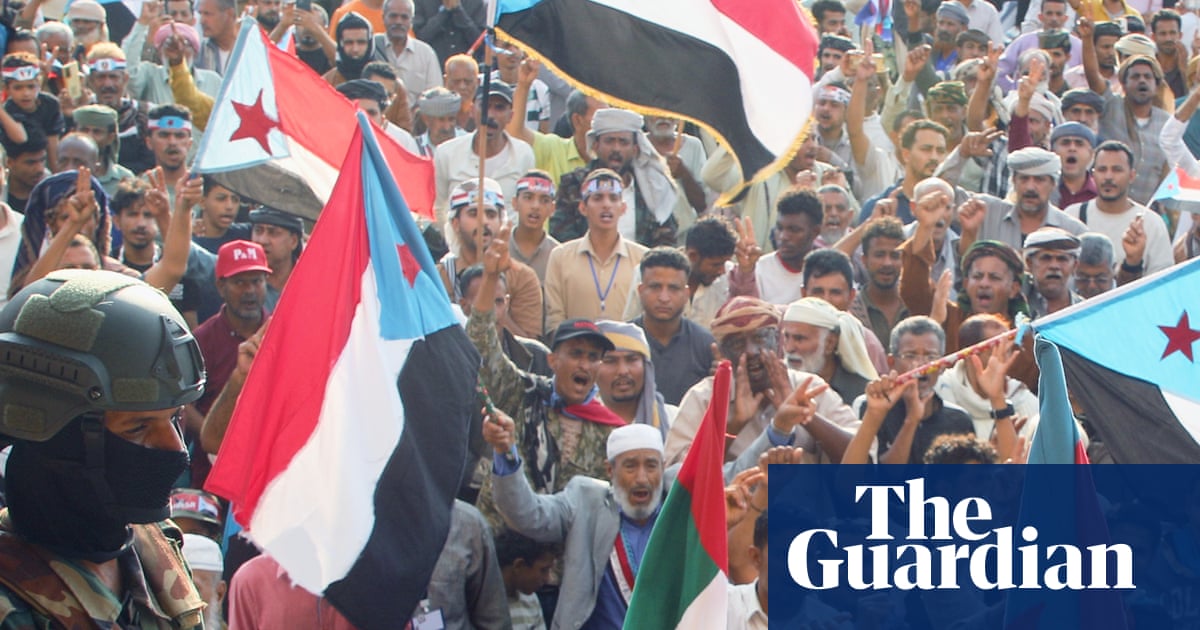
Yemen’s southern separatists have announced plans to hold a referendum on independence from the north in two years, after their seizure of swathes of the country last month triggered a major feud between Gulf powers.
The Southern Transitional Council leader, Aidarous al-Zubaidi, called on the international community to sponsor talks between concerned parties in the south and north on a path and mechanisms that “guarantee rights of the people of the south”.
The announcement came as the Saudi-backed and internationally recognised government moved to recapture the crucial region of Hadramout from the STC, which is backed by the United Arab Emirates. The STC seized much of Hadramout, bordering Saudi Arabia, and neighbouring al-Mahra last month.
Saudi Arabia and the UAE have for years supported rival factions in Yemen’s government-run territories. The STC’s offensive has angered Riyadh and left the oil-rich Gulf powers at loggerheads.
Earlier on Friday, Salem al-Khanbashi, the Hadramout governor under the internationally recognised government, said he had launched a “peaceful” operation to restore control over the area.
Saudi airstrikes hit an airport in Hadramout, according to a spokesperson for the province’s tribes, and the governor said his forces had taken control of the most important military base in the area.
“This operation is not a declaration of war nor an attempt to escalate tensions,” Khanbashi was quoted as saying by the Saba Net news agency. “This operation does not target any political or social group,” he said, adding that it “aims to peacefully and systematically hand over military sites”.
Mohammed Abdulmalik, the head of the STC in Wadi Hadramaot and Hadramaot desert, said seven airstrikes hit al-Khasah camp, killing seven people and wounding more than 20. Further strikes targeted other sites in the same region, he added.
Saudi sources confirmed the strikes were carried out by the Saudi-led coalition, which nominally includes the UAE and was formed in 2015 to fight the Iran-backed Houthi rebels in Yemen’s north.
A source close to the Saudi military said: “It will not stop until the Southern Transitional Council withdraws from the two governorates.”
The wealthy Gulf powers formed the backbone of the military coalition aimed at dislodging the Houthis, who forced the government from the capital, Sana’a, in 2014 and seized Yemen’s most populated areas. But after a decade-long civil war, the Houthis remain in place and the Saudis and Emiratis are backing different factions in the government-held territories.
Amr al-Bidh, the foreign affairs representative for the STC, accused Riyadh of having “knowingly misled the international community by announcing a ‘peaceful operation’ that they never had any intention to keep peaceful”. “This was evidenced by the fact that they launched 7 airstrikes minutes later,” he posted on X.
Saudi Arabia has repeatedly urged the STC to withdraw from the recently conquered territories.
After the Saudi-led coalition bombed an alleged Emirati weapons shipment on Tuesday, the UAE’s defence ministry said it would withdraw its remaining troops in Yemen.
On Friday the Saudi ambassador to Yemen, Mohammed al-Jabir, said the STC had blocked a Saudi delegation from landing at Aden airport, accusing the group of “intransigence”.
On Thursday, Yemen’s STC-controlled transport ministry had denounced a Saudi demand that all planes to and from the UAE make a stop in Saudi Arabia for security checks.
According to Flightradar24, no planes have taken off or landed at Aden airport for more than 24 hours, although the transport ministry did not officially announce its closure.