
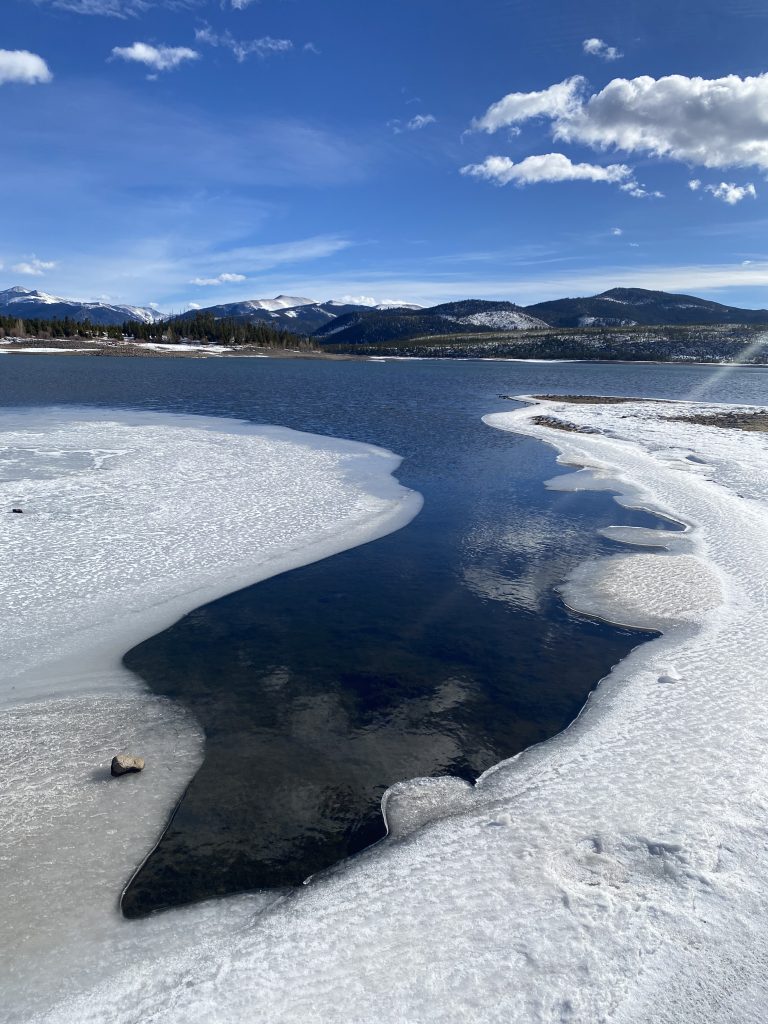
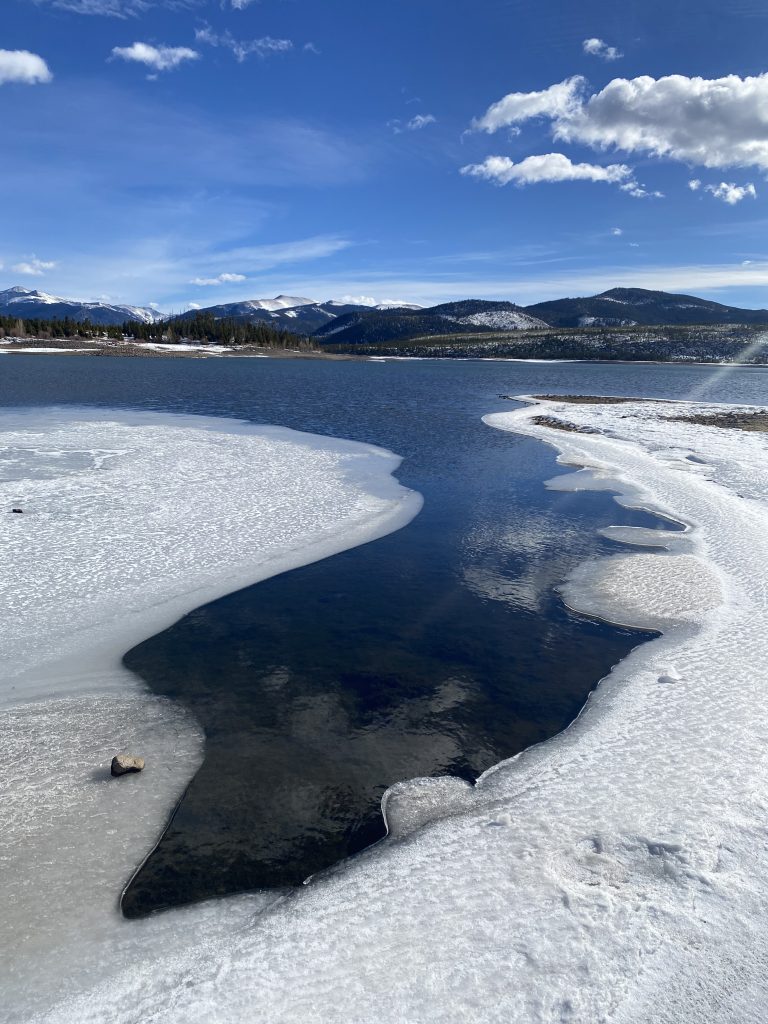
 Dillon Reservoir is not yet iced over as warm weather has lingered in Colorado’s mountains. To see your photos featured in print or online, email submissions to share@summitdaily.com.
Janet Reuther/Courtesy photo
A few storms heading toward Colorado’s mountains in the next week may help bolster the state’s scant snowpack, but another dry spell forecast for mid-January is expected to keep snow levels well below normal.
Summit County, home to four world-class ski areas and towns above 8,000 feet elevation, had one of the deepest snowpacks in the state during the 2024-25 ski season and typically outpaces most areas of Colorado for snow depth, but it entered 2026 at the zeroth percentile, which means it’s the lowest level on record since scientists started collecting data 44 years ago in 1981.
Across Colorado, this past December was among the hottest ever recorded.
Both Denver and Grand Junction recorded their second-hottest December on record, according to the National Weather Service. Steamboat Springs, where the period of record dates to 1893, had its hottest December ever, averaging about 30 degrees through the month.
In Dillon, where the period of record dates back to 1910, this past December was also the second-warmest on record, with a monthly average temperature about 28 degrees, about one degree cooler than 1980, which was the hottest December.
“There were just some extremely warm temperatures in December,” National Weather Service meteorologist Dennis Phillips said. “You can see that in the averages that were 8 to 9 degrees above normal.”
Phillips noted that many mountain towns have much shorter periods of record than other places in Colorado and some weather stations have not yet been updated with data from the final days of the year. Still, for most mountain towns, he said “2025 will probably be up there in the top five (warmest December’s on record), if not the top two or three, like we’ve seen in other places.”
At one weather station in Vail, temperatures averaged about 26 degrees Fahrenheit last month, making the hottest December recorded in the period of record that dates back to 1985.
In Aspen, the average monthly temperature in December was 30 degrees, compared to the normal average monthly temperature of about 22 degrees for that month.
On Christmas Day, mountain towns including Leadville, Breckenridge, Keystone and Aspen received small amounts of rain, rather than snow, according to the National Weather Service. A weather station in Dillon also broke the all-time daily record-high temperature on Christmas, recording a temperature of 54 degrees.
Across the state, the snowpack was also at or near record lows in several river basins, including those where popular ski resorts are located. Statewide, the sat at 59% of the 30-year median as of Friday, ranking in at the 5th percentile, meaning that 95% of years on record had more snow at this time.
The Roaring Fork Basin and the Yampa River Basin both ranked in at the 3rd percentile. Meanwhile, the Eagle River Basin and the Colorado-Kremmling to Glenwood Springs Basin both came in at the zeroth percentile, meaning that the snowpack is the worst on record.
With low amounts of precipitation and hot weather, drought conditions continue to sweep over the Western Slope, according to the most recent U.S. Drought Monitor map.
Substantial portions of Eagle and Pitkin counties are now facing exceptional and extreme drought. Extreme drought has also pushed into Grand County, while the rest of Northwestern Colorado is facing moderate to severe drought.
Looking at the forecast for the next week, Phillips said “there’s a pretty big pattern change.”
Temperatures are expected to drop to levels that are closer to normal for this time of year and a storm Monday could bring a couple inches of snow to the mountains, potentially 4 inches or more in the Steamboat area, Phillips said. Then, by next Friday, another storm could be on its way through the mountains, although he said it is difficult to say at this point how much snow it will bring with it.
“We’ll see how long this holds, this cooler pattern mid-month,” Phillips said. “Unfortunately, if you look at some of the longer-term outlooks, we’re still trending warmer than normal.”
Editor’s note: Summit Daily News editor Andrew Maciejewski contributed to this report.