
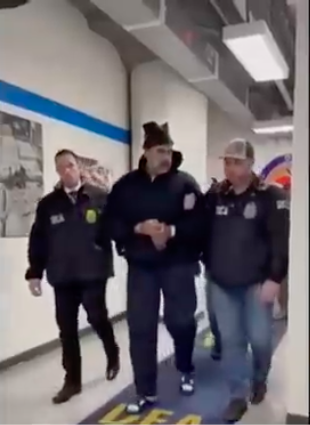
We begin today with an El País editorial on the capture Venezuelan President Nicolás Maduro in a U.S. military operation yesterday.
The capture of President Nicolás Maduro following a U.S. military operation in Venezuela that violates international law opens a dangerous scenario. The risk at this moment is twofold. On the one hand, there is the attempt to portray a military operation as synonymous with democratic liberation. On the other, chavismo may use the foreign intervention and the capture of its leader as a pretext to close ranks, further militarize the country, and justify limitless repression under the banner of national defense. Neither narrative withstands serious scrutiny. Violence, wherever it comes from, does not build institutions or restore rights.
Donald Trump’s decision caps a year of impulsive, personalistic foreign policy that ignores multilateral norms. Trump is not acting here as a guarantor of democracy, but rather placing force above the rule of law. Other powers will take note of these new rules as they look at Taiwan or Ukraine. Pointing this out is not a defense of the Venezuelan regime, but a warning: democracy is not exported by missile strike, nor imposed from the air —much less when invoked by someone who has repeatedly shown contempt for institutions.[…]
Added to this political ambition is another, no less alarming: the announcement that U.S. companies will take over Venezuela’s oil industry to “make money,” reinforcing the perception that the intervention is not aimed at restoring rights, but at managing power and wealth. Even if the reconstruction of devastated infrastructure is invoked, this amounts to the forcible external appropriation of natural resources, blurring the line between aid, investment, and economic domination.
While my link is to El País in English, it’s exactly the same editorial written in the Spanish version of the newspaper.
And I know that the tacky shoe salesman has long been averse to so-called “nation-building” and interfence in foreign wars but there have always been certain exceptions to that policy from the very beginning of his career. But the capture of Maduro and the take over of Venezuela meets none of the conditions mentioned in the Guardian article.
Venezuelan social psychologist Collette Capriles writes forThe New York Times that a country without Maduro is only the beginning.
For Venezuelans, our situation will not be fixed by Mr. Maduro’s departure, let alone by a foreign occupying force. We are not a nation held together by a government or a social contract, but a collection of individuals trapped in a struggle for survival. Replacing the man at the top will not dismantle the web of bosses, private loyalties, corrupt practices and institutional ruins that have replaced public life here. […]
Even without Mr. Maduro, the state remains a maze, comprising a sprawling web of overlapping intelligence services, paramilitary groups known as “colectivos” and regional bosses who compete for kickbacks. This fragmentation has been the ultimate insurance policy: It helped ensure that no single general or minister held enough unified power to lead a coup, while keeping every official tethered to the center through the shared need for protection and profit.
Mr. Trump has not said how the United States will begin to run Venezuela or when it will stop, except to say it will do so until “we can do a safe, proper and judicious transition.” Whatever is to come, the system that Mr. Maduro has overseen can’t be dismantled overnight. His followers, longstanding Chavistas or armed opportunists, could very well mount a prolonged insurgency — the type of war in which the population is held hostage, regardless of political preferences. It is very easy to create chaos and make a country ungovernable when the formal institutions are already broken. No matter who is in power, the path to healing the anxiety, distrust and isolation that have flourished over the past decade is not clear.
Whitney Neulich, Sophie Hills, and Caitlin Babcock of Christian Science Monitor point out the dangerous precedent that the U.S. capture of Nicolás Maduro presents.
The U.S. has accused Mr. Maduro of being central to regional destabilization – from increasing drug trafficking and the flow of migrants to the U.S. to using Venezuela’s oil reserves to prop up other U.S. political foes, such as Cuba. […]
The White House did not seek congressional approval before Saturday’s strike and capture, raising ire among Democratic lawmakers. Some analysts say the U.S. likely violated international law under the United Nations charter, and that the action could create a road map to be replicated by other nations facing stalwart political foes.
“If the United States asserts the right to use military force to invade and capture foreign leaders it accuses of criminal conduct, what prevents China from claiming the same authority over Taiwan’s leadership? What stops [Russian leader] Vladimir Putin from asserting similar justification to abduct Ukraine’s president?” asked Sen. Mark Warner of Virginia, the Democratic vice chairman of the Senate Select Committee on Intelligence, following Saturday’s operation. “Once this line is crossed, the rules that restrain global chaos begin to collapse, and authoritarian regimes will be the first to exploit it.”
Ryan Goodman of Just Security looks at a 1989 DO legal memorandum authored by then-Assistant Attorney General Bill Barr that has been used as legal justification for the Trump regime’s actions in Venezuela.
In the operation to abduct Nicolás Maduro, the Trump administration reportedly relied on a highly controversial 1989 legal memorandum claiming the President does not need to abide by the U.N. Charter as a matter of domestic law. Over the decades, the opinion generated sharp criticisms, including from Congress, and the Justice Department conspicuously avoided following its conclusions when presenting the administration’s position in courts.
The Department of Justice’s Office of Legal Counsel opinion, Authority of the Federal Bureau of Investigation to Override International Law in Extraterritorial Law Enforcement Activities, was signed by then-Assistant Attorney General Bill Barr.
Among other things, the Barr memo concluded that the President could, as a domestic law matter, order actions in contravention of the UN Charter’s prohibition on the use of force, such as a forcible abduction of a foreign national in another country. The memorandum ran 22-pages long concerning, most of which entailed statutory interpretation of FBI authorities and the domestic status of customary international law. The explanation for its claim about the UN Charter and treaty law covered only four brief paragraphs. The analysis boiled down to a (flawed) assertion that Article 2(4) of the UN Charter is “non-self-executing” for courts to enforce and thus not domestic law binding on the Executive.
As explained at length below, the four-paragraph analysis reached a radical conclusion that cannot withstand serious scrutiny.
Isaac Chotiner of The New Yorker interviews Yale Law School international law professor Oona Hathaway about the illegality of the Trump regime’s military operation in Venezuela although the excerpt that I provided says it might be legal to arrest Maduro (and this is something that I considered)
What other arguments have you heard from the Administration?
One of the claims is that Maduro is not, in fact, the leader of Venezuela. This is something that they’ve been saying for a while now—that he’s not the legitimate leader of the country, that they don’t recognize him as the head of state. And that might justify his seizure and indictment, although using military force to do that would not be justified. I don’t know how they get from there to an argument that they can use military force in Venezuela.
What do you mean, exactly, about his “seizure and indictment”? Venezuela had an election. It was not a free election. He declared himself President, and he’s broadly recognized as the President of Venezuela, but, again, he was not freely elected by the people of Venezuela. That could justify his indictment in an American court?
I should back up. As part of this military operation, at least one of the key goals seems to have been the capture of Maduro and his wife, who have been indicted for criminal charges in the Southern District of New York. The only way they can do that is if they’re claiming that he’s not a head of state, because heads of state get immunity and heads of state are not subject to criminal prosecution in the domestic courts of other states. That’s just a basic rule of international law. The United States has long recognized it.
Finally today, Victoria Bekiempis of The Guardian asks around: why was Jeffrey Epstein’s crimes never stopped when thee were plenty of opportunities to do so?
Some never-before-seen documents recently released under the Epstein Files Transparency Act, as well as previously public filings tucked deep into prior civil litigation included in these disclosures, spell out numerous missed opportunities to stop Epstein before his 2019 arrest and subsequent suicide in prison.
Longtime attorneys told the Guardian that there are multiple reasons why this might have occurred.
“The Epstein and Maxwell problem is twofold. First, law enforcement agencies, especially at the local level, do not communicate well with one another,” Neama Rahmani, founder of West Coast Trial Lawyers and a former federal prosecutor, said. “Second, prosecutors are risk-averse and do not want to prosecute difficult cases.”
More, authorities can see sexual abuse cases as risky propositions in terms of success.
“Sexual assault and sexual abuse prosecutions are often ‘he said, she said’ cases where the defense argues consent, or that the sexual contact never happened,” Rahmani said, explaining that prosecutors are expected to win every time. “They may hesitate taking difficult cases to trial, especially against defendants with significant resources.”
Everyone have the best possible day that you can!